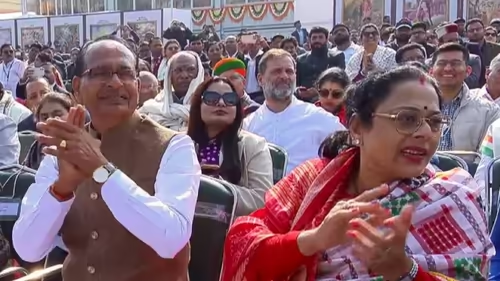
The grandeur of India’s Republic Day parade was overshadowed this year by a simmering political controversy. The Republic Day seating row has ignited a fierce war of words between the Congress and the BJP, with the opposition alleging a calculated slight against its top leadership—while the ruling party dismisses it as sour grapes over protocol.
At the heart of the dispute? The placement of Congress president Mallikarjun Kharge and former party chief Rahul Gandhi in the third row of the VIP enclosure during the January 26 event—a spot traditionally reserved for less prominent dignitaries, not the heads of India’s principal opposition party [[1]].
Table of Contents
- What Happened at the Republic Day Parade?
- Congress Outrage and Allegations of Political Snub
- BJP’s Response: “It’s Protocol, Not Politics”
- How Is VIP Seating Actually Determined?
- Historical Precedents: Has This Happened Before?
- Why This Matters Beyond the Rows
- Conclusion: Protocol or Power Play?
- Sources
What Happened at the Republic Day Parade?
On January 26, 2026, as dignitaries gathered at Rajpath (now Kartavya Path) for the 77th Republic Day celebrations, eagle-eyed observers noticed that Congress leaders Rahul Gandhi and Mallikarjun Kharge were seated in the third row of the main VIP stand—behind several Union ministers, foreign diplomats, and even some state governors [[1]].
For context, the front row is typically reserved for the President, Prime Minister, Vice President, and Chief Justice of India. The second row often includes key Cabinet ministers, service chiefs, and leaders of major political parties. The third row is generally for junior ministers, MPs, and other invitees [[3]].
Congress Outrage and Allegations of Political Snub
Congress leaders did not mince words. Senior leader Jairam Ramesh called the seating arrangement “deliberate and disrespectful,” arguing that as the Leader of the Opposition in the Lok Sabha and the party president, Kharge deserved a place in the second row [[2]].
“This isn’t about ego—it’s about institutional respect,” Ramesh stated. “The Leader of the Opposition is a constitutional post. To relegate him to the third row is to undermine the very idea of parliamentary democracy.”
Rahul Gandhi, though not holding an official parliamentary position, remains the de facto face of the party and a former Lok Sabha MP. His supporters argue his national stature warrants better placement [[4]].
BJP’s Response: “It’s Protocol, Not Politics”
The BJP swiftly hit back, framing the issue as a manufactured controversy. Union Minister Anurag Thakur asserted that seating arrangements are strictly governed by the Ministry of Home Affairs’ “Order of Precedence” guidelines—not political whims [[5]].
“There is no politics here. It’s pure protocol,” Thakur said. “Many former PMs and CMs also sit in the third row. Should we move them all to the front? This is just an attempt to create unnecessary drama.”
BJP sources pointed out that in past years, even senior opposition figures have been seated beyond the first two rows when their official status didn’t warrant higher placement [[6]].
How Is VIP Seating Actually Determined?
The official “Warrant of Precedence” issued by the President’s Secretariat is the ultimate guide. It ranks officials based on constitutional and administrative hierarchy. Key factors include:
- Constitutional office holders (President, VP, PM, CJI) get top priority.
- Current Cabinet ministers outrank former ministers and most party leaders.
- Leader of the Opposition (LoP) is recognized, but only if the party meets the 10% seat threshold in the Lok Sabha—which Congress does.
- Former PMs and party presidents without current office are placed lower, often in rows 3 or 4 [[7]].
According to experts, while the LoP is entitled to second-row placement, the final layout can be influenced by space constraints and the number of invitees—especially with foreign dignitaries present [[8]].
Historical Precedents: Has This Happened Before?
This isn’t the first time seating has sparked controversy. In 2019, then-LoP Adhir Ranjan Chowdhury (Congress) was seated in the third row, drawing similar complaints [[9]]. In 2014, L.K. Advani (then BJP leader) was placed behind Arvind Kejriwal during an event, causing internal party friction [[10]].
These incidents highlight how symbolic gestures in Indian politics often carry outsized weight—where a chair’s position can be read as a barometer of political clout.
Why This Matters Beyond the Rows
While it may seem trivial to outsiders, the Republic Day seating row reflects deeper tensions:
- It underscores the BJP’s dominance in setting the national narrative—and its willingness to marginalize opponents symbolically.
- It reveals Congress’s struggle to assert relevance despite being the largest opposition party.
- It shows how ceremonial events are increasingly weaponized in India’s hyper-polarized political climate [[INTERNAL_LINK:india-political-symbolism]].
Conclusion: Protocol or Power Play?
On paper, the seating may align with bureaucratic protocol. But in practice, optics matter. By placing Congress’s top brass behind junior ministers and diplomats, the government sent a clear message: in the current political order, the opposition’s status is diminished.
Whether this was a neutral application of rules or a subtle act of political messaging remains debatable. But one thing is certain—the Republic Day seating row has become yet another flashpoint in India’s escalating battle over respect, representation, and power.
Sources
- Times of India: Protocol or politics? Cong upset over seating at R-Day parade; BJP hits back
- The Hindu: Congress protests seating of Kharge, Rahul Gandhi at Republic Day parade
- Press Information Bureau (PIB): Guidelines on Warrant of Precedence
- Indian Express: Explained: How VIP seating is decided at Republic Day parade
- NDTV: BJP Hits Back At Congress Over Republic Day Seating Row