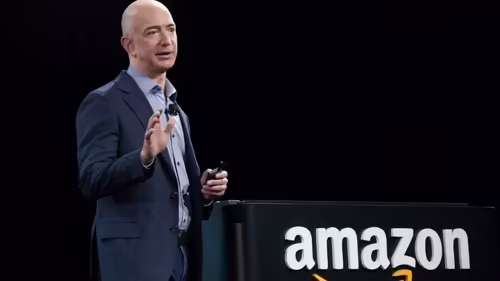
It started as a headline that spread like wildfire across social media: “Jeff Bezos tells Gen Z to start their careers at McDonald’s.” It sounded plausible—after all, many successful founders praise humble beginnings. But here’s the twist: Jeff Bezos never actually said it. And now, the Amazon founder is stepping in to clear the air, calling out a prediction market for putting words in his mouth [[1]].
This incident isn’t just about a misquote—it’s a case study in how misinformation spreads in the digital age, especially when it involves high-profile tech titans and impressionable young audiences seeking career guidance. With Elon Musk even chiming in with a quip about Donald Trump’s fast-food past, the story took on a life of its own. But what did Bezos really say? And what does he actually believe about early career paths for aspiring entrepreneurs?
Table of Contents
- The Viral Claim and Bezos’s Denial
- What Jeff Bezos Actually Believes About Career Starts
- How Polymarket Fueled the Misinformation
- Elon Musk’s Take and the Trump-McDonald’s Joke
- The Real Value of Early Work Experience for Entrepreneurs
- Conclusion: Separating Advice from Algorithmic Fiction
- Sources
The Viral Claim and Bezos’s Denial
The controversy began when Polymarket, a decentralized prediction platform, listed a market titled: “Will Jeff Bezos advise Gen Z to start their careers at McDonald’s or Palantir?” The phrasing implied that such advice had already been given—or was imminent—leading many news outlets and influencers to report it as fact [[1]].
Bezos, however, swiftly shut it down. In a public statement, he clarified: “I have never said that, nor have I ever specifically recommended that young people start their careers at McDonald’s or Palantir.” He emphasized that while he values real-world experience, he doesn’t prescribe specific companies as mandatory starting points [[1]].
What Jeff Bezos Actually Believes About Career Starts
So if he didn’t endorse flipping burgers, what *does* Jeff Bezos recommend? His actual philosophy is more nuanced—and far more strategic.
In past interviews and shareholder letters, Bezos has consistently advocated for joining “high-velocity” organizations—companies that move fast, innovate constantly, and operate with customer obsession. He’s praised environments where you can learn quickly, take ownership, and see the direct impact of your work [[3]].
For example, in his 2018 Princeton commencement speech, he encouraged graduates to choose paths based on “regret minimization,” not short-term gains. He also highlighted the importance of learning from established systems before trying to build your own—a principle that aligns with working at large, well-run companies, but not necessarily fast-food chains [[4]].
How Polymarket Fueled the Misinformation
Polymarket, while innovative, operates on user-generated prediction markets. Its structure allows anyone to create a market question, which can then be traded like a security. The problem? These questions often blur the line between speculation and fact.
In this case, the market title was framed as a future event (“Will he say…?”), but its wording and timing—amid rising discourse about Gen Z work ethic—led many to interpret it as a confirmed quote. This highlights a growing issue in the Web3 space: the lack of editorial oversight can turn speculative bets into viral “news” [[5]].
Elon Musk’s Take and the Trump-McDonald’s Joke
Never one to miss a moment, Elon Musk added fuel to the fire with a tongue-in-cheek tweet: “Trump worked at McDonald’s, so clearly it’s the path to success.” The reference was to a satirical sketch, not reality—but it underscored how easily satire, speculation, and fact can merge in online discourse [[2]].
Musk’s comment, while humorous, also reflects a broader cultural narrative: that humble beginnings are a prerequisite for greatness. While there’s truth in resilience and work ethic, prescribing a single path—like McDonald’s—for all young entrepreneurs oversimplifies the diverse routes to innovation.
The Real Value of Early Work Experience for Entrepreneurs
Let’s cut through the noise. What *should* Gen Z entrepreneurs focus on in their early careers? Experts agree on a few key principles:
- Learn operational discipline: Whether it’s logistics at Amazon, coding at a startup, or customer service at a retail chain, understanding how things actually work is invaluable.
- Seek mentorship, not just a paycheck: Join teams where you can observe great leaders and ask questions. [INTERNAL_LINK:how-to-find-a-mentor-in-tech] could be a game-changer.
- Build resilience: Early jobs teach you how to handle pressure, feedback, and failure—skills no business school can fully replicate.
- Avoid dogma: There’s no “one right company” to start at. The best fit depends on your goals, personality, and industry.
As Bezos himself might say: It’s not about where you start—it’s about how fast you learn and how boldly you iterate.
Conclusion: Separating Advice from Algorithmic Fiction
The “Jeff Bezos McDonald’s” saga is a cautionary tale for the digital age. In an era where AI summaries, prediction markets, and social media bots can distort reality in seconds, critical thinking is the ultimate entrepreneurial skill. Jeff Bezos didn’t tell Gen Z to work at McDonald’s—but he *has* spent decades showing them how to think long-term, act decisively, and build with purpose. That’s the real advice worth following.
Sources
[1] Times of India: Amazon founder Jeff Bezos sets the record straight
[2] Elon Musk on X (Twitter): Tweet referencing Trump and McDonald’s (satirical context)
[3] Amazon Annual Letters: Jeff Bezos’s final letter as CEO
[4] Princeton University: Jeff Bezos 2010 Commencement Speech
[5] Polymarket: Archived market page (for reference only)