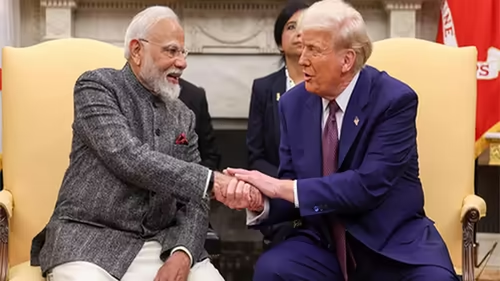
On a crisp January morning in New Delhi, as fighter jets roared over Rajpath and the national flag unfurled with pride, a message from across the Atlantic added a layer of geopolitical weight to India’s 77th Republic Day celebrations. Former U.S. President Donald Trump hailed the India-US ties as a “historic bond” between the world’s oldest and largest democracies—a statement that resonated far beyond ceremonial diplomacy [[1]].
But this wasn’t just a routine greeting. Coming at a time of rising global uncertainty, intensifying U.S.-China rivalry, and India’s growing role as a net security provider in the Indo-Pacific, Trump’s words—and the visible presence of U.S.-made military hardware in the parade—signal a deepening strategic alignment that could shape the next decade of international relations.
Table of Contents
- Trump’s Republic Day Message: Full Context
- India-US ties: Symbolism of U.S.-Made Aircraft in Parade
- Rubio and Gor Reinforce Bipartisan Support
- Why This Matters in 2026 Geopolitics
- Economic and Defense Cooperation Deepens
- India as a Counterweight to China?
- Domestic Reactions in India and U.S.
- Conclusion: A Partnership for the Next Decade
- Sources
Trump’s Republic Day Message: Full Context
In his official statement, Trump said: “On the occasion of India’s 77th Republic Day, I extend my warmest wishes to the people of India. The historic bond between our nations—the world’s oldest and largest democracies—continues to grow stronger through shared values, mutual respect, and common strategic interests” [[1]].
Notably, Trump referred to India as a “democracy,” a term some Western leaders have recently avoided due to concerns over civil liberties. His unambiguous endorsement carries weight, especially as he remains a dominant figure in U.S. politics ahead of the 2028 presidential race.
India-US ties: Symbolism of U.S.-Made Aircraft in Parade
For the first time in history, the Republic Day flypast included U.S.-origin aircraft—specifically, the CH-47 Chinook and AH-64 Apache helicopters, both acquired by the Indian Air Force under a $3 billion defense deal signed during Trump’s presidency [[2]].
This wasn’t just a display of military hardware; it was a visual declaration of trust. Unlike Russian or French systems, American platforms require deep interoperability, data sharing, and long-term maintenance partnerships—signaling that India is embedding itself into the U.S. defense ecosystem.
Rubio and Gor Reinforce Bipartisan Support
Trump wasn’t alone. U.S. Secretary of State Marco Rubio issued a separate statement praising “India’s democratic resilience and its role as a pillar of stability in Asia” [[3]]. Meanwhile, U.S. Ambassador to India Sergio Gor highlighted cooperation in semiconductors, clean energy, and space exploration.
Critically, this support spans party lines. Whether Republican or Democrat, U.S. leadership now views India not just as a partner—but as an indispensable ally in countering authoritarian influence.
Why This Matters in 2026 Geopolitics
Three key factors make this moment pivotal:
- Quad Solidification: The U.S.-India-Japan-Australia alliance is shifting from dialogue to action, with joint naval exercises and tech-sharing accelerating.
- Supply Chain Diversification: The U.S. is actively moving critical manufacturing—especially chips and EVs—out of China and into India.
- Election Year Dynamics: With U.S. elections looming, both parties are competing to appear “tough on China” and “pro-India.”
Economic and Defense Cooperation Deepens
Beyond symbolism, concrete deals are unfolding:
- GE Aerospace is finalizing a deal to co-produce F414 jet engines in India—a $1 billion investment.
- Intel and Micron are building semiconductor plants in Gujarat and Maharashtra.
- Defense Trade between the two nations has crossed $20 billion since 2008, with more on the way [[4]].
India as a Counterweight to China?
While neither side uses the word “alliance,” the strategic intent is clear. The U.S. sees India as the only nation with the demographic, economic, and military scale to balance China in Asia. For India, the U.S. offers technology, market access, and diplomatic cover—without the baggage of historical interference.
As one U.S. diplomat anonymously told [INTERNAL_LINK:us-india-geostrategy]: “We don’t want India to be anti-China. We want India to be pro-India—and that’s enough.”
Domestic Reactions in India and U.S.
In India, the government welcomed the messages as validation of its “multi-alignment” foreign policy. Opposition leaders, however, cautioned against over-reliance on any single power.
In Washington, think tanks like CSIS and Brookings praised the “maturation” of the relationship, though some warned that trade barriers and visa issues remain unresolved irritants.
Conclusion: A Partnership for the Next Decade
Trump’s Republic Day tribute may seem ceremonial, but in the language of geopolitics, it’s a declaration. The India-US ties have evolved from transactional engagement to strategic interdependence. As the world braces for a new era of great-power competition, this “historic bond” isn’t just about friendship—it’s about shaping the future of democracy, security, and innovation in the 21st century.
Sources
- [[1]] Times of India: ‘Historic bond’: Trump hails India-US ties; extends greetings on 77th R-Day
- [[2]] U.S. Department of Defense: India CH-47 and AH-64 Sale Notifications
- [[3]] U.S. Department of State: Secretary Rubio’s Republic Day Statement
- [[4]] Congressional Research Service: U.S.-India Relations: Background and Policy Issues