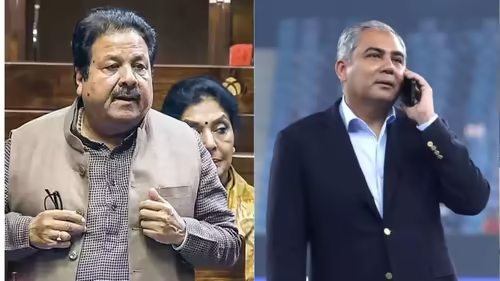
The political undercurrents swirling around the T20 World Cup 2026 have just intensified dramatically. In a bold and unprecedented statement, BCCI Vice-President Rajeev Shukla has directly accused Pakistan of orchestrating Bangladesh’s withdrawal from the tournament, calling it a deliberate act of provocation that threatens the integrity of the global event [[1]].
This explosive claim comes at a time when the cricketing world is already reeling from the ICC’s decision to replace Bangladesh with Scotland after the Bangladesh Cricket Board (BCB) refused to travel to India for their scheduled matches [[3]]. Now, with Pakistan itself hesitating to confirm its own participation, Shukla’s comments have added a new layer of geopolitical tension to an already fragile situation.
Table of Contents
- The Bangladesh Withdrawal: A Recap
- Rajeev Shukla’s Explosive Allegations
- Pakistan in the Eye of the Storm
- Security Assurances and Misleading Narratives
- What This Means for the T20 World Cup 2026
- Conclusion: A Tournament at Risk
- Sources
The Bangladesh Withdrawal: A Recap
The controversy began when the BCB officially informed the ICC that its team would not travel to India for its group-stage fixtures in the T20 World Cup 2026. Citing unspecified security concerns, the BCB’s stance was firm despite repeated assurances from Indian authorities and the ICC about the safety protocols in place [[3], [5]].
As a result, the ICC had no choice but to invoke its contingency plans. Scotland, the next highest-ranked non-qualified team, was swiftly named as Bangladesh’s replacement, marking a historic first for the European nation in a men’s T20 World Cup main draw [[4]].
Rajeev Shukla’s Explosive Allegations
It is in this context that Rajeev Shukla made his most damning remarks. Speaking to the media, he stated, “Pakistan is provoking Bangladesh.” He went on to allege that Bangladesh was initially willing to participate but was “misled” by external forces—specifically pointing the finger at the Pakistan Cricket Board (PCB) [[1], [2]].
Shukla emphasized that the BCCI and Indian government had provided ironclad security guarantees to all participating nations, including Bangladesh. “There was no real threat,” he asserted, suggesting that the security concerns were a smokescreen created through Pakistani “intervention” [[1]].
Pakistan in the Eye of the Storm
Pakistan’s own position is fraught with uncertainty. The PCB, under chairman Mohsin Naqvi, has paused all team preparations and deferred the final decision on participation to the Pakistani government, with a deadline expected in early February 2026 [[6], [7]].
Shukla’s comments appear to be a strategic move to isolate Pakistan diplomatically. By framing Pakistan as a destabilizing force that manipulated a fellow cricketing nation, the BCCI is attempting to shift the narrative away from its own hosting challenges and onto Pakistan’s alleged interference.
Security Assurances and Misleading Narratives
A key pillar of Shukla’s argument is the robustness of India’s security infrastructure for international events. He pointed to the successful hosting of numerous high-profile tournaments, including the IPL and previous ICC events, as proof of India’s capability [[1]].
According to sources close to the BCCI, direct communications between Indian and Bangladeshi officials had been positive until a sudden shift in Dhaka’s stance. This abrupt change, Shukla implies, coincided with high-level discussions between Pakistani and Bangladeshi political figures, lending credence to his claim of external pressure [[2]].
While these claims are difficult to independently verify, they highlight the deep-seated mistrust that often underpins cricketing relations in the subcontinent. The sport, unfortunately, remains a frequent proxy for broader political rivalries.
What This Means for the T20 World Cup 2026
The fallout from this diplomatic spat could have far-reaching consequences for the T20 World Cup 2026:
- Reputational Damage: The tournament’s image as a truly global and inclusive event is being tarnished by political maneuvering.
- Commercial Impact: The absence of major teams like Bangladesh and potentially Pakistan drastically reduces broadcast viewership and sponsorship value, especially in the massive South Asian market.
- Precedent Setting: If nations can withdraw based on politically motivated security concerns, it sets a dangerous precedent for future ICC events hosted in any country.
Conclusion: A Tournament at Risk
Rajeev Shukla’s public accusation against Pakistan is more than just a war of words; it’s a desperate attempt to protect the credibility and commercial viability of the T20 World Cup 2026. By alleging that Pakistan “provoked” Bangladesh, the BCCI is trying to frame the issue as one of bad faith rather than legitimate security concerns.
However, the core problem remains unresolved: the deep entanglement of politics and cricket in the region. Until the PCB makes a clear and timely decision on its own participation, and until trust can be rebuilt among the subcontinental boards, the shadow of uncertainty will continue to loom over the tournament. For fans worldwide, the hope is that the game they love can rise above these divisions. To understand the historical context of these tensions, see our feature on [INTERNAL_LINK:india-pakistan-cricket-diplomacy]. For official updates, visit the ICC’s T20 World Cup page.
Sources
- [[1]] Times of India – ‘Pakistan is provoking Bangladesh’: BCCI VP hits out as PCB delays T20 WC decision
- [[2]] Hindustan Times – BCCI VP Rajeev Shukla accuses Pakistan of influencing Bangladesh’s T20 WC call
- [[3]] ESPNcricinfo – Bangladesh officially out of T20 World Cup 2026
- [[4]] ICC – Scotland to replace Bangladesh in ICC Men’s T20 World Cup 2026
- [[5]] The Daily Star – BCB cites security concerns for T20 WC withdrawal
- [[6]] Geo News – PCB Chairman Mohsin Naqvi to meet PM over T20 World Cup participation
- [[7]] AP7am – PCB suspends all T20 World Cup preparations pending govt decision