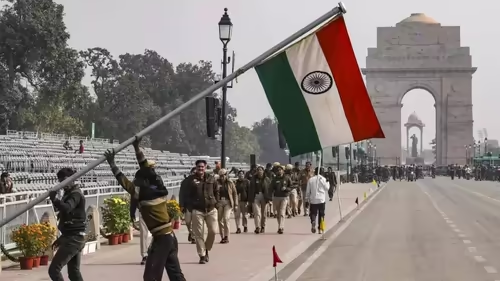
As tricolor kites soared over Delhi and marching bands echoed through Rajpath (now Kartavya Path), a different kind of patriotism resonated across social media feeds on Republic Day 2026. From Olympic medalists to rising cricket stars, India’s sports fraternity didn’t just post festive greetings—they issued a collective call to action: “Let us honour our Constitution.”
In a powerful display of civic consciousness, athletes used their massive digital platforms to reflect on the values enshrined in India’s founding document. This wasn’t just performative patriotism; it was a reminder that national pride goes beyond celebration—it demands responsibility.
Table of Contents
- Republic Day 2026: A Constitutional Celebration
- Voices from the Field: Athletes Speak Out
- Why the Constitution Matters to Sportspersons
- Beyond Greetings: Sports Bodies Take a Stand
- The Power of Platform: How Athletes Inspire Civic Duty
- Conclusion: More Than a Holiday
- Sources
Republic Day 2026: A Constitutional Celebration
India marked its 77th Republic Day on January 26, 2026—a milestone commemorating the day in 1950 when the Constitution of India came into full effect, transforming the nation into a sovereign democratic republic. While the grand parade in New Delhi showcased military might and cultural diversity, the true spirit of the day lies in the principles that bind 1.4 billion people together: justice, liberty, equality, and fraternity.
This year, that spirit found a passionate voice in an unexpected quarter: the world of sports. Far from generic “Happy Republic Day” posts, many athletes shared deeply personal reflections on what the Constitution means to them—not just as citizens, but as public figures with influence.
Voices from the Field: Athletes Speak Out
Across platforms like X (formerly Twitter) and Instagram, India’s sporting icons posted messages that blended pride with purpose. Here are some standout examples:
- Neeraj Chopra, Olympic gold medalist in javelin throw, shared a photo of himself saluting the national flag with the caption: “Our Constitution is our compass. It guides us toward unity, dignity, and progress. Proud to be an Indian on this Republic Day 2026.”
- Mirabai Chanu, Olympic silver medalist in weightlifting, posted a video of her reading an excerpt from Dr. B.R. Ambedkar’s famous speech on fraternity, urging followers to “protect our democracy with every choice we make.”
- The Board of Control for Cricket in India (BCCI) released an official statement reaffirming its commitment to “upholding constitutional values in all sporting activities,” accompanied by a collage of players from diverse backgrounds.
- Rising star Manu Bhaker, the teenage shooting sensation, wrote: “My right to compete, to dream, to represent my country—comes from the Constitution. Today, I honour that gift.”
These weren’t isolated posts. Dozens of athletes—from hockey captain Harmanpreet Singh to Paralympic champion Avani Lekhara—echoed similar themes, turning social media into a digital durbar of democratic values.
Why the Constitution Matters to Sportspersons
At first glance, one might wonder: why would athletes focus on the Constitution rather than just celebrating national glory? The answer lies in the very nature of modern sport in India.
Sport has become a powerful vehicle for social mobility, gender equality, and regional representation—all ideals directly rooted in the Constitution. For instance, Article 15 prohibits discrimination on grounds of religion, race, caste, sex, or place of birth. This principle has enabled women like Sakshi Malik and PV Sindhu to rise to global prominence despite societal barriers.
Likewise, the Directive Principles of State Policy (Part IV of the Constitution) encourage the state to promote the educational and economic interests of weaker sections—a mission mirrored in grassroots sports initiatives like Khelo India, which aims to democratize athletic opportunity [[INTERNAL_LINK:khelo-india-program]].
Beyond Greetings: Sports Bodies Take a Stand
It wasn’t just individual athletes making noise. Major sports federations also issued formal statements aligning themselves with constitutional ethos:
- The Indian Olympic Association (IOA) emphasized “fair play, inclusion, and integrity” as extensions of constitutional morality.
- The All India Football Federation (AIFF) highlighted how football unites fans across linguistic and religious lines—a living example of “unity in diversity.”
- Even the National Rifle Association of India (NRAI) linked discipline in sport to the “fundamental duties” outlined in Article 51A of the Constitution.
This institutional alignment signals a maturing of India’s sports ecosystem—one that sees itself not just as an entertainment industry, but as a pillar of civic life.
The Power of Platform: How Athletes Inspire Civic Duty
With millions of followers, today’s athletes wield influence comparable to politicians or celebrities. When they speak about the Constitution, they’re not just sharing opinions—they’re modeling civic engagement for young fans.
Consider this: a teenager in Assam might never read the Preamble, but seeing their idol Neeraj Chopra quote it can spark curiosity. That’s the ripple effect of authentic advocacy. In an era of misinformation and polarization, such voices serve as anchors of shared values.
Moreover, by tying national pride to constitutional principles rather than mere symbolism, these athletes help reframe patriotism as active participation—not passive allegiance. As Dr. Ambedkar once warned, “However good a Constitution may be, it is sure to turn out bad because those who are called to work it, happen to be a bad lot.” Athletes, by speaking up, are part of ensuring that “lot” remains vigilant and virtuous.
Conclusion: More Than a Holiday
Republic Day 2026 will be remembered not just for its spectacular parade, but for the quiet yet powerful chorus of voices from India’s sports community. By choosing to honor the Constitution—not just the flag—they reminded us that democracy is a daily practice, not a yearly ritual.
In a time when public discourse can feel fractured, these messages of unity, duty, and constitutional faith offer a hopeful counter-narrative. As fans, we don’t just cheer for medals—we stand with those who defend the values that make winning meaningful.
Sources
- The Times of India: Republic Day: Sports fraternity says ‘let us honour our Constitution’
- Constitution of India Official Portal: constitutionofindia.net
- Olympic Gold Quest: Athlete Statements Archive
- BCCI Official Website: Republic Day 2026 Message