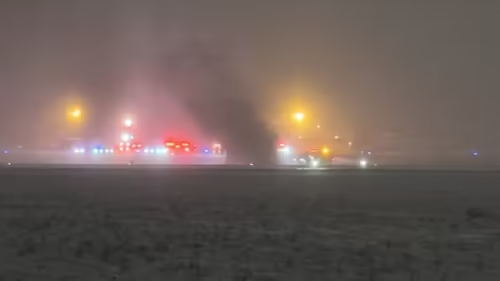
Maine Private Jet Crash Amid Winter Storm: What We Know About the Bombardier Challenger 600 Incident
In the midst of one of the most severe winter storms to hit the northeastern United States in years, tragedy struck at Bangor International Airport in Maine. On Sunday night, a Bombardier Challenger 600 private jet—carrying eight souls—crashed during its takeoff roll, sending shockwaves through the aviation community and prompting an immediate federal response . The Maine private jet crash occurred under treacherous weather conditions, with heavy snow, gusting winds, and near-zero visibility complicating both the flight operation and the emergency response.
While details remain fluid, the incident has raised urgent questions about flight safety protocols during extreme weather, the performance of aging business jets, and the pressures faced by private operators in high-demand travel corridors. With the Federal Aviation Administration (FAA) and the National Transportation Safety Board (NTSB) now leading a full-scale investigation, the nation watches closely for answers .
Table of Contents
- The Incident: Timeline and Known Facts
- Maine Private Jet Crash: The Aircraft and Its History
- Winter Storm Impact on Eastern U.S. Air Travel
- FAA and NTSB Investigation: What to Expect
- Broader Implications for Private Aviation Safety
The Incident: Timeline and Known Facts
According to preliminary reports from airport officials and emergency services, the Bombardier Challenger 600 was attempting to depart Bangor International Airport (BGR) around 9:30 PM local time on Sunday, January 25, 2026 . Witnesses reported seeing the aircraft veer off the runway before crashing in a fiery impact just beyond the tarmac.
Key confirmed details include:
- Aircraft: Bombardier Challenger 600 (a mid-size business jet first introduced in the early 1980s).
- Passengers & Crew: 8 people on board (exact breakdown of passengers vs. crew not yet released).
- Location: Bangor International Airport, Maine—a common refueling stop for transatlantic flights.
- Weather Conditions: Active winter storm with blizzard warnings, wind gusts over 40 mph, and visibility below 1/4 mile .
- Response: Local fire and rescue teams responded within minutes; the extent of injuries or fatalities has not been officially confirmed as of Monday morning.
Emergency crews worked through the night in sub-freezing temperatures to secure the scene and assist survivors, if any.
Maine Private Jet Crash: The Aircraft and Its History
The Bombardier Challenger 600, while a pioneering aircraft in its time, is now considered a legacy model. First certified in 1980, it laid the foundation for Bombardier’s highly successful Challenger family. However, many of these early models are still in service, particularly in private and charter operations.
Aviation experts note that while the Challenger 600 has a generally solid safety record, its age can pose maintenance challenges. The NTSB will likely scrutinize the aircraft’s maintenance logs, recent inspections, and whether any mechanical failures contributed to the loss of control during takeoff—a critical phase of flight, especially in poor weather .
Winter Storm Impact on Eastern U.S. Air Travel
The crash occurred at the peak of a major nor’easter that has paralyzed much of the East Coast. The storm, unofficially dubbed “Winter Storm Helena,” has dumped over 20 inches of snow in parts of Maine, New Hampshire, and Massachusetts, leading to thousands of flight cancellations and widespread travel chaos .
Bangor International Airport, though equipped to handle winter operations, was operating under severe constraints. The decision to attempt a takeoff in such conditions will be a central focus of the investigation. Were proper de-icing procedures followed? Was the runway adequately cleared? Did air traffic control clear the flight despite known hazards? These are among the critical questions investigators will seek to answer.
FAA and NTSB Investigation: What to Expect
The NTSB, renowned for its methodical and transparent approach, has already dispatched a “Go Team” to Bangor. Their investigation will typically unfold in several phases:
- On-site evidence collection: Securing the wreckage, mapping debris, and recovering the flight data recorder (FDR) and cockpit voice recorder (CVR), if equipped.
- Witness interviews: Speaking with air traffic controllers, ground crew, and eyewitnesses.
- Technical analysis: Reviewing maintenance records, weather data, and ATC communications.
- Preliminary report: Expected within 30 days, offering initial findings without assigning probable cause.
- Final report: A comprehensive analysis, often taking 12–24 months, that includes the probable cause and safety recommendations.
For real-time updates on this and other aviation incidents, refer to [INTERNAL_LINK:us-aviation-safety-news].
Broader Implications for Private Aviation Safety
This Maine private jet crash highlights a growing concern in the aviation industry: the safety oversight of private and charter operations, which often operate under less stringent regulations than commercial airlines. With demand for private travel surging post-pandemic, older aircraft like the Challenger 600 are being pressed into service more frequently.
The incident may reignite debates about mandatory upgrades for legacy jets, stricter weather minimums for private operators, and enhanced pilot training for winter operations. As the NTSB’s findings emerge, they could lead to sweeping changes aimed at preventing similar tragedies in the future.
Conclusion
The Maine private jet crash is a sobering reminder of the inherent risks of air travel, especially when compounded by extreme weather. While the full story remains untold, the swift response from federal authorities offers hope for clarity and, ultimately, improved safety. Our thoughts are with the families of those on board as the investigation unfolds.
Sources
- Times of India: Winter storm in US: Private jet crashes at Maine airport
- National Transportation Safety Board (NTSB) – Aviation Investigations
- Federal Aviation Administration (FAA) – Press Updates
- National Weather Service – Boston/Norton: Winter Storm Warnings
- Bangor International Airport Official Website