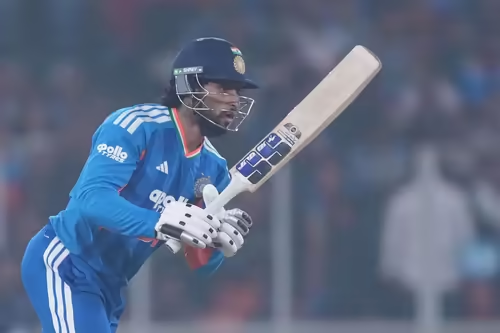
Just when the cricketing world thought India’s T20I middle order was settling into a new rhythm, an unexpected delay has thrown the script into flux. Shreyas Iyer, initially drafted only for the first three matches of the five-game series against New Zealand, will now remain with the squad for the final two fixtures. The reason? Young star Tilak Varma’s return to competitive cricket has been pushed back due to lingering fitness concerns—a development that not only reshapes the current lineup but also reignites long-standing debates about experience versus youth in India’s high-stakes T20 planning .
This isn’t just a routine squad adjustment. It’s a strategic pivot with implications stretching far beyond Ranchi and Chennai. With the 2026 T20 World Cup looming, every match is a laboratory for experimentation. Yet, the decision to retain Shreyas Iyer—a seasoned campaigner with a turbulent recent past—suggests that the selectors aren’t ready to fully hand the reins to the next generation just yet.
Table of Contents
- Why Shreyas Iyer Was Called Back
- The Tilak Varma Delay: What Happened?
- Shreyas Iyer: Form, Fitness, and Fighting Spirit
- Impact on India’s T20I Middle Order
- Selection Dilemmas Ahead of the 2026 T20 World Cup
- What This Means for the Final Two T20Is
- Conclusion: Experience vs. Future Planning
- Sources
Why Shreyas Iyer Was Called Back
Shreyas Iyer’s return to the T20I setup in January 2026 was already seen as a cautious reintroduction. After being dropped from the side in late 2025 following inconsistent performances and questions over his strike rate in the death overs, his inclusion for the first three games against New Zealand was framed as a “trial run” . The original plan was crystal clear: give him three matches to prove his match-readiness, then seamlessly reintegrate Tilak Varma, who had been recovering from a minor hamstring strain.
But cricket rarely follows scripts. With Varma not yet cleared for full-intensity play, the BCCI’s medical and selection committees opted for stability. “Bringing in a completely new player for just two games would’ve disrupted the team’s rhythm,” a senior team official told the Times of India. “Shreyas knows the systems, the language, and the game plans. He’s a safe pair of hands.”
The Tilak Varma Delay: What Happened?
Tilak Varma, the 22-year-old left-handed batter from Hyderabad, has emerged as one of India’s most reliable T20 performers over the past 18 months. Known for his composure under pressure and ability to rotate strike without taking undue risks, he was expected to reclaim his No. 4 or 5 spot after missing the opening leg of the series.
However, during a domestic training camp in early January, Varma experienced discomfort in his right hamstring—the same area that troubled him briefly in 2025. While not a serious tear, the BCCI’s medical team has adopted a “better safe than sorry” approach, especially with the ICC Champions Trophy and T20 World Cup scheduled for later in 2026. “There’s no point risking a relapse for two T20Is,” a source close to the camp explained. “His long-term availability is more important than short-term exposure.”
Shreyas Iyer: Form, Fitness, and Fighting Spirit
At 31, Shreyas Iyer is no longer the young prodigy who lit up the IPL with Delhi Daredevils. But what he lacks in explosive power, he compensates with tactical maturity. In the first three T20Is against New Zealand, he scored 28, 41*, and 19—modest numbers, but crucial in context. His unbeaten 41 in the second match helped India chase down a tricky target after early wickets, showcasing his ability to anchor an innings when chaos looms.
More importantly, Iyer brings leadership depth. A former captain of Kolkata Knight Riders and Delhi Capitals, he’s respected in dressing rooms for his cricketing brain. His fielding—once a liability—has improved dramatically, making him a genuine all-round asset in the modern T20 game.
Impact on India’s T20I Middle Order
With Iyer staying on, India’s likely batting order for the 4th and 5th T20Is looks like this:
- Yashasvi Jaiswal
- Ruturaj Gaikwad
- Suryakumar Yadav (c)
- Shreyas Iyer
- Rinku Singh
- Hardik Pandya
- Jitesh Sharma (wk)
This setup offers balance: aggression at the top (Jaiswal, SKY), stability in the middle (Iyer, Ruturaj), and explosive finishers (Rinku, Hardik). However, it also delays the much-anticipated return of Tilak, who would typically slot in at No. 4—a role many believe is critical for building depth ahead of global tournaments.
Selection Dilemmas Ahead of the 2026 T20 World Cup
The real stakes lie beyond this bilateral series. With the T20 World Cup set for June 2026 in South Africa, every selection carries weight. The middle-order battle is particularly tight:
- Shreyas Iyer: Experience, temperament, but aging profile and declining strike rate in high-pressure finishes.
- Tilak Varma: Consistency, calmness, but limited big-match explosiveness in run chases.
- Rinku Singh: Best suited as a finisher; thrives at No. 5/6 but less effective as an anchor.
Retaining Iyer now gives selectors more data—but risks delaying the integration of younger players who need exposure under pressure. It’s a classic balancing act between winning now and building for the future. For deeper insights into India’s T20 World Cup planning, see our analysis on [INTERNAL_LINK:india-t20-world-cup-squad-projections].
What This Means for the Final Two T20Is
With the series currently tied 1-1 (after one washout), the remaining matches in Ranchi and Chennai are crucial. Iyer’s presence adds stability, especially on slower Indian pitches where his classical technique thrives. He could be the anchor that allows the top order to play freely, knowing someone can rebuild if early wickets fall.
Moreover, his fielding—once a weakness—has improved significantly, making him a reliable option in the circle. Every run he saves or catch he takes could be the difference in a tight contest.
Conclusion: Experience vs. Future Planning
The decision to keep Shreyas Iyer in the squad is a pragmatic one, born out of necessity rather than preference. It highlights the fragile nature of athlete recovery and the constant juggling act team management must perform. While fans may debate whether this delays India’s generational transition, the immediate priority is securing a series win against a resilient New Zealand side. One thing is certain: in the high-stakes world of international cricket, every player—veteran or rookie—must be ready when called. And right now, Shreyas Iyer is answering that call once again.