Table of Contents
- The Grand Tribute on Kartavya Path
- Vande Mataram: A 150-Year Journey of Resistance and Unity
- From Anandamath to the Heart of the Nation
- Republic Day 2026: A Visual Symphony of Heritage and Progress
- Why This Tribute Matters Today
- Conclusion: The Enduring Mantra of a Nation
- Sources
The Grand Tribute on Kartavya Path
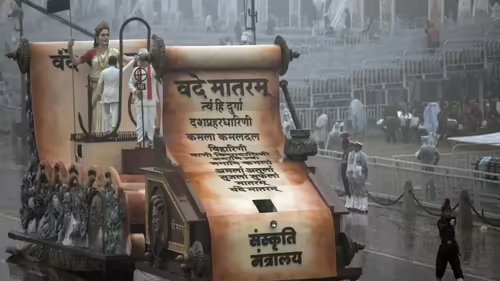
On a crisp January morning in 2026, as the sun rose over Kartavya Path, the air didn’t just hum with the anticipation of the annual Republic Day parade—it resonated with a deep, collective memory. This year’s celebration was unlike any other. It was a monumental, nation-wide homage to Vande Mataram, marking its sesquicentennial—the 150th anniversary of its first publication.
The entire event was masterfully curated around two powerful themes: ‘Swatantrata ka Mantra: Vande Mataram‘ (The Mantra of Freedom: Vande Mataram) and ‘Samriddhi ka Mantra: Aatmanirbhar Bharat‘ (The Mantra of Prosperity: Self-Reliant India) . From the intricate floral designs lining the parade route to the state tableaux and even the official invitation, every element was a visual echo of the national song’s verses and spirit .
Vande Mataram: A 150-Year Journey of Resistance and Unity
So, what is it about this song that commands such reverence? Vande Mataram is far more than a collection of poetic verses; it is the very soul of India’s struggle for independence. Composed by the literary genius Bankim Chandra Chattopadhyay, it was first published on November 7, 1875 . While it later found its home in his 1882 novel, Anandamath, its power as a standalone anthem was undeniable from the start .
During the darkest days of colonial rule, Vande Mataram became the rallying cry for millions. It was a political slogan first used in 1905 during the anti-partition movement of Bengal, uniting people across linguistic and cultural divides under a single, powerful banner of patriotism . Its message was simple yet profound: a deep, spiritual love for the motherland, personified as a goddess worthy of veneration.
From Anandamath to the Heart of the Nation
Bankim Chandra Chattopadhyay, born in 1838 in a Bengali Brahmin family, was a visionary who understood the power of words to ignite a nation . He penned Vande Mataram in a blend of Sanskrit and Bengali, creating a linguistic tapestry that was both deeply rooted in Indian tradition and accessible to a wide audience .
The song’s journey from the pages of a novel to the heart of the freedom movement is legendary. Leaders like Subhas Chandra Bose and countless unsung heroes carried its spirit with them, often facing imprisonment for simply chanting it. After independence, while “Jana Gana Mana” was adopted as the National Anthem, Vande Mataram was granted the distinct and equal honor of being the National Song—a testament to its irreplaceable role in shaping modern India .
Republic Day 2026: A Visual Symphony of Heritage and Progress
The 2026 parade was a masterclass in storytelling. The government didn’t just tell the story of Vande Mataram; it showed it. The parade showcased a unique blend of the nation’s military strength, its developmental strides, and its rich cultural diversity, all unified under the central theme of the national song .
One of the most poignant tributes was the inclusion of a series of paintings created by Shri Tejendra Kumar Mitra in 1923, which vividly illustrated the verses of Vande Mataram . These historical artworks served as a bridge between the past and the present, reminding viewers of the song’s enduring visual and emotional impact.
The state tableaux were not just displays of local culture but were carefully designed to reflect the dual themes of freedom and self-reliance. They depicted stories of innovation, social welfare, and heritage, proving that the spirit of Vande Mataram is not confined to history books but is alive in India’s ongoing journey towards prosperity .
Why This Tribute Matters Today
In an era of rapid change and global challenges, the 150th-anniversary celebration of Vande Mataram serves as a powerful anchor. It’s a reminder of the core values that bind the nation together: unity, resilience, and an unwavering love for the motherland .
This isn’t just about nostalgia. By linking the song’s legacy of freedom (Swatantrata) with the modern vision of a self-reliant India (Aatmanirbhar Bharat), the government has created a compelling narrative for the future. It suggests that the same spirit that fought for independence is now driving the nation’s economic and technological ambitions. For a deeper understanding of India’s current policy direction, explore our analysis on [INTERNAL_LINK:aatmanirbhar-bharat-policy].
Conclusion: The Enduring Mantra of a Nation
The Republic Day Parade of 2026 will be remembered not just for its impressive displays of military hardware or its vibrant cultural performances, but for its profound emotional core. By centering the celebration on the 150th anniversary of Vande Mataram, the event transcended a mere ceremony and became a national act of remembrance and reaffirmation.
It reminded every citizen that the song’s call—“I bow to thee, Mother”—is as relevant today as it was 150 years ago. It is a call to protect our unity, to cherish our heritage, and to work tirelessly for a prosperous and self-reliant future. The mantra of freedom has seamlessly evolved into the mantra of progress, and Vande Mataram remains its eternal soundtrack.
Sources
- Press Information Bureau. (2025, November 6). 150 Years of Vande Mataram. Retrieved from https://pib.gov.in/PressReleasePage.aspx?PRID=2173812
- Ministry of Home Affairs, Government of India. (2026). Republic Day Ceremony, 2026. Retrieved from https://www.mha.gov.in/
- Cultural Resources and Training (CCRT). (2024, November 7). National Song of India: Vande Mataram. Retrieved from https://ccrtindia.gov.in/
- Encyclopaedia Britannica. (2024). Bankim Chandra Chatterjee. Retrieved from https://www.britannica.com/biography/Bankim-Chandra-Chatterjee