Table of Contents
- The Car Import Tariffs Shockwave
- Why Now? The India-EU FTA Details
- Winners and Losers: Who Benefits?
- Protections for Domestic EVs
- Broader Economic Impact
- Conclusion: A Calculated Gamble
- Sources
In a move that will reshape the luxury car market in India, the government is poised to execute a dramatic policy shift. According to multiple reports, India is set to slash its exorbitant car import tariffs on vehicles from the European Union from a staggering 110% down to a much more competitive 40% . This isn’t just a minor adjustment; it’s a seismic change that signals a major opening of one of the world’s most protected auto markets.
For years, the high duties have been a significant barrier for European luxury brands, making their vehicles prohibitively expensive for all but the wealthiest buyers. This new policy, however, is about far more than just making BMWs and Audis more affordable. It’s a strategic chess move in a much larger game: the long-awaited Free Trade Agreement (FTA) with the European Union.
The Car Import Tariffs Shockwave
The current import duty structure in India has been a cornerstone of its “Make in India” initiative, designed to protect and nurture domestic manufacturing. For completely built units (CBUs) from nations without an FTA, the combined tax burden can exceed 100%, effectively pricing out mass-market foreign vehicles .
The decision to cut these car import tariffs to 40% is the most significant concession India has made in its trade negotiations with the EU. It directly addresses a key demand from European automakers who have long argued that the high duties prevent them from establishing a meaningful presence in the country. This reduction is expected to take effect as early as January 27, 2026, coinciding with the formalization of the FTA .
Why Now? The India-EU FTA Details
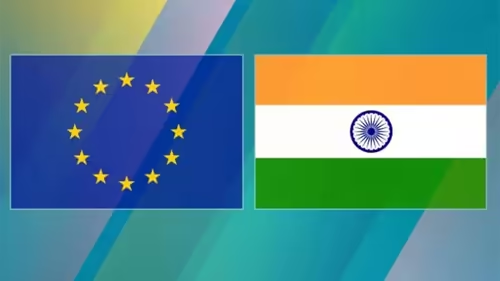
The India-EU FTA, which has been under negotiation for over a decade, is finally nearing its conclusion. The agreement aims to boost bilateral trade, diversify global supply chains away from China, and create a more predictable business environment for companies in both regions .
In exchange for India’s concession on car import tariffs, the EU is expected to provide significant benefits to Indian exporters. Key Indian sectors like pharmaceuticals, textiles, gems and jewellery, and agricultural products are slated to gain duty-free or preferential access to the vast European market . This is a classic trade-off: opening up a protected domestic market in return for greater access to a lucrative foreign one.
Winners and Losers: Who Benefits?
The immediate winners are clear: European luxury car manufacturers.
- BMW, Mercedes-Benz, Audi, and Volkswagen: These brands will see their landed costs in India drop significantly, allowing them to either lower prices for consumers or increase their profit margins. They may also use this window to test the market before committing to local assembly or manufacturing.
- Indian Consumers: Affluent buyers will finally have access to a wider range of European models at more competitive prices, increasing their choices in the premium segment.
However, the potential losers are a cause for concern:
- Domestic Luxury Brands (or Aspirants): While India doesn’t have a strong domestic luxury car brand yet, companies like Tata Motors (with its premium JLR arm) could face stiffer competition in the high-end segment.
- Local Auto Component Makers: If European brands flood the market with CBUs instead of sourcing parts locally, it could hurt the domestic component industry, though the FTA’s rules of origin are designed to mitigate this .
Protections for Domestic EVs
Recognizing the vulnerability of its burgeoning electric vehicle (EV) industry, the Indian government has reportedly included a crucial safeguard in the deal. The initial tariff reduction is expected to apply primarily to internal combustion engine (ICE) vehicles. The government is likely to maintain higher protective duties on imported electric cars to give its domestic EV champions, like Tata Motors and startups such as Ola Electric, time to scale up and become globally competitive . This phased approach shows a level of strategic thinking, aiming to liberalize trade without completely sacrificing its long-term industrial goals.
Broader Economic Impact
Beyond the auto sector, this FTA is a signal of India’s willingness to engage more deeply with the global trading system. By striking a deal with the EU, India is positioning itself as a reliable alternative manufacturing hub in an era of geopolitical uncertainty. The agreement is expected to boost overall trade volumes, attract more European investment into India, and enhance the country’s standing as a key player in global supply chains . You can read more about India’s broader trade strategy in our analysis on [INTERNAL_LINK:india-global-trade-policy].
For a high-authority perspective on global trade dynamics, the World Trade Organization provides valuable insights into how such agreements shape the global economy (WTO on Free Trade Agreements).
Conclusion: A Calculated Gamble
India’s decision to cut car import tariffs is a bold and calculated gamble. It sacrifices short-term protection for its auto market in exchange for long-term gains in trade, investment, and strategic partnerships. While European luxury brands are set to celebrate, the real test will be whether this move spurs greater local investment from these companies and whether the safeguards for the domestic EV industry prove effective. The success of this policy will be measured not just in increased car sales, but in its contribution to a more robust and globally integrated Indian economy.