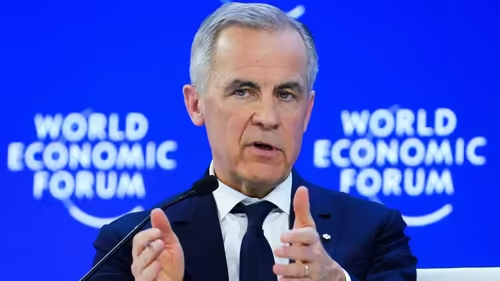
Carney Slams Door on China Free Trade Deal Amid Trump’s Tariff Threats
In a move that sends a clear signal to both Beijing and Washington, Canadian Prime Minister Mark Carney has firmly shut down any notion of a Canada China free trade deal. His statement comes just one day after former U.S. President Donald Trump threatened to impose crippling 100% tariffs on Canadian goods if Ottawa were to pursue closer economic ties with Beijing . This high-stakes diplomatic maneuver underscores the immense pressure Canada faces in navigating its relationships with its two largest trading partners.
Table of Contents
- The Trump Factor: A New Tariff Threat
- Carney’s Clear Denial and the CUSMA Shield
- What is CUSMA Article 32.10? The “Poison Pill” Explained
- Canada’s Actual China Agenda: Beyond the Headlines
- Walking the Geopolitical Tightrope
- Conclusion
- Sources
The Trump Factor: A New Tariff Threat
The timing of Carney’s remarks is no coincidence. They are a direct response to Donald Trump’s latest volley in his ongoing trade war rhetoric. In January 2026, Trump, a key figure in the upcoming U.S. election, has revived his aggressive stance, explicitly warning Canada against any free trade overtures to China . His threat of a 100% tariff is not just an economic weapon; it’s a stark political message designed to keep Canada firmly within the U.S. economic orbit and to isolate China further . Experts warn that such a move would be economically damaging for both nations, creating a lose-lose scenario for consumers and businesses on both sides of the border .
Carney’s Clear Denial and the CUSMA Shield
Prime Minister Carney wasted no time in addressing the speculation. He stated unequivocally that Canada has “no intention” of seeking a free trade pact with China . This isn’t just a political talking point; it’s a legal necessity under the terms of the Canada-United States-Mexico Agreement (CUSMA), the modernized version of NAFTA. Carney emphasized that Canada’s recent diplomatic engagements with China have been solely focused on resolving existing bilateral trade disputes, such as those involving canola and other agricultural products, and are “entirely consistent” with its CUSMA obligations .
What is CUSMA Article 32.10? The “Poison Pill” Explained
At the heart of this controversy lies a specific clause in the CUSMA treaty: Article 32.10, often dubbed the “poison pill.” This provision was a key demand from the Trump administration during the original negotiations and is designed explicitly to restrict member countries from entering into free trade agreements with so-called “non-market economies”—a term universally understood to refer to China .
Here’s how it works:
- Advance Notice: Any CUSMA country (Canada, the U.S., or Mexico) must inform the other two parties at least three months before it intends to start free trade negotiations with a non-market economy.
- Transparency & Review: The negotiating country must provide full details of its proposed agreement to its CUSMA partners.
- The Ultimate Leverage: If a CUSMA partner enters a free trade deal with a non-market economy, the other partners have the right to terminate CUSMA and replace it with a bilateral agreement between themselves, effectively kicking the offending nation out of the trilateral pact .
This clause gives the United States, by far the largest market for Canadian exports, a de facto veto over any major Canadian trade initiative with China .
Canada’s Actual China Agenda: Beyond the Headlines
While a comprehensive free trade deal is off the table, it would be a mistake to think Canada is completely disengaging from China. The world’s second-largest economy remains a crucial market for Canadian resources, agriculture, and education. Carney’s government is likely pursuing a more pragmatic, issue-by-issue approach. This involves:
- Resolving Existing Disputes: Working to lift Chinese tariffs and non-tariff barriers on key Canadian exports like canola, pork, and seafood.
- Managing Investment Flows: Navigating the complex landscape of foreign investment, particularly from state-owned enterprises, with a focus on national security reviews.
- Cooperating on Global Issues: Finding areas of potential cooperation on transnational challenges like climate change or public health, where mutual interests may align.
This strategy allows Canada to protect its economic interests without triggering the CUSMA “poison pill” or provoking a full-blown trade war with the United States .
Walking the Geopolitical Tightrope
Carney’s statement perfectly encapsulates the delicate balancing act Canada must perform. On one side is the United States, its most important ally and trading partner, which demands loyalty and alignment on its strategic competition with China. On the other side is China, a massive economic opportunity that cannot be ignored, but whose political and economic system is fundamentally at odds with Western liberal democracies.
For a nation like Canada, whose prosperity is deeply intertwined with global trade, this is an incredibly difficult position. The CUSMA agreement, while providing immense economic benefits, also acts as a significant constraint on its foreign policy autonomy. Carney’s firm denial of a Canada China free trade deal is less a statement of long-term principle and more a necessary concession to the current geopolitical reality and the immediate threat posed by Trump’s tariff ultimatum .
Conclusion
Prime Minister Mark Carney’s definitive ruling out of a Canada China free trade deal is a pivotal moment in Canadian foreign and trade policy. It is a direct consequence of the powerful combination of the CUSMA treaty’s restrictive Article 32.10 and the renewed, aggressive trade threats from Donald Trump. While Canada will continue to engage with China on specific economic issues, the dream of a comprehensive free trade agreement is effectively dead for the foreseeable future. This situation highlights the profound impact that great power rivalry has on the strategic choices of middle powers like Canada, forcing them to make difficult decisions that prioritize immediate economic security over long-term, diversified trade ambitions. For more on North American trade dynamics, see our deep dive on [INTERNAL_LINK:cusma-impact-on-canadian-business].
Sources
- Times of India: ‘No intention’: Carney rules out free trade pact with China after Trump threatens tariffs
- Government of Canada: CUSMA Chapter 32 – Exceptions and General Provisions
- Centre for International Governance Innovation (CIGI): The USMCA and the U.S. Effort to Exclude China