In India’s high-stakes startup ecosystem, there’s a silent stigma that haunts many founders: the belief that if you’re no longer at the helm of your own company, you’ve failed.
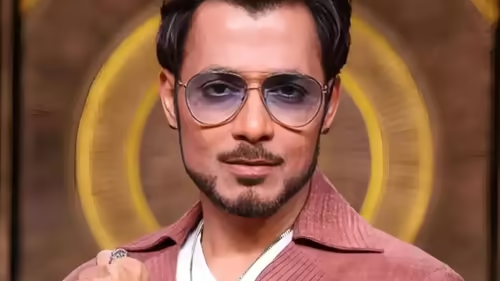
But Anupam Mittal—the visionary behind Shaadi.com and a prominent judge on Shark Tank India—is calling this narrative out for what it really is: outdated, harmful, and fundamentally wrong. In a recent statement, Mittal declared that a founder exit not failure, but rather a strategic evolution essential for long-term success .
This perspective isn’t just opinion—it’s grounded in global best practices and hard-won entrepreneurial wisdom. Yet in India, where founder identity is often fused with company identity, stepping back is still seen as surrender. Mittal wants to change that.
Table of Contents
- Why Founders Need to Step Down
- Founder Exit Not Failure: The Global Perspective
- The Indian Mindset Problem
- When Is the Right Time to Transition?
- Real-World Examples of Successful Founder Transitions
- How to Plan a Smooth Leadership Handover
- Conclusion
- Sources
Why Founders Need to Step Down
Founders are brilliant at ideation, hustle, and early-stage execution. They build from zero, wear multiple hats, and operate in chaos with remarkable agility. But as a startup scales—hitting ₹100 crore, then ₹500 crore in revenue—the skill set required changes dramatically.
“A company outgrows the founder’s management capabilities,” Mittal explains. “That doesn’t mean the founder is inadequate—it means the business has evolved beyond its original operating system” .
Scaling demands structured processes, financial discipline, cross-functional team leadership, and regulatory navigation—areas where professional executives often have deeper expertise. Clinging to the CEO role out of ego or fear can actually stunt growth.
Founder Exit Not Failure: The Global Perspective
Globally, founder-to-CEO transitions are not just common—they’re celebrated as milestones of maturity. Think of Larry Page and Sergey Brin handing Google’s reins to Eric Schmidt, or Mark Zuckerberg bringing in Sheryl Sandberg to scale Facebook’s operations.
According to a Harvard Business Review study, over 50% of founders are replaced as CEO by the time their startup raises Series B funding . This isn’t a crisis—it’s a planned evolution. Investors often encourage it, knowing that specialized leadership drives sustainable value.
As Mittal points out, “In Silicon Valley, stepping down is seen as responsible stewardship. In India, it’s misread as defeat” .
The Indian Mindset Problem
Why does India struggle with this concept? Several cultural and structural factors are at play:
- Founder-as-Hero Narrative: Media glorifies the “lone genius” founder, making any departure seem like a fall from grace.
- Lack of Succession Planning: Many Indian startups don’t build governance structures early enough to facilitate smooth transitions.
- Emotional Attachment: Founders often view their company as an extension of themselves, making detachment feel like betrayal.
- Investor Pressure (Misguided): Some early-stage investors equate founder presence with commitment, discouraging necessary changes.
This mindset doesn’t just hurt founders—it limits the entire ecosystem’s ability to produce world-class, professionally managed companies.
When Is the Right Time to Transition?
Mittal doesn’t advocate for arbitrary exits. The timing must be strategic. Here are key signals that it might be time:
- Revenue Plateau: Growth stalls despite market opportunity—often due to operational bottlenecks only experienced execs can fix.
- Team Scaling Issues: Hiring, retention, or culture problems emerge as headcount crosses 100+.
- Personal Misalignment: The founder no longer enjoys day-to-day operations but excels in vision, product, or investor relations.
- Investor Confidence: New funding rounds come with expectations for professionalized leadership.
The goal isn’t to push founders out—but to let them thrive in roles where they add the most value.
Real-World Examples of Successful Founder Transitions
India has its own success stories that prove Mittal’s point:
- Bhavish Aggarwal (Ola): Stepped back from daily operations to focus on Ola Electric and long-term innovation while professional managers run core mobility.
- Vijay Shekhar Sharma (Paytm): While still CEO, he’s built a strong executive layer, showing how founders can delegate without disappearing.
- Kunal Bahl (Snapdeal): After stepping down, he co-founded Titan Capital—a move that expanded his impact beyond one company.
These aren’t failures. They’re evolutions.
How to Plan a Smooth Leadership Handover
If you’re a founder considering this step, Mittal’s advice is clear: plan early and communicate openly.
Key steps include:
- Start grooming internal talent or scouting external candidates 12–18 months in advance.
- Define your post-transition role (e.g., Chief Vision Officer, Board Chair, Product Lead).
- Involve investors and key stakeholders in the decision to build consensus.
- Publicly frame the move as strategic—not reactive—to shape the narrative.
For more on building resilient startup leadership, see our guide on [INTERNAL_LINK:building-startup-leadership-teams].
Conclusion
Anupam Mittal’s message is both timely and transformative: a founder exit not failure—it’s a mark of wisdom, humility, and commitment to the company’s future. As India’s startup ecosystem matures, embracing this mindset will be crucial for building enduring, globally competitive businesses. The real failure isn’t stepping down; it’s letting ego override what’s best for the company you built.
Sources
- Times of India: Founder exit, not failure: Shark Tank India judge Anupam Mittal explains why
- Harvard Business Review: Who Should Be CEO of Your Start-Up?
- Inc. Magazine: When Founders Should Step Down as CEO