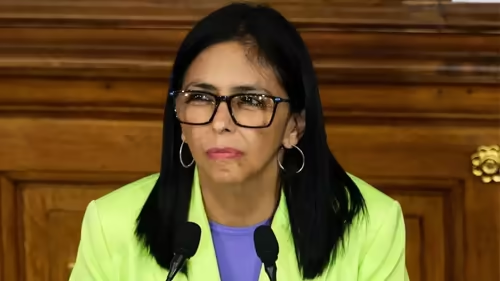
In a dramatic escalation of rhetoric that has stunned diplomats and analysts alike, Venezuela’s interim president Delcy Rodriguez has declared: “Enough orders from Washington.” Her defiant statement comes in the wake of what she describes as an unprecedented act of aggression—an alleged U.S. military raid on Caracas on January 3, 2026, during which American forces supposedly captured President Nicolás Maduro and his wife.
While the veracity of this extraordinary claim remains unverified by independent sources or the U.S. government, it has become the centerpiece of Venezuela’s latest diplomatic offensive against decades of perceived American interference. This moment marks a critical flashpoint in the already fraught Venezuela US relations, raising urgent questions about sovereignty, disinformation, and the future of hemispheric diplomacy.
Table of Contents
- Delcy Rodriguez’s Explosive Statement
- The Tangled History of Venezuela US Relations
- What Really Happened on January 3 in Caracas?
- Bolivarian Diplomacy: A New Strategy or Old Rhetoric?
- International Reactions and Geopolitical Implications
- Conclusion: Defiance, Disinformation, or Diplomatic Turning Point?
- Sources
Delcy Rodriguez’s Explosive Statement
Speaking to Xinhua News Agency, Venezuela’s interim leader—acting in place of the allegedly detained Maduro—accused the United States of crossing a red line. “We will no longer accept dictates from Washington,” Rodriguez stated. “Venezuela will resolve its long-standing disputes with the United States face to face, through Bolivarian diplomacy—not under the shadow of gunships or covert raids.”
She emphasized that her government was shocked that “a South American capital would be subjected to a military attack by a foreign power,” directly referencing the January 3 incident. This narrative, whether factual or not, is being leveraged to galvanize domestic support and rally anti-imperialist sentiment across Latin America.
The Tangled History of Venezuela US Relations
To understand the weight of Rodriguez’s words, one must look back at over two decades of deteriorating ties between Caracas and Washington. Since Hugo Chávez rose to power in 1999, Venezuela has positioned itself as a vocal opponent of U.S. hegemony in Latin America.
Key flashpoints include:
- The U.S. recognition of opposition leader Juan Guaidó as “interim president” in 2019, which Venezuela dismissed as a coup attempt.
- Extensive U.S. sanctions on Venezuela’s oil sector, crippling its economy.
- Indictments of top Venezuelan officials, including Maduro, on drug trafficking and corruption charges.
- Repeated allegations from Caracas that the CIA has plotted multiple assassinations and coups.
This deep-seated mistrust forms the bedrock of today’s crisis. For more on the economic impact of these sanctions, see our analysis on [INTERNAL_LINK:venezuela-economic-crisis-sanctions].
What Really Happened on January 3 in Caracas?
The most controversial element of Rodriguez’s statement is the claim that U.S. forces conducted a military operation in Caracas and captured Maduro. As of January 26, 2026, there is no credible evidence
The White House has issued no statement about a raid, and major global news outlets like BBC, Reuters, and AP have reported no such incident. In fact, Nicolás Maduro appeared in a state television broadcast on January 5, 2026, addressing the nation—raising serious doubts about the abduction narrative.
Experts suggest this may be a case of strategic disinformation—either to justify internal crackdowns, distract from domestic unrest, or test international reactions. Alternatively, it could refer to a failed or exaggerated covert operation that never materialized as described.
Bolivarian Diplomacy: A New Strategy or Old Rhetoric?
Rodriguez’s invocation of “Bolivarian diplomacy” is not new—it’s a term rooted in the ideology of Simón Bolívar, championed by Chávez to promote Latin American unity and resistance to foreign intervention. But in practice, it often translates into alliances with U.S. adversaries like Russia, China, Iran, and Cuba.
Under this banner, Venezuela may seek to:
- Strengthen ties with BRICS nations.
- Push for OPEC+ coordination to counter U.S.-led energy policies.
- Appeal to the Non-Aligned Movement for diplomatic cover.
Yet, without concrete actions beyond rhetoric, “Bolivarian diplomacy” risks becoming a hollow slogan—especially if based on disputed events.
International Reactions and Geopolitical Implications
The international community remains divided. Countries like Cuba, Nicaragua, and Bolivia have expressed solidarity with Venezuela, condemning alleged U.S. aggression. Meanwhile, the European Union and several Latin American nations have called for transparency and urged restraint.
The U.S. State Department, while not addressing the raid claim directly, reiterated its commitment to “democratic transition” in Venezuela and condemned “authoritarian propaganda.” Analysts at the Council on Foreign Relations note that such narratives could further destabilize the region ahead of crucial elections in both Venezuela and the U.S. in 2026.
For authoritative context on U.S. policy in Latin America, refer to the U.S. Department of State.
Conclusion: Defiance, Disinformation, or Diplomatic Turning Point?
Whether the January 3 raid occurred or not, Delcy Rodriguez’s statement signals a hardening stance in Caracas. The phrase “enough orders from Washington” resonates deeply with a population weary of external pressure. Yet, if built on false premises, it could isolate Venezuela further and undermine genuine diplomatic efforts.
For now, the world watches closely. Will this lead to renewed dialogue—or push Venezuela US relations into their most dangerous phase yet? One thing is certain: the battle for narrative control in the Americas is intensifying, and truth may be the first casualty.
Sources
- Times of India: ‘Enough orders from Washington’: Venezuela interim leader amid pressure from US
- Xinhua News Agency: Official statements by Delcy Rodriguez (as cited in ToI)
- U.S. Department of State: U.S. Relations With Venezuela
- Council on Foreign Relations: Venezuela’s Crisis Explained