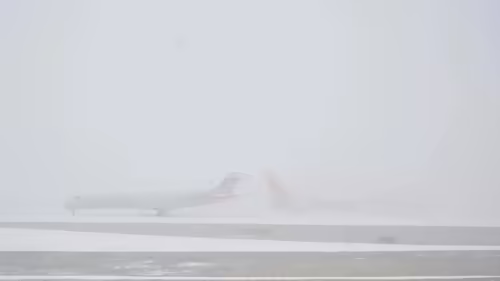
Imagine this: you’re packed, checked in, and ready for your flight—only to get a dreaded notification that it’s been cancelled. For tens of thousands of travelers across the United States on Sunday, January 25, 2026, this nightmare became reality. A massive winter storm, packing heavy snow, ice, and sub-zero wind chills, slammed into the eastern and southern U.S., triggering one of the worst single-day disruptions in recent aviation history. With over **10,000 US flights cancelled** in just 24 hours, the ripple effects are being felt nationwide—and possibly worldwide .
Table of Contents
- The Scale of Disruption: By the Numbers
- Hardest-Hit Airports: Ground Zero for Delays
- Why So Many Cancellations? It’s Not Just the Snow
- What Passengers Should Do: Your Action Plan
- Airline Policies: Refunds, Rebooking & Passenger Rights
- Conclusion: Patience, Preparation, and Proactive Planning
- Sources
The Scale of Disruption: By the Numbers
According to flight tracking service FlightAware, more than **10,000 US flights were cancelled** on Sunday alone—a staggering figure that represents nearly 30% of all scheduled domestic and international departures from U.S. airports that day [[1], [2]]. To put that in perspective, that’s enough grounded planes to fill every gate at Atlanta’s Hartsfield-Jackson Airport—the world’s busiest—for over two full days.
And the pain isn’t over. Thousands more flights have already been flagged for delays or cancellations on Monday as airlines struggle to reposition crews, aircraft, and passengers. The storm’s timing—hitting on a weekend when leisure and business travel peaks—has magnified the chaos exponentially.
Hardest-Hit Airports: Ground Zero for Delays
While the storm’s reach was vast, certain major hubs bore the brunt of the operational meltdown:
- Dallas/Fort Worth International (DFW): As a critical American Airlines hub, DFW saw over 1,200 cancellations, crippling connections across the South and Midwest .
- Charlotte Douglas (CLT): Another American Airlines fortress, CLT faced near-total shutdowns due to ice accumulation on runways and taxiways .
- Philadelphia (PHL) & New York (JFK/LGA): Northeastern airports were buried under 8–12 inches of snow, with de-icing operations overwhelmed by demand .
- Hartsfield-Jackson Atlanta (ATL): Even though Atlanta rarely sees heavy snow, its sheer volume means even minor weather can cause cascading delays nationwide .
These aren’t just local inconveniences—they’re national bottlenecks. A delay in Charlotte can strand passengers in Seattle; a cancellation in Dallas can derail a connection in London.
Why So Many Cancellations? It’s Not Just the Snow
Many travelers wonder: “Why cancel so far in advance if the storm hasn’t even hit?” The answer lies in airline strategy. Unlike delays, which create chaos at terminals, **proactive cancellations** allow carriers to:
- Keep flight crews rested and legally compliant with work-hour limits.
- Prevent aircraft from getting stranded in snowbound cities.
- Protect ground equipment (like jet bridges and fuel trucks) from freezing.
- Issue refunds and rebookings before call centers are flooded.
In short, it’s a controlled retreat to avoid total system collapse. As the Federal Aviation Administration (FAA) notes, safety is non-negotiable—especially when ice makes runways as slick as glass .
What Passengers Should Do: Your Action Plan
If your flight is affected—or you’re flying in the next 72 hours—here’s your survival guide:
- Don’t call the airline yet. Websites and apps update faster than overwhelmed phone lines. Use your airline’s mobile app to check status and rebook instantly.
- Rebook online immediately. Most carriers offer free same-day changes during major disruptions. Look for “waived change fees” banners.
- Monitor your flight number. Cancellations can happen up to 48 hours in advance. Set alerts via Google Flights or FlightAware.
- Know your rights. If the airline cancels your flight, you’re entitled to a full refund—even on non-refundable tickets .
Airline Policies: Refunds, Rebooking & Passenger Rights
Major U.S. carriers—including American, Delta, United, and Southwest—have issued travel waivers for impacted routes. These typically allow passengers to:
- Change their itinerary without fees.
- Request a full cash refund if they no longer wish to travel.
- Rebook on partner airlines if space is available.
Critically, the U.S. Department of Transportation (DOT) mandates that **if the airline cancels your flight, you must be offered a refund**—not just a credit . This is a legal right, not a favor. If you’re denied, file a complaint directly with the DOT .
Conclusion: Patience, Preparation, and Proactive Planning
The scale of this winter storm disruption is a stark reminder of how fragile our air travel network can be. While the immediate focus is on clearing runways and reuniting passengers with their plans, the long-term lesson is clear: always have a backup plan. Monitor weather forecasts, understand your airline’s policy, and act fast when trouble hits. The good news? With most storms passing within 24–48 hours, normal operations usually resume quickly. Until then, patience—and a fully charged phone—are your best travel companions.
Sources
[INTERNAL_LINK:travel-tips-for-winter-weather]
[INTERNAL_LINK:how-to-get-airline-refund-usa]
U.S. Department of Transportation – Airline Passenger Rights
- Times of India: Winter storm grounds US air travel…
- FlightAware: Live Flight Cancellations Dashboard
- FAA: Winter Weather Travel Advisory