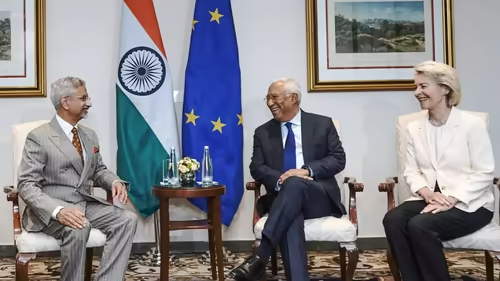
In a world increasingly defined by division, a powerful new alliance is taking shape in New Delhi. The India-EU summit isn’t just another diplomatic meeting; it’s the launchpad for what European Commission President Ursula von der Leyen has boldly called the “mother of all deals with India” . This historic gathering is set to deliver not one, but two landmark agreements that could fundamentally reshape trade, security, and technology cooperation between the world’s largest democracy and a major economic bloc.
Table of Contents
- Why the India-EU Summit Matters Now
- The Free Trade Agreement: A Decade in the Making
- Beyond Trade: The Groundbreaking Security and Defence Pact
- “Leveraging Complementary Strengths”: Von der Leyen’s Vision
- What This Means for Businesses and Citizens
- Conclusion: A United Front in a Fractured World
- Sources
Why the India-EU Summit Matters Now
Held on January 27, 2026, in New Delhi, this summit arrives at a critical juncture . Global supply chains are under strain, technological competition is fierce, and traditional security alliances are being tested. Against this backdrop, the EU and India are positioning themselves as reliable partners who can offer a stable, rules-based alternative. Their shared democratic values and mutual economic interests form the bedrock of this deepening relationship, making the India-EU summit a pivotal moment for the future of international cooperation.
The Free Trade Agreement: A Decade in the Making
The most anticipated outcome of the summit is the conclusion of a comprehensive Free Trade Agreement (FTA). Negotiations began way back in 2007, stalled for years, and were only relaunched with serious momentum in recent times . Now, after lengthy talks, both sides are reportedly on the cusp of a final deal .
This agreement is expected to be a massive boon for businesses in both regions. It will likely slash tariffs on a wide range of goods, from European wine and olive oil to Indian textiles and pharmaceuticals . For consumers, this means greater choice and potentially lower prices. For companies, it opens up vast new markets and streamlines cross-border operations.
Key Benefits of the India-EU FTA
- Market Access: Unprecedented access to a combined market of over 1.8 billion people.
- Tariff Reductions: Significant cuts on thousands of products, boosting trade volumes .
- Investment Boost: A more predictable and stable regulatory environment will attract foreign direct investment.
- Supply Chain Resilience: Diversifying trade partners away from volatile regions strengthens global supply chains.
Beyond Trade: The Groundbreaking Security and Defence Pact
Perhaps even more strategically significant is the new Security and Defence Partnership set to be signed at the summit . This pact will formalize cooperation on critical issues like maritime security in the Indo-Pacific, counter-terrorism, and cyber security . India will join an elite group, becoming only the third Asian nation—after Japan and South Korea—to have such a formal agreement with the EU .
This move signals a clear intent from both sides to play a more active role in maintaining a stable and secure global order. It’s a direct response to growing regional challenges and underscores the depth of the evolving EU-India strategic partnership.
“Leveraging Complementary Strengths”: Von der Leyen’s Vision
European Commission President Ursula von der Leyen has been a vocal champion of this partnership. She frames it as a positive force in a “fractured world,” where India and Europe are making a “clear choice” to build a strategic alliance based on shared interests and democratic values [[7], [12]]. Her now-famous phrase, “leveraging complementary strengths,” perfectly captures the essence of the deal .
Europe brings its advanced technology, capital, and regulatory expertise, while India offers a massive, young, and dynamic market, a thriving digital economy, and a strategic geographic position. Together, they aim to create a powerful synergy that drives innovation and prosperity for both sides. This vision extends beyond just economics into a joint agenda on climate action, digital governance, and global health .
What This Means for Businesses and Citizens
The ripple effects of the India-EU summit will be felt far beyond the negotiating table.
- For Exporters & Importers: Reduced tariffs and streamlined customs procedures will make cross-border trade significantly easier and cheaper.
- For Tech Companies: Enhanced cooperation on digital technologies, AI, and clean energy will open new avenues for collaboration and R&D.
- For Students & Professionals: Discussions on mobility are expected to lead to easier visa processes and more opportunities for academic and professional exchange [INTERNAL_LINK:study-abroad-europe].
- For Consumers: Expect a wider variety of European and Indian goods on shelves at more competitive prices.
Conclusion: A United Front in a Fractured World
The 2026 India-EU summit is more than a series of signed documents; it’s a powerful statement of intent. By finalizing a long-awaited Free Trade Agreement and a pioneering Security and Defence Partnership, India and the EU are demonstrating that cooperation, not conflict, is the path forward in a complex world. This strategic partnership, built on “complementary strengths,” has the potential to deliver immense economic benefits, enhance global security, and offer a compelling model of democratic collaboration for the 21st century. The world is watching.
Sources
- European Council: EU-India summit, 27 January 2026
- Times of India: ‘Leveraging complementary strengths’: Von der Leyen highlights strategic India-EU partnership
- Reuters: India and EU near conclusion of landmark free trade deal
- The Hindu: Maritime security to terror fight: India-EU pact ready
- CGTN Europe: ‘A fractured world, a new way’: Ursula von der Leyen on India-EU partnership