Table of Contents
- The Chilling Discovery on Republic Day Eve
- What is Ammonium Nitrate and Why is it So Dangerous?
- The Ammonium Nitrate Seizure in Detail
- Security Alert: Republic Day Under Threat?
- How is Ammonium Nitrate Regulated in India?
- Conclusion: A Wake-Up Call for National Security
- Sources
The Chilling Discovery on Republic Day Eve
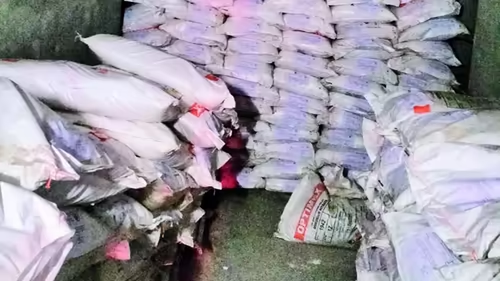
In a move that sent shockwaves through India’s security establishment, the Rajasthan Police made a massive and alarming discovery just hours before the nation was set to celebrate its 77th Republic Day. Acting on a specific intelligence tip, officers from the Nagaur district raided a secluded farmhouse in Sarhad Harsaur village and unearthed a veritable arsenal of dangerous materials .
The haul was staggering: nearly **10,000 kilograms** of ammonium nitrate, a chemical compound notorious for its use in powerful improvised explosive devices (IEDs). Alongside it, investigators also found various other explosive precursors and detonation equipment . One individual has been arrested in connection with the case, and a high-level investigation is now underway to trace the origins of the material and uncover any potential network behind it. This ammonium nitrate seizure is being hailed as a critical success that may have averted a catastrophic event during one of India’s most important national holidays.
What is Ammonium Nitrate and Why is it So Dangerous?
Ammonium nitrate is a common chemical, primarily used as a high-nitrogen fertilizer in agriculture. On its own, it’s relatively stable. However, its danger lies in its potential when mixed with a fuel source like diesel or other combustible materials. This mixture, known as ANFO (Ammonium Nitrate Fuel Oil), is a powerful industrial explosive widely used in mining and construction .
Unfortunately, its accessibility and low cost have also made it a favorite among terrorists and criminals. Some of the deadliest non-nuclear explosions in history have involved ammonium nitrate, including the 1995 Oklahoma City bombing and the devastating 2020 Beirut port explosion . Its dual-use nature—essential for farming yet capable of immense destruction—makes its regulation and tracking a constant challenge for law enforcement worldwide.
The Ammonium Nitrate Seizure in Detail
The operation in Nagaur was executed with precision. Here’s a breakdown of what we know so far:
- Location: A remote, isolated farmhouse in Sarhad Harsaur village, Nagaur district, Rajasthan. The seclusion of the location suggests a deliberate attempt to avoid detection.
- Materials Recovered: Approximately 10,000 kg of ammonium nitrate, along with other unspecified explosive materials and components that could be used to construct IEDs.
- Arrests: One person has been taken into custody. Authorities are conducting intense interrogations to determine if this was a lone actor or part of a larger, organized group.
- Timing: The raid occurred on January 25, 2026, the eve of India’s Republic Day, a day marked by large public gatherings and heightened national pride, making it a prime target for those seeking to cause mass panic and disruption.
Possible Motives and Links
While the investigation is in its early stages, security experts are exploring several angles. The timing strongly points to an intent to disrupt Republic Day celebrations. The region has also seen sporadic activity from various extremist groups in the past. Police are now working to trace the supply chain of the ammonium nitrate—whether it was stolen from a legitimate industrial or agricultural source or smuggled in from elsewhere. [INTERNAL_LINK:india-terrorism-threats-2026]
Security Alert: Republic Day Under Threat?
This incident underscores a persistent and evolving threat to India’s internal security. The fact that such a massive quantity of explosive material could be stockpiled so close to a major national holiday is deeply concerning. It highlights potential gaps in the monitoring of hazardous chemicals and the need for even more robust intelligence-sharing between state and central agencies.
Following the seizure, security has been significantly heightened across Rajasthan and other major cities in India. Parades and public events are under maximum surveillance, and checkpoints have been reinforced on all major highways leading to sensitive areas .
How is Ammonium Nitrate Regulated in India?
Recognizing its dangers, the Indian government has strict regulations governing the sale, storage, and transport of ammonium nitrate. The Ammonium Nitrate Rules, 2012, were enacted under the Explosives Act, 1884, to control its use. These rules mandate that any entity handling ammonium nitrate must obtain a license from the Petroleum and Explosives Safety Organisation (PESO) .
PESO, a premier authority under the Department for Promotion of Industry and Internal Trade (DPIIT), is responsible for ensuring the safe manufacture, storage, and transport of all explosives and flammable materials in the country. The massive seizure in Nagaur raises serious questions about whether these regulations were circumvented or if there was a failure in their enforcement. A thorough audit of the ammonium nitrate supply chain is now an urgent necessity.
Conclusion: A Wake-Up Call for National Security
The ammonium nitrate seizure in Rajasthan is more than just a successful police operation; it’s a stark reminder of the constant vigilance required to protect a nation. While the immediate threat appears to have been neutralized, the underlying vulnerabilities it exposed cannot be ignored. Strengthening the regulatory framework for hazardous materials, enhancing intelligence capabilities, and fostering greater coordination between security agencies are critical steps to prevent such a close call from happening again. For now, the nation can breathe a sigh of relief, but the work to secure its future has only just intensified.
Sources
- Times of India: Rajasthan cops seize 10,000 kg of ammonium nitrate on Republic Day eve; 1 held
- Web Search Results: Security tightened in Rajasthan after seizure of 10000 kg ammonium nitrate
- Web Search Results: What is ammonium nitrate and why is it dangerous?
- National Fire Protection Association (NFPA): Information on Hazardous Materials Safety
- Petroleum and Explosives Safety Organisation (PESO): Official Website and Regulations