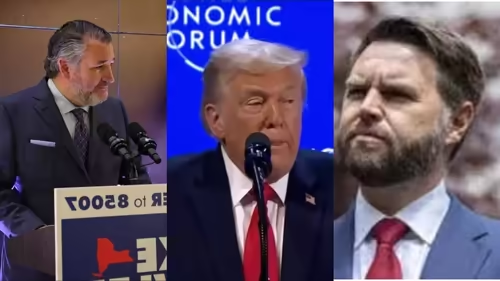
Inside the Leaked Audio: The Collapse of the India Trade Deal
In a stunning political revelation, a secretly recorded conversation has exposed deep fractures within the Republican Party over international trade. The recording features Senator Ted Cruz, a prominent figure in the GOP, making explosive claims that the much-anticipated India trade deal was deliberately sabotaged by two of Donald Trump’s closest allies: former trade advisor Peter Navarro and current Vice President JD Vance.
Cruz didn’t just stop at assigning blame; he went on to deliver a scathing critique of Trump’s signature tariff policy, warning wealthy donors that it could trigger an economic crisis severe enough to threaten the President’s political future. This leak offers a rare, unfiltered glimpse into the private anxieties of a key Republican about the direction of the party’s economic agenda.
Table of Contents
- The Secret Recording: What Cruz Allegedly Said
- Navarro and Vance’s Role in Blocking the Deal
- The Real Economic Fallout of Trump’s Tariffs
- JD Vance’s Growing Influence on Foreign Policy
- Political Implications for the 2026 Landscape
- Conclusion: A Party at a Crossroads
- Sources
The Secret Recording: What Cruz Allegedly Said
According to reports, the leaked audio captures Senator Cruz in a private meeting with major donors. In this candid setting, he is said to have recounted a “heated” phone call with then-President Trump, where he attempted to reason against the sweeping tariff measures. Cruz allegedly warned that these tariffs were not a strategic tool but a blunt instrument that would ultimately be paid for by American consumers and businesses, potentially leading to a significant economic downturn .
His most damning remarks, however, were reserved for his colleagues. Cruz reportedly stated that the promising negotiations for an India trade deal were derailed not by external forces, but by internal opposition from Peter Navarro and JD Vance. He painted a picture of a White House where personal agendas and ideological purity tests were taking precedence over pragmatic economic statecraft.
Navarro and Vance’s Role in Blocking the Deal
Cruz’s accusations are particularly pointed. He tied JD Vance directly to media personality Tucker Carlson, suggesting that Vance was acting as a conduit for Carlson’s more isolationist and anti-interventionist views within the administration. This, according to Cruz, influenced key foreign policy appointments and decisions, including the fate of the India trade deal .
Peter Navarro, Trump’s long-time trade hawk, has been a consistent advocate for aggressive protectionism. His influence on Trump’s trade policy is well-documented, and Cruz’s claim that Navarro played a key role in blocking the deal aligns with his established stance against what he often labels as “bad” trade agreements. The implication is that any deal that didn’t meet their stringent, America-first criteria was doomed from the start.
The Real Economic Fallout of Trump’s Tariffs
Cruz’s private warnings to donors appear to be grounded in a growing body of economic analysis. In 2026, experts project that Trump’s tariffs will generate a massive $175.1 billion in federal tax revenue—a figure that represents a 0.55% hit to the nation’s GDP and is being described as the largest tax hike since 1993 .
The burden of these tariffs isn’t falling on foreign nations as intended, but squarely on the shoulders of U.S. consumers and the domestic supply chain. A recent survey from the Association for Supply Chain Management confirmed that these policies have already led to rising layoffs and a chilling effect on new investment . Furthermore, the United Nations has forecast that global trade growth will slow dramatically in 2026, from 3.8% in 2025 to just 2.2%, largely due to the ripple effects of these U.S. policies .
JD Vance’s Growing Influence on Foreign Policy
While traditionally a ceremonial role, JD Vance has emerged as a surprisingly active and influential Vice President in Trump’s second term. He has been described as a “foreign policy attack dog” and a key liaison between the White House and Congress . His close alignment with Trump on issues like trade and foreign intervention marks a significant shift from previous administrations.
Cruz’s comments suggest that Vance’s influence extends beyond public messaging into the core decision-making process. By framing Vance as a protégé of Tucker Carlson, Cruz is attempting to highlight a specific ideological current within the administration that he believes is detrimental to America’s global economic interests. This positions Vance not just as a political figure, but as a central architect of a new, more insular U.S. foreign policy doctrine .
Political Implications for the 2026 Landscape
This leak arrives at a critical juncture. With the 2026 midterms on the horizon, the Republican Party is grappling with its identity. The rift exposed by Cruz’s comments—between traditional free-market conservatives and the new populist, protectionist wing led by figures like Vance and Navarro—could have profound consequences.
For business-minded Republicans, the economic data on tariffs is alarming. For the party’s base, however, the “America First” message remains potent. Cruz’s decision to voice these concerns, even if in a private setting, reveals the intense pressure building within the GOP. It’s a gamble that could either position him as a voice of reason or paint him as a disloyal critic during a time of party unity.
Conclusion: A Party at a Crossroads
The leaked audio of Ted Cruz is far more than just political gossip. It’s a stark illustration of the ideological battle raging within the Republican Party over its economic future. The blocking of the India trade deal serves as a powerful case study of how internal dynamics can override strategic international opportunities. As the economic costs of the Trump tariff regime become increasingly clear, the tension between populist rhetoric and economic reality will only intensify. This story is a must-read for anyone trying to understand the complex and often contradictory forces shaping US policy in 2026. For more on the evolving landscape of US trade policy, see our deep dive on [INTERNAL_LINK:us-trade-policy-2026].
Sources
- Times of India: Cruz says Navarro, Vance blocked India trade deal; mocks Trump tariffs in leaked audio
- Tax Foundation: Trump Tariffs: The Economic Impact of the Trump Trade War
- United Nations: Global Growth to Slow in 2026 as Trump’s Tariffs Bite
- Association for Supply Chain Management: Supply Chain Job Cuts Report
- Foreign Policy Magazine: Key players in the Trump administration — and what they mean for foreign policy