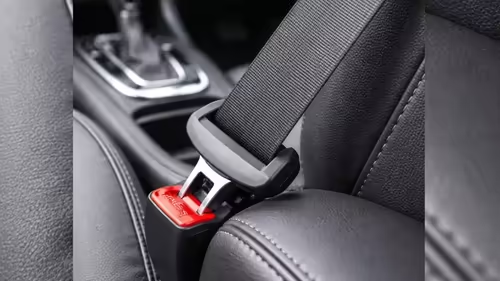
In the quiet hours near Konni, a violent collision sent an official government vehicle tumbling off the road. Inside were Pathanamthitta District Collector Prem Krishnan S, his security officer, and his driver. The car was wrecked, but miraculously, all three emerged with only minor injuries. Their shared secret to survival? They were all buckled in.
“Local, pull me out of the vehicle,” the Collector recounted saying after the crash, a moment that underscores just how close the call was . This isn’t just a story of luck; it’s a stark, real-time demonstration of how a seat belt saves life—a lesson that’s desperately needed across India, where compliance remains dangerously low.
Table of Contents
- The Accident That Shook Kerala
- Why a Seat Belt Saves Life: The Science Behind Survival
- Kerala’s Road Safety Paradox
- The Alarming State of Seat Belt Usage in India
- Key Takeaways for Every Driver and Passenger
- Conclusion: A Simple Habit with a Massive Impact
- Sources
The Accident That Shook Kerala
The incident occurred when a speeding private vehicle, allegedly driving on the wrong side of the road, slammed into the Collector’s official car. The force of the impact was so severe that the government vehicle overturned. It was a scenario that could have easily ended in tragedy .
However, Collector Prem Krishnan S has been vocal about the one factor that made all the difference: “However, the injuries were not serious as they were all wearing seat belts,” he stated publicly . This simple admission from a high-ranking official has sparked a much-needed conversation about road safety protocols, not just for government personnel but for every citizen. For more on government safety protocols, see our guide on [INTERNAL_LINK:road-safety-policies-in-india].
Why a Seat Belt Saves Life: The Physics of Protection
A seat belt saves life by performing a critical function during a crash: it keeps you inside the vehicle and spreads the force of the impact across the stronger parts of your body—the pelvis and chest. In a rollover like the one in Pathanamthitta, being ejected from the vehicle is one of the leading causes of death. The seat belt acts as your primary anchor to survival.
The data is unequivocal. Accident investigations in India have shown that a staggering 95% of drivers and front passengers who used seat belts were uninjured in crashes where their unbuckled counterparts suffered severe or fatal injuries . This isn’t a marginal benefit; it’s a near-guarantee of survival in many common crash scenarios.
Kerala’s Road Safety Paradox
Kerala presents a complex picture when it comes to road safety. On one hand, it boasts one of the lowest fatality rates per accident in the country. On the other, the sheer number of accidents is climbing at an alarming rate. From January to November 2024 alone, the state recorded a massive 44,938 road accidents .
While the total number of fatalities has seen a slight decrease in recent years, dropping to 3,874 in 2024 , the volume of crashes means that thousands of lives are still being disrupted daily. The Collector’s accident is a microcosm of this larger issue—a single, avoidable event on a network of roads under immense strain.
The Alarming State of Seat Belt Usage in India
The Collector’s experience is a powerful anecdote, but it stands in sharp contrast to the national reality. Despite clear laws and overwhelming evidence, seat belt usage in India is abysmally low.
- A 2022 survey revealed that a shocking 70% of Indians do not wear a seat belt when seated in the rear seat of a car .
- Nationwide, it’s estimated that 75% of vehicle users don’t wear seat belts, contributing to a grim statistic of 15 deaths every single day .
- In 2023, accidents attributed to not wearing seat belts resulted in over 16,000 deaths and 40,000 injuries across the country .
These numbers paint a clear picture: the knowledge of the seat belt saves life principle is not translating into action. For deeper insights into national trends, the Ministry of Road Transport and Highways’ annual Road Accidents in India report is a crucial resource.
Key Takeaways for Every Driver and Passenger
The Pathanamthitta incident offers several critical lessons for all of us:
- Buckle Up, Every Time, Every Seat: It doesn’t matter if you’re in the front or the back, on a highway or a city street. A crash can happen anywhere, at any time.
- It’s the Law, and for Good Reason: Wearing a seat belt is mandatory under Indian law. Fines are a consequence, but the real penalty for non-compliance is measured in lives lost.
- Lead by Example: As a senior government official, Collector Krishnan’s public acknowledgment of his seat belt use is a powerful form of leadership. We should all strive to be that example for our families and friends.
Conclusion: A Simple Habit with a Massive Impact
The story of the Kerala collector is more than just a news headline; it’s a visceral, real-world case study in the power of a simple safety measure. In a nation grappling with a road safety crisis, his experience is a clarion call. A seat belt saves life not through magic, but through basic physics and a commitment to a simple, five-second habit. In a world of complex problems, this is a solution that is immediate, free, and universally available. The question isn’t whether your seat belt will work—it’s whether you’ll give it the chance to.
Sources
- Times of India: ‘Local, pull me out of vehicle’: How seat belt saved Kerala collector’s life during car crash
- Ministry of Road Transport and Highways, India: Road Accidents in India – 2023 Report
- LocalCircles Survey (2022): Seat Belt Usage in India
- Kerala Police Crime Records Bureau: Road Accident Statistics 2024