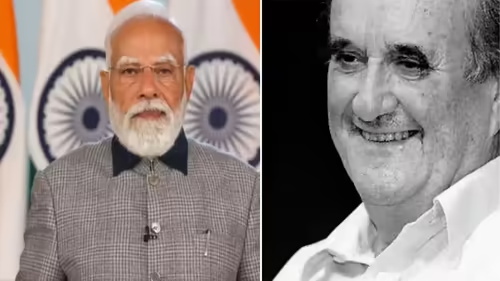
The world of journalism has lost one of its most revered and steady voices. On January 25, 2026, Sir Mark Tully, the legendary British journalist who became synonymous with reporting on India for a global audience, passed away in New Delhi. His death marks not just the end of a life but the closing of a remarkable chapter in the history of international broadcasting. Prime Minister Narendra Modi was among the first to pay tribute, calling him a ‘towering voice of journalism’—a fitting epitaph for a man whose career spanned over three decades of India’s most tumultuous and transformative years.
Table of Contents
- Who Was Mark Tully?
- Mark Tully Death and Final Days
- PM Modi and National Tributes
- The Enduring Legacy of a Journalistic Giant
- Conclusion: A Voice That Shaped India
- Sources
Who Was Mark Tully?
Born in Kolkata (then Calcutta) in 1935 to British parents, Mark Tully’s connection to India was deep and personal from the very beginning . He returned to the country in 1965 as the BBC’s India Correspondent, a role that would define his life and career . For an incredible 22 years, he served as the BBC’s Bureau Chief in New Delhi, becoming the trusted ‘Voice of India’ for millions of listeners around the world .
Tully’s reporting was characterized by its calm authority, meticulous fairness, and profound understanding of the Indian subcontinent’s complex social and political fabric. He covered every major event from the Indo-Pakistani wars and the Emergency declared by Indira Gandhi to the Bhopal gas tragedy and the rise of economic liberalization. His ability to explain India’s intricate realities to a foreign audience without resorting to clichés or sensationalism earned him immense respect both within India and internationally.
After a distinguished 30-year career with the BBC, Tully resigned in 1994 but never truly left the field. He continued to be a prolific author and commentator, writing several acclaimed books on India and remaining a sharp, critical, yet always affectionate observer of the nation he called home .
Mark Tully Death and Final Days
The news of the Mark Tully death came as a shock to many, though he had been unwell in his final days. He was admitted to Max Super Speciality Hospital in Saket, New Delhi, on January 21, 2026 . According to an official statement from the hospital, he passed away peacefully on Sunday, January 25, at 2:35 PM .
The primary cause of his death was multi-organ failure, which followed a stroke . At the age of 90, Tully’s passing feels like the natural conclusion of a long and extraordinarily well-lived life, but it leaves a void that will be hard to fill in the world of thoughtful, nuanced journalism.
PM Modi and National Tributes
Prime Minister Narendra Modi was quick to express his condolences, leading a wave of tributes from across the political and media spectrum. In his statement, PM Modi described Tully as a ‘towering voice of journalism’ and acknowledged his significant contribution to chronicling India’s journey . This is a notable recognition from a leader who has often had a complex relationship with the press, underscoring the unique and apolitical respect Tully commanded.
Modi’s tribute highlights a key aspect of Tully’s legacy: his ability to be a critical friend to India. He was never afraid to point out the nation’s flaws, from corruption to communal tensions, but he did so from a place of deep affection and a desire for its betterment. His work, including his famous ‘Mann Ki Baat’ programme, demonstrated this balanced perspective .
The Enduring Legacy of a Journalistic Giant
What makes Mark Tully’s legacy so enduring? In an age of hot takes and 24/7 news cycles, Tully represented a different kind of journalism—one rooted in patience, context, and deep knowledge. His legacy can be seen in several key areas:
- Setting the Gold Standard for Foreign Correspondence: He proved that a foreign correspondent could achieve a level of intimacy and understanding with their host country that rivals any local journalist.
- Mentorship and Influence: Generations of Indian and international journalists have cited Tully as a major influence, learning from his commitment to factual, calm, and insightful reporting.
- A Bridge Between Cultures: Through his radio broadcasts and books, he built a crucial bridge of understanding between India and the rest of the world, demystifying a complex nation for a global audience.
For those looking to understand modern India, his body of work remains an essential resource. You can explore his insights further in our related piece on [INTERNAL_LINK:history-of-indian-media].
Conclusion: A Voice That Shaped India
The Mark Tully death is more than the loss of a single individual; it is the silencing of a voice that, for over half a century, helped narrate India’s story to itself and to the world. His calm, authoritative, and deeply human reporting provided a steady anchor during times of national chaos and celebration alike. As we remember his life and work, we are reminded of the immense power of journalism done with integrity, empathy, and unwavering dedication to the truth. In the words of many who knew him, ‘Rest in peace, Sir Mark Tully—the calm voice that narrated India’s storms’ .
Sources
- Times of India: A towering voice of journalism’: PM Modi condoles death of veteran journalist Mark Tully
- Max Hospital Official Statement: Max Super Speciality Hospital, Saket
- Trinity Hall Cambridge: Sir Mark Tully – Trinity Hall Cambridge