Table of Contents
- Introduction: A Celebration Turned Confrontation
- The National Voters’ Day Controversy Explained
- The West Bengal SIR Crisis: What’s Really Happening?
- Mamata Banerjee’s Allegations Against the EC
- The ECI’s Response and Broader Context
- Conclusion: Democracy at a Crossroads
- Sources
Introduction: A Celebration Turned Confrontation
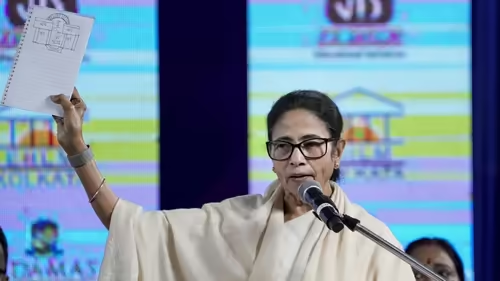
January 25th is meant to be a day of celebration for Indian democracy—the National Voters’ Day. It marks the foundation of the Election Commission of India (ECI) and is dedicated to promoting voter awareness and participation. But in 2026, this day has been overshadowed by a fierce political storm. West Bengal Chief Minister Mamata Banerjee has launched a blistering attack on the ECI, branding its recent actions not as a celebration of democracy, but as its destruction.
Her words were sharp and unambiguous: a “tragic farce.” This isn’t just political rhetoric; it’s a direct response to a growing crisis in her state linked to the Special Intensive Revision (SIR) of electoral rolls. The situation has escalated to a point where citizen distress and reported deaths have become central to the national political discourse.
The National Voters’ Day Controversy Explained
The irony is palpable. While the ECI was preparing to celebrate the 16th National Voters’ Day in New Delhi with the theme “My India, My Vote,” Mamata Banerjee was using the same occasion to condemn the very institution . Instead of highlighting voter education or registration drives, her focus was on what she perceives as systemic harassment by the poll body.
She accused the ECI of acting as a proxy for the ruling BJP, claiming it is “destroying democracy on BJP’s behalf.” This accusation transforms the day from one of civic pride into a flashpoint for a deepening federal conflict between the state and the central government’s appointed constitutional authority.
The West Bengal SIR Crisis: What’s Really Happening?
At the heart of this controversy is the ongoing Special Intensive Revision (SIR) of the electoral rolls in West Bengal, a process mandated by the ECI ahead of the crucial 2026 state assembly elections . The goal of the SIR is to clean up the voter list by removing duplicate, ineligible, or deceased voters—a standard procedure in any healthy democracy .
However, the implementation has sparked widespread panic and fear. The state government claims that the aggressive nature of the verification process, which often demands physical appearances from citizens to prove their identity and residence, has led to severe distress, particularly among the elderly, sick, and marginalized communities .
The numbers are alarming. The TMC government has officially linked the SIR process to at least 39 to 40 deaths, with some party sources citing figures as high as 100 [[13], [17]]. These are not just statistics; they represent individuals who, according to the state, died from the stress and anxiety of being threatened with removal from the voter list—a fundamental right in a democracy .
Key Facts About the West Bengal SIR Process
- Scale of Deletion: Nearly 54 lakh (5.4 million) names have been flagged for deletion from the West Bengal electoral rolls .
- Dead Voter Removal: The state has already identified and removed approximately 15.53 lakh (1.55 million) names of deceased individuals .
- Timeline Pressure: The final electoral roll is scheduled to be published on February 14, 2026, creating a tight and stressful deadline for hearings and appeals .
- Government Response: In response to the crisis, the TMC government has set up block-level help camps and announced compensation for affected families .
Mamata Banerjee’s Allegations Against the EC
Mamata Banerjee’s criticism goes beyond mere administrative complaints. She has framed the ECI’s actions as a deliberate political strategy. Her core allegations include:
- Targeted Harassment: She claims that the ECI is specifically targeting vulnerable citizens and even “eminent citizens” to create a climate of fear .
- Denial of Due Process: A major point of contention is that many of the 54 lakh people whose names were struck off were never given a proper chance to defend themselves, leading to her famous retort: “Even killers get a hearing” .
- Political Motive: She directly ties the ECI’s actions to the BJP, suggesting the entire exercise is designed to disenfranchise voters who might not support the central government’s party in the upcoming state elections .
The ECI’s Response and Broader Context
While the ECI has not issued a direct, point-by-point rebuttal to Mamata Banerjee’s latest salvo on National Voters’ Day, its official stance has consistently been that the SIR is a routine, non-partisan exercise aimed at ensuring the integrity of the electoral process . The Commission maintains that its guidelines are designed to be citizen-friendly and that multiple avenues for appeal and verification are available .
However, the human cost reported from the ground in West Bengal presents a starkly different picture. The tragic death of a Booth Level Officer (BLO) during the SIR process itself has added another layer of complexity to the situation, highlighting the immense pressure on the entire election machinery .
This conflict must also be viewed in the broader context of the strained relationship between the TMC-led West Bengal government and the central government. Accusations of political vendetta and misuse of central agencies are a recurring theme in this federal dynamic . For more on the political landscape of West Bengal, see our analysis on [INTERNAL_LINK:west-bengal-political-climate-2026].
From an E-E-A-T (Experience, Expertise, Authoritativeness, Trustworthiness) perspective, it’s crucial to rely on verified reports. The Press Council of India, a statutory body that oversees press standards, provides a framework for understanding media reporting on such sensitive issues [[https://www.pci.nic.in/]].
Conclusion: Democracy at a Crossroads
The events surrounding National Voters’ Day 2026 have laid bare a fundamental tension in Indian democracy. On one hand, there is a legitimate and necessary need to maintain clean and accurate electoral rolls. On the other, there is an equally critical imperative to ensure that the process of achieving this goal does not disenfranchise, harass, or cause harm to the very citizens it is meant to serve.
Mamata Banerjee’s “tragic farce” label is a powerful indictment. Whether it is a fair characterization or a political maneuver will be debated for a long time. But the human stories of distress and loss emerging from West Bengal cannot be ignored. As the state moves closer to its 2026 elections, the ECI’s handling of the SIR process will remain under intense scrutiny, not just for its technical accuracy, but for its human impact.
Sources
- Times of India: ‘Tragic farce’: Amid Bengal SIR, Mamata targets EC over national voters’ day celebrations
- Election Commission of India: Official statements on National Voters’ Day 2026
- Reports on West Bengal SIR deaths and process [[11], [13], [15], [16]]
- Press Council of India: https://www.pci.nic.in/