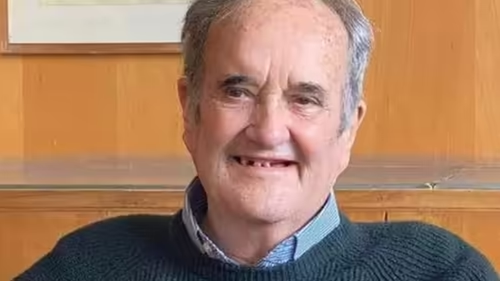
Mark Tully’s Death: A Nation Mourns Its Chronicler
The calm, measured, and deeply insightful voice that narrated India’s most tumultuous moments to the world has fallen silent. On Sunday, January 25, 2026, veteran journalist and author Sir Mark Tully passed away at the age of 90 in a private hospital in New Delhi . His death, confirmed by close friends and former colleagues, marks the end of an extraordinary chapter in both Indian and international journalism.
Table of Contents
- What Was the Cause of Mark Tully’s Death?
- The Unparalleled BBC Career: Becoming the ‘Voice of India’
- Fearless Reporting from the Eye of the Storm
- A Literary Legacy: Books and Prestigious Honors
- The Enduring Legacy of a Gentleman Journalist
What Was the Cause of Mark Tully’s Death?
The immediate cause of Mark Tully’s death was a pulmonary embolism, a serious condition involving a blood clot in the lungs . He had been unwell for a period leading up to his passing at Max Hospital Saket in New Delhi . His close friend and fellow journalist, Satish Jacob, confirmed the news to the Press Trust of India, sending shockwaves through media circles across the globe .
The Unparalleled BBC Career: Becoming the ‘Voice of India’
Born in October 1935, Mark Tully’s connection with India was profound, having spent his formative years in the country before returning as a foreign correspondent. His career with the British Broadcasting Corporation (BBC) spanned an impressive 30 years, from 1964 until his resignation in 1994 . For over two decades, he served as the Chief of Bureau for the BBC in New Delhi, a position that made him a household name not just in the UK, but across the Indian subcontinent .
Tully wasn’t just a reporter; he was an interpreter of India for a global audience. His unique ability to blend deep cultural understanding with journalistic integrity earned him the moniker “the BBC’s voice of India” . His broadcasts were a trusted source of information during times of great uncertainty, a beacon of calm amidst the chaos he so often reported on.
Fearless Reporting from the Eye of the Storm
Tully’s tenure was defined by his courageous coverage of some of India’s most defining and harrowing events. He reported on wars, famines, and communal riots with a clarity and empathy that was unmatched. His fearless reporting included:
- The Indian Army’s controversial 1984 operation at the Golden Temple in Amritsar, a story he later explored in his book “Amritsar: Mrs Gandhi’s Last Battle” .
- The catastrophic Bhopal gas tragedy, where his reports brought the scale of the human disaster to the world’s attention .
- The political assassinations that shook the nation, including those of Indira and Rajiv Gandhi.
His commitment to truth was so strong that it sometimes put him at odds with the authorities. In a famous act of defiance, he refused to broadcast a government-mandated message during the Emergency in 1975, a decision that cemented his reputation for journalistic independence [[INTERNAL_LINK:history-of-indian-journalism]].
A Literary Legacy: Books and Prestigious Honors
After leaving the BBC, Tully’s work was far from over. He transitioned seamlessly into a successful career as an author and radio presenter. He penned several acclaimed books that offered deep dives into Indian society, politics, and spirituality, including “No Full Stops in India,” “India in Slow Motion,” and “The Kumbh Mela” [[24], [26]].
His contributions were recognized with some of the highest honors from both his home country and his adopted one. His list of accolades is a testament to his immense stature:
| Award/Honor | Year | Conferring Body |
|---|---|---|
| Officer of the Order of the British Empire (OBE) | 1985 | United Kingdom |
| Padma Shri | 1992 | Government of India |
| Knighted (KBE) | 2002 | United Kingdom |
| Padma Bhushan | 2005 | Government of India |
These awards, particularly the dual recognition from both the UK and India, highlight the unique bridge he built between the two nations through his work [[20], [22]].
The Enduring Legacy of a Gentleman Journalist
In an age of sensationalism and rapid-fire news cycles, Mark Tully stood as a pillar of thoughtful, nuanced, and deeply human journalism. He was a master of the long-form report, a believer in context over clickbait, and a journalist who prioritized understanding over judgment. His legacy is not just in the stories he told, but in the standard he set for a generation of reporters who followed in his footsteps.
For millions of Indians, he was more than a foreign correspondent; he was a trusted friend who spoke about their country with a rare blend of affection and critical insight. His passing is not just a personal loss for his family and friends, but a significant moment for the entire journalistic community. The world has lost a true gentleman of the press, and India has lost one of its most eloquent and honest chroniclers.
Summary
The Mark Tully death announcement on January 25, 2026, signifies the closing of a legendary chapter in journalism. From his fearless reporting on the frontlines of history for the BBC to his insightful books on Indian life, Tully’s career was a masterclass in integrity and depth. Honored by both Britain and India, his legacy as a calm, authoritative, and deeply empathetic voice will continue to inspire journalists and readers for generations to come.