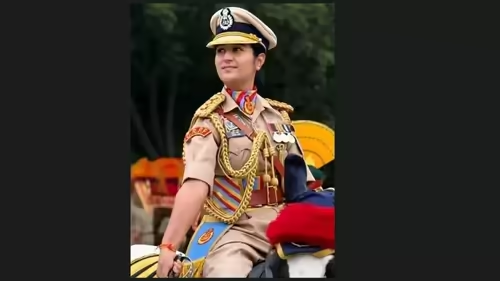
On January 26, 2026, as the nation stands in awe along Kartavya Path in New Delhi, one figure will command attention not just for her precision and poise—but for the powerful message she embodies. At just 26 years old, Assistant Commandant Simran Bala of the Central Reserve Police Force (CRPF) will become the first woman from Rajouri district in Jammu & Kashmir to lead an all-male contingent during the Republic Day parade.
This isn’t just a ceremonial milestone—it’s a seismic shift in the narrative of women in India’s paramilitary forces. Hailing from a remote border village where opportunities for girls were once limited, Simran’s journey from rural Rajouri to the heart of national pride is a testament to resilience, ambition, and quiet defiance against the odds.
Table of Contents
- Who Is Simran Bala? The Woman Making History
- From Rajouri to Republic Day: A Journey of Grit
- Simran Bala CRPF: Breaking Barriers in Paramilitary Forces
- Why Leading an All-Male Contingent Matters
- The Growing Role of Women in Indian Paramilitary Forces
- Inspiring a New Generation in Jammu and Kashmir
- Conclusion: More Than a Parade—A Symbol of Change
- Sources
Who Is Simran Bala? The Woman Making History
Simran Bala, now an Assistant Commandant in the CRPF—the largest paramilitary force in India—is no stranger to breaking ground. Born and raised in a small village near the Line of Control (LoC) in Rajouri, she grew up witnessing the dual realities of conflict and courage that define life in this border region.
Despite societal expectations and limited infrastructure, Simran pursued academics with unwavering focus. She cleared the Union Public Service Commission (UPSC) examination on her first attempt—a feat fewer than 1% of candidates achieve—and chose the CRPF over other civil services, driven by a desire to serve on the frontlines of national security.
Her selection to lead the Republic Day contingent wasn’t handed to her; it was earned through rigorous physical drills, leadership assessments, and exemplary service in field postings across challenging terrains.
From Rajouri to Republic Day: A Journey of Grit
Rajouri, nestled in the Pir Panjal range, has long been a strategic yet underserved district. For young girls there, dreams of careers in defense or policing were often dismissed as unrealistic. But Simran’s family—particularly her father, a schoolteacher—encouraged her ambitions.
“I wanted to prove that a girl from a border village can stand shoulder-to-shoulder with anyone in uniform,” she shared in a rare interview . Her training at the CRPF Academy in Gurugram tested her limits, but she emerged not just as an officer, but as a role model.
Her Republic Day assignment is especially symbolic: leading over 150 male personnel in one of the most scrutinized military displays in the world. Every step she takes down Kartavya Path will echo in classrooms and homes across J&K.
Simran Bala CRPF: Breaking Barriers in Paramilitary Forces
The inclusion of women in combat and leadership roles within India’s paramilitary forces has been gradual but transformative. While women were first inducted into the CRPF in the 1980s, they were largely restricted to administrative or support roles. It wasn’t until 2016 that the government opened select combat positions to women in central armed police forces (CAPFs).
Today, women like Simran are pushing those boundaries further. Her appointment as contingent commander—traditionally a role reserved for seasoned male officers—signals a cultural shift within the force. As one senior CRPF official noted anonymously, “She didn’t get this because she’s a woman. She got it because she’s the best.”
This moment also aligns with broader national efforts to integrate women into core security operations, including the recent deployment of all-women battalions in sensitive regions .
Why Leading an All-Male Contingent Matters
Some might ask: why does gender matter in a parade? The answer lies in visibility. In a country where only 7% of personnel in CAPFs are women , representation at the highest ceremonial levels sends a powerful signal: competence knows no gender.
For the young men marching behind Simran, it normalizes female leadership. For millions of girls watching on TV, it redefines what’s possible. As one educator in Rajouri put it, “[INTERNAL_LINK:women-in-defence-india] used to be a distant dream. Now, it’s a local reality.”
The Growing Role of Women in Indian Paramilitary Forces
Simran’s story is part of a larger trend:
- In 2023, the BSF deployed its first all-women camel-mounted unit in Rajasthan.
- The ITBP now has women officers stationed at altitudes above 15,000 feet in the Himalayas.
- The CRPF’s Mahila Battalions have played critical roles in counter-insurgency and disaster relief.
Yet challenges remain—gender bias, lack of infrastructure in remote postings, and slow promotion pipelines. Leaders like Simran Bala are crucial in accelerating change from within.
Inspiring a New Generation in Jammu and Kashmir
In a region often portrayed through the lens of conflict, Simran offers a different narrative—one of hope, agency, and national contribution. Schools in Rajouri are already organizing special assemblies to celebrate her achievement, and local girls are reportedly queuing up for career counseling in defense services.
“She’s our daughter, our pride,” said a community elder in her village. “If Simran can march in Delhi, our daughters can do anything.”
Conclusion: More Than a Parade—A Symbol of Change
When Simran Bala steps onto Kartavya Path on Republic Day 2026, she won’t just be leading a contingent—she’ll be leading a movement. Her presence is a quiet revolution in khaki, proving that courage, discipline, and leadership aren’t bound by geography or gender.
The Simran Bala CRPF story is more than inspirational—it’s a blueprint for inclusive patriotism. And in a nation striving for “Sabka Saath, Sabka Vikas,” her footsteps may well pave the way for thousands to follow.