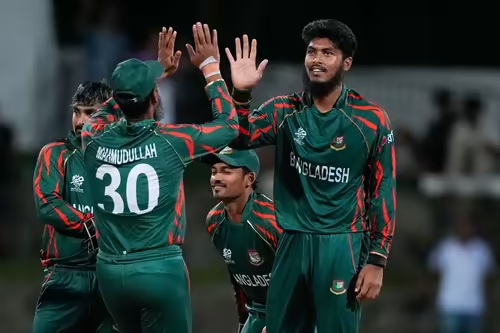
The International Cricket Council (ICC) is facing a major credibility crisis—and it’s not coming from fans or journalists, but from one of the game’s most respected voices. Former Australia fast bowler and ex-Pakistan head coach Jason Gillespie has publicly called out what he describes as glaring ICC double standards in its recent handling of international tournaments.
Gillespie’s outrage stems from the ICC’s decision to exclude Bangladesh from the 2026 Men’s T20 World Cup—a move that’s sent shockwaves through the cricketing world. But what truly ignited his fury was the stark contrast with how the ICC treated India’s participation in the upcoming 2025 ICC Champions Trophy. While Bangladesh was penalized, India was permitted to play its matches at a neutral venue due to security concerns over hosting in Pakistan. For Gillespie, this isn’t just inconsistent—it’s unjust.
Table of Contents
- The Bangladesh Ban: What Happened?
- Gillespie’s Scathing Critique: “Why Were India Allowed?”
- ICC Double Standards: A Pattern of Inconsistency?
- Reactions from the Cricketing World
- What This Means for Global Cricket Governance
- Conclusion: Fair Play or Favoritism?
- Sources
The Bangladesh Ban: What Happened?
In late 2025, the ICC announced that Bangladesh would not participate in the 2026 Men’s T20 World Cup. The official reason cited was the country’s failure to meet certain administrative and governance benchmarks set by the ICC—a consequence of prolonged internal disputes within the Bangladesh Cricket Board (BCB). While governance issues are serious, many observers argue that the punishment—complete exclusion from a global event—was disproportionate, especially when compared to how other nations have been treated.
Bangladesh, a Full Member of the ICC since 2000, has consistently fielded competitive teams in both ODIs and T20Is. Their absence from the 2026 tournament not only deprives fans of exciting cricket but also raises questions about the ICC’s enforcement philosophy. Is the goal reform—or exclusion?
Gillespie’s Scathing Critique: “Why Were India Allowed?”
Speaking in a recent interview, Jason Gillespie didn’t mince words. “Why were India allowed?” he asked pointedly, referencing the ICC’s decision to let India compete in the 2025 Champions Trophy despite refusing to travel to Pakistan—the designated host—due to political and security tensions .
Instead of disqualifying India, the ICC moved the entire tournament to a neutral venue (widely expected to be the UAE or South Africa). This accommodation ensured India’s participation while sidestepping diplomatic complications. For Gillespie, this sets a dangerous precedent: powerful cricketing nations receive flexibility, while smaller or less influential members face harsh penalties for non-playing-related infractions.
“If you’re going to apply rules,” Gillespie stated, “you have to apply them equally. Otherwise, you lose all credibility.” His comments resonate deeply in a sport where perceptions of bias can erode fan trust and player morale alike.
ICC Double Standards: A Pattern of Inconsistency?
This isn’t the first time the ICC has faced accusations of uneven treatment. Critics have long argued that the council’s decisions often reflect the commercial and political weight of its biggest members—primarily India, England, and Australia—rather than a consistent application of its own regulations.
Consider these examples:
- Neutral Venues vs. Bans: India plays at neutral venues for security reasons; Bangladesh gets banned for administrative delays.
- Scheduling Power: The Future Tours Programme (FTP) is frequently reshaped to accommodate India’s broadcast and logistical preferences, sometimes at the expense of smaller nations’ revenue opportunities.
- Decision-Making Transparency: Key ICC rulings—like tournament hosting rights or membership status—are often made behind closed doors with limited public justification.
These inconsistencies fuel the perception that the ICC operates on a two-tier system: one set of rules for the elite, another for everyone else.
Reactions from the Cricketing World
Gillespie’s remarks have sparked widespread debate. Former Bangladesh captain Mashrafe Mortaza expressed disappointment but stopped short of direct criticism, urging the BCB to “resolve internal issues swiftly.” Meanwhile, several current and former players from associate nations have voiced support for Gillespie on social media, calling for a more equitable global structure.
Even in India, some commentators have acknowledged the optics problem. As one noted analyst put it, “[INTERNAL_LINK:icc-governance-reform] isn’t just about fairness—it’s about the long-term health of the sport worldwide.”
What This Means for Global Cricket Governance
The controversy highlights a deeper structural issue: the ICC’s governance model remains heavily influenced by its top three revenue-generating boards. While reforms in 2014 aimed to democratize decision-making, financial realities have kept power concentrated.
For the game to grow beyond its traditional strongholds, the ICC must demonstrate impartiality—not just in words, but in actions. That means:
- Clear, transparent criteria for tournament eligibility.
- Consistent enforcement of rules across all member nations.
- Support mechanisms for boards facing governance challenges, rather than immediate punitive measures.
Without these changes, the credibility of global cricket’s governing body will continue to erode.
Conclusion: Fair Play or Favoritism?
Jason Gillespie’s intervention is more than just a complaint—it’s a wake-up call. The ICC double standards he highlights threaten the very spirit of fair competition that cricket claims to uphold. If the council allows geopolitical influence and commercial interests to dictate its decisions, it risks alienating fans, players, and entire cricketing nations.
The path forward is clear: consistency, transparency, and equity must become the pillars of ICC policy. Otherwise, the question won’t just be “Why were India allowed?”—it’ll be “Why should we trust the ICC at all?”