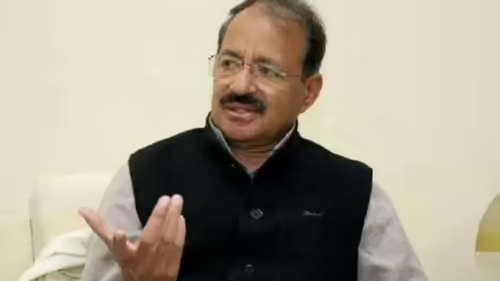
The Indian National Congress is facing yet another storm from within. Just days after former Union Minister Shakeel Ahmed launched a blistering attack on Rahul Gandhi following his resignation, senior party leader Rashid Alvi has stepped into the fray, warning of a critical and potentially fatal flaw at the heart of the grand old party: a severe communication gap.
Alvi’s intervention, coming on the heels of Ahmed’s explosive departure, has amplified fears of a widening rift and a leadership seemingly out of touch with its own rank and file. The question on everyone’s mind is no longer just about policy or elections, but about the very cohesion of the party itself. Where can they go, indeed?
Table of Contents
- Shakeel Ahmed’s Exit: The First Crack
- Rashid Alvi’s Warning: A Dangerous Communication Gap
- The Deepening Congress Crisis: An Analysis
- What Does This Mean for the Future of Congress?
- Conclusion: A Party at a Crossroads
- Sources
Shakeel Ahmed’s Exit: The First Crack
The current wave of internal dissent was triggered by the high-profile resignation of Dr. Shakeel Ahmed, a former Union Minister and a senior Congress figure from Bihar. In November 2025, Ahmed formally quit the party, citing long-standing differences with the local leadership in his home state . However, it was his subsequent public statements that truly sent shockwaves through the political establishment.
Ahmed didn’t just leave quietly; he went on the offensive, launching a scathing critique of Rahul Gandhi, labeling him as “darpok” (cowardly) and “insecure” . His core accusation was that the party’s central leadership, particularly Rahul Gandhi, was disconnected from the ground realities and the concerns of its own leaders, creating an environment of frustration and alienation. This public airing of grievances set a precedent, opening the floodgates for other disgruntled voices.
Rashid Alvi’s Warning: A Dangerous Communication Gap
Now, Rashid Alvi, another veteran Congress leader known for his forthright opinions, has echoed and amplified Ahmed’s concerns. In a recent statement, Alvi explicitly pointed to a “communication gap” within the party structure as a major source of its current woes . His remarks are significant because they move beyond personal grievances to diagnose a systemic failure.
Alvi’s central question—”Where can they go?”—is a poignant reflection of the loyalty many leaders still feel towards the party’s legacy, even as they are pushed away by its current functioning. He argues that the problem isn’t necessarily a lack of capable leaders, but a breakdown in the channels that should connect them to the decision-making core. This communication gap means that valuable feedback, ground-level intelligence, and strategic suggestions from experienced members are simply not reaching the top, or worse, are being ignored.
This isn’t an isolated incident. Reports throughout 2025 and early 2026 have chronicled a series of setbacks for the Congress, from poor electoral performances in key states like Bihar and Delhi to a general sense of strategic drift . The party appears to be grappling with what one analysis called a “crisis of structure,” where its institutional mechanisms have eroded over time .
The Deepening Congress Crisis: An Analysis
The combined effect of Ahmed’s resignation and Alvi’s warning paints a picture of a party in the throes of a profound identity and operational crisis. Several key factors are at play:
- Leadership Vacuum: With the Gandhi family often perceived as the sole center of gravity, the party struggles to project a collective leadership. The reported absence of both Rahul and Priyanka Gandhi abroad, coupled with Sonia Gandhi’s health issues, has left a visible void .
- Erosion of Internal Democracy: The communication gap highlighted by Alvi is a symptom of a larger disease: the decline of internal party democracy. Decisions appear to be made in a top-down manner, leaving little room for consultation or debate among senior leaders.
- Exodus of Experienced Leaders: The departure of seasoned figures like Shakeel Ahmed is not just a loss of individual talent but a signal to the wider cadre that their contributions are undervalued. This creates a cycle of disillusionment and further exits .
This internal turmoil is happening at a critical juncture, with important state elections on the horizon. A party consumed by its own internal conflicts is ill-equipped to mount a coherent challenge against its opponents.
What Does This Mean for the Future of Congress?
The path forward for the Indian National Congress is fraught with difficulty. Alvi’s call for “internal dialogue” is a necessary first step, but it will require more than just a few meetings. The party needs a fundamental reset. This could involve:
- Empowering Regional Leaders: Delegating real authority to state units and regional satraps to make decisions based on local contexts.
- Rebuilding Consultative Mechanisms: Reviving forums like the Congress Working Committee (CWC) as genuine platforms for debate and strategy formulation, not just rubber-stamp bodies.
- Transparent Communication Channels: Establishing formal and informal channels for leaders at all levels to provide feedback directly to the central leadership without fear of reprisal.
Without such structural reforms, the Congress crisis is likely to deepen. The party risks becoming a shell of its former self, unable to retain its veterans or attract new talent, ultimately ceding more ground in the national political landscape. For a party that once dominated Indian politics, this is a stark and sobering reality.
Conclusion: A Party at a Crossroads
The warnings from Rashid Alvi and the departure of Shakeel Ahmed are not mere political gossip; they are critical distress signals from within the Indian National Congress. The identified “communication gap” is a euphemism for a deeper organizational and leadership failure. The party stands at a historic crossroads. It can either heed these calls for genuine internal dialogue and reform, or it can continue on its current path of fragmentation and decline. The choice it makes in the coming months will determine its fate for years to come.