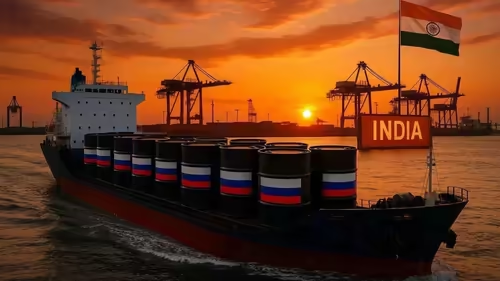
India’s Crude Oil Pivot: A Strategic Shift in a Volatile Market
In a world where energy security is paramount, India’s every move in the global oil market sends ripples across the geopolitical landscape. For the past two years, the nation has been a major buyer of discounted Russian crude, a lifeline for Moscow and a profit engine for Indian refiners. But now, a significant shift is underway. The latest data reveals a clear trend: India is reducing its reliance on Russian oil and turning its gaze back to its long-standing partners in the Middle East. This isn’t just a change in supplier; it’s a calculated strategic pivot driven by a complex mix of economics, geopolitics, and risk management.
Table of Contents
- The Changing Face of India’s Crude Oil Basket
- Why the Shift from Russia to the Middle East?
- The Ongoing Role of Russian Crude
- What Does This Mean for India’s Energy Future?
- Conclusion: A Delicate Balancing Act
- Sources
The Changing Face of India’s Crude Oil Basket
India’s India crude oil import portfolio, often referred to as its “crude basket,” has undergone a dramatic transformation since the Ukraine conflict began. While Russia surged to become the top supplier, accounting for nearly 40% of imports at its peak, that dominance is now waning . Recent months show a clear recalibration. India is actively increasing shipments from its traditional Middle Eastern allies like Iraq, Saudi Arabia, and the UAE, who have long been the bedrock of its energy security .
This diversification is a return to a more familiar structure. Historically, the Middle East has supplied 60–70% of India’s crude needs, a relationship built on decades of trust and logistical efficiency . The current move appears to be a strategic reversion to this stable foundation, ensuring a reliable and less politically fraught supply chain.
Why the Shift from Russia to the Middle East?
The primary catalyst for this strategic retreat from Russian oil is the looming threat of U.S. sanctions. The Trump administration’s aggressive stance, including the imposition of a 25% penalty on certain Indian exports, has created a significant compliance risk for Indian refiners . This pressure has already had a tangible effect, with only a few state-owned players like Indian Oil, Nayara, and BPCL continuing to lift Russian cargoes, while others have pulled back .
Beyond sanctions, other factors are at play:
- Logistical Complexity: Shipping Russian oil requires a complex web of tankers, insurance, and payment mechanisms to circumvent Western restrictions, adding cost and uncertainty.
- Refinery Economics: While Russian Urals crude offers deep discounts, its quality (a heavy sour grade) is not ideal for all Indian refineries. Middle Eastern crudes often provide a better technical fit, optimizing yields and margins without the associated political baggage .
- Long-Term Security: Relying heavily on a sanctioned nation is a risky long-term strategy. Diversifying back to the stable and predictable Middle East aligns with India’s broader goal of energy security .
The Ongoing Role of Russian Crude
Despite the strategic shift, it would be premature to write off Russian oil entirely. It remains a significant, albeit more selective, part of India’s energy mix. In November 2025 alone, imports from Russia were still a substantial 1.83 million barrels per day, even showing a month-on-month increase .
The economic logic is undeniable. The deep discounts on Russian crude continue to offer attractive refining margins, allowing Indian companies to produce fuels for both the domestic market and export. As one analyst noted, “Discounts set to draw India back to Russian crude next year,” suggesting the relationship is transactional and will ebb and flow with price and risk . The key takeaway is that India is becoming more selective, purchasing Russian oil when the price is right and the risk is manageable, but no longer treating it as a primary pillar of its supply.
What Does This Mean for India’s Energy Future?
This pivot highlights India’s sophisticated approach to navigating the treacherous waters of global energy politics. The nation is not making an emotional or purely political decision; it’s executing a pragmatic business strategy. By maintaining a flexible portfolio, India can leverage the best deals from both Russia and the Middle East while mitigating its exposure to any single source of risk.
This strategy also underscores a critical vulnerability: India imports a staggering 84% of its petroleum products, making it acutely sensitive to global price swings and supply disruptions . Therefore, the ultimate goal isn’t just to choose between Russia and the Middle East, but to build a resilient and diversified India crude oil import strategy that can withstand future shocks. This includes exploring new suppliers in Africa and Latin America, and, in the long term, accelerating its transition to renewable energy sources [INTERNAL_LINK:india-renewable-energy-transition].
Conclusion: A Delicate Balancing Act
India’s crude oil strategy is a masterclass in realpolitik. The nation is walking a tightrope, balancing its economic interests in securing cheap Russian oil against the diplomatic and financial risks posed by U.S. sanctions. The current trend of favoring the Middle East is a clear signal of risk aversion and a return to a more stable, traditional partnership. However, the door to Russian oil remains ajar, ready to be pushed open again if the discounts become too lucrative to ignore. For now, India’s energy future hinges on its ability to maintain this delicate balance, ensuring its economic engine keeps running without getting caught in the crossfire of great power competition.
Sources
- Times of India: India’s crude basket: More Middle East, less Russia
- Economic Times: Russia, Middle East account for over 80% of India’s crude
- Financial Express: Discounts set to draw India back to Russian crude next year
- Reuters: US signals possible rollback of 25% tariff on India
- Ministry of Petroleum & Natural Gas, India: Energy Statistics India 2025