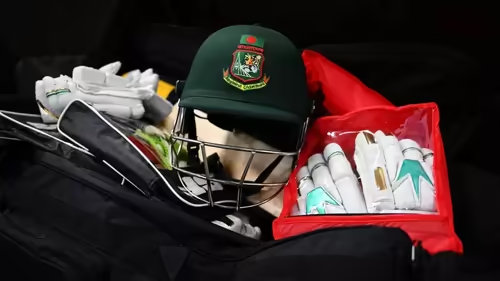
Cricket fans around the world are stunned. In an unprecedented move that blurs the line between sport and geopolitics, the Bangladesh Cricket Board (BCB) has formally pulled out of the upcoming ICC Men’s T20 World Cup in India. Their reason? A stark and unambiguous statement: “India is not safe for us.”
This isn’t just a scheduling conflict or a player boycott—it’s a full-scale withdrawal backed by government-level security concerns. And now, the International Cricket Council (ICC) has confirmed that Scotland will take Bangladesh’s place in the tournament, marking one of the most controversial substitutions in modern cricket history.
Table of Contents
- The BCB Decision Explained: Safety Over Sport
- ICC Response and Scotland’s Surprise Entry
- What Are the Alleged Safety Concerns?
- Impact on the T20 World Cup Format and Fair Play
- Long-Term Consequences for Bangladesh Cricket
- Conclusion: A Sport in the Shadow of Politics
- Sources
The BCB Decision Explained: Safety Over Sport
The BCB’s announcement didn’t come out of nowhere. According to official statements, the board had been in constant dialogue with the ICC, proposing alternative venues for their group-stage matches due to “security advice” received from the Government of Bangladesh .
Despite these repeated efforts, the ICC reportedly refused to relocate any matches, citing a lack of credible threats and the logistical complexity of last-minute changes. Faced with this impasse, the BCB made its final call: national safety trumps international competition. In their words, they have now “accepted the ICC’s decision” to replace them—but they stand firm on their core position.
This Bangladesh T20 World Cup pullout is more than a sporting absence; it’s a diplomatic signal wrapped in a cricket jersey.
ICC Response and Scotland’s Surprise Entry
The ICC moved swiftly to contain the fallout. In a brief but firm statement, the governing body confirmed that Scotland—the next highest-ranked team from the qualifying stage—would step into the main tournament. This gives the Scottish squad a second chance at glory, though under circumstances no one could have predicted.
For fans, this raises serious questions about fairness. Teams in Bangladesh’s original group had prepared specific strategies against Shakib Al Hasan, Litton Das, and Mustafizur Rahman. Now, they must pivot overnight to face a completely different playing style—a disruption that undermines the integrity of the competition.
What Are the Alleged Safety Concerns?
Neither the BCB nor the Bangladeshi government has publicly detailed the specific nature of the security threat. However, regional analysts point to recent diplomatic strains between India and Bangladesh, including trade disputes and political rhetoric, as potential context .
It’s worth noting that other international teams—including Australia, England, and South Africa—have toured India recently without incident. The ICC has also engaged independent security firms to assess all host cities, consistently reporting that conditions are safe for international visitors. Yet, sovereign nations retain the right to issue travel advisories based on their own intelligence assessments.
Impact on the T20 World Cup Format and Fair Play
The logistical ripple effects are massive:
- Schedule chaos: Broadcasters, ticket vendors, and local organizers must rework plans at short notice.
- Competitive imbalance: Scotland enters a group not calibrated for their ranking, potentially giving some teams an unintended advantage.
- Financial loss: The BCB may forfeit millions in ICC participation fees and sponsorship revenue.
More broadly, this incident challenges the very foundation of global sports: the assumption that participating nations can rely on mutual trust and standardized safety protocols. If every country begins making unilateral decisions based on internal advisories, the future of multi-nation tournaments could be in jeopardy.
Long-Term Consequences for Bangladesh Cricket
While the BCB prioritized its players’ safety, the cost to Bangladesh cricket could be steep. Beyond the immediate disappointment for fans and athletes, the nation risks being labeled “unreliable” by the ICC and other boards. Future tour invitations may come with hesitation—or additional financial guarantees.
Moreover, young Bangladeshi cricketers lose a critical opportunity to test themselves on the world stage. For a cricket-mad nation that has worked hard to establish itself as a competitive force, this self-imposed exile is a bitter pill to swallow.
For deeper insights into how this affects player development, see our feature on [INTERNAL_LINK:youth-cricket-in-south-asia].
Conclusion: A Sport in the Shadow of Politics
The Bangladesh T20 World Cup pullout is a sobering reminder that even the world’s second-most popular sport cannot escape real-world tensions. While the BCB acted on what it believes is its duty to protect its citizens, the decision casts a long shadow over the spirit of international cricket.
As Scotland steps onto the field in Bangladesh’s place, fans everywhere will be left wondering: when politics speaks, does the game ever get the final word?
Sources
- Times of India: ‘India is not safe for us’: BCB’s final word as they say ‘accept ICC’s decision’
- International Cricket Council (ICC): Official Website