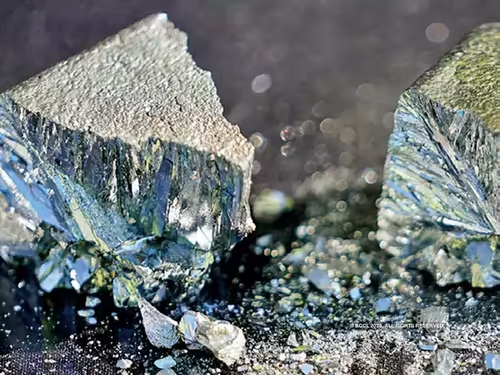
US Government Takes 10% Stake in USA Rare Earth: A Bold Move to Break China’s Monopoly
In a historic and strategically significant development, the U.S. federal government has announced a $1.6 billion investment in USA Rare Earth, acquiring a 10% equity stake in the company. This move—part of a broader national effort to secure domestic access to critical minerals—marks one of the most direct interventions by Washington into the rare earth supply chain in decades. The USA Rare Earth government stake isn’t just about ownership; it’s a declaration of economic and national security intent.
Table of Contents
- Why Rare Earths Matter
- The USA Rare Earth Deal: Full Breakdown
- Trump Administration’s Strategic Push
- China’s Dominance and U.S. Vulnerability
- What This Means for Investors and Industry
- Conclusion: A New Era for U.S. Mineral Independence?
- Sources
Why Rare Earths Matter
Rare earth elements (REEs)—a group of 17 chemically similar metals—are essential for modern technology. From electric vehicle motors and wind turbines to fighter jets and smartphones, these minerals are irreplaceable. Despite their name, they’re not actually rare in the Earth’s crust—but economically viable, environmentally responsible, and geopolitically secure sources are extremely scarce.
For years, the U.S. has been dangerously dependent on foreign suppliers, particularly China, which controls over 80% of global rare earth processing capacity . This dependency became a glaring national security risk during trade tensions and global supply chain disruptions.
The USA Rare Earth Deal: Full Breakdown
The newly announced $1.6 billion investment package includes both equity and warrants, with the U.S. government receiving a 10% ownership stake in USA Rare Earth. The deal was structured at a valuation aligned with the company’s recent trading levels, ensuring fair market terms .
Crucially, this public funding is being matched by $1 billion in private capital, demonstrating strong investor confidence in the project’s viability. The funds will directly support two key initiatives:
- The Round Top Mine in Texas: One of the largest known rare earth and lithium deposits in North America.
- A U.S.-based magnet manufacturing facility: Critical for producing finished components used in defense and clean energy tech.
This vertical integration—from raw ore to high-performance magnets—is designed to create a fully domestic supply chain, reducing reliance on overseas processing.
Trump Administration’s Strategic Push
While the investment was finalized under current leadership, its roots trace back to policies initiated during the Trump administration. In 2020, President Trump signed an executive order declaring a national emergency to expand domestic mining and processing of critical minerals . The Department of Defense also awarded USA Rare Earth an initial $30 million grant to accelerate magnet production—a precursor to today’s larger commitment.
This latest move can be seen as the culmination of that strategic vision: using public-private partnerships to rebuild American industrial capacity in sectors deemed vital to national security. It reflects a bipartisan consensus that the U.S. must reclaim leadership in critical mineral supply chains.
China’s Dominance and U.S. Vulnerability
China’s control over rare earths isn’t accidental—it’s the result of decades of state-backed investment, lax environmental regulations (historically), and strategic stockpiling. In 2010, Beijing temporarily restricted rare earth exports to Japan during a diplomatic dispute, sending shockwaves through global markets .
The U.S. once led the world in rare earth production—the Mountain Pass mine in California was the global leader until the 1990s. But due to rising costs and environmental concerns, operations dwindled, and the supply chain shifted overseas. Today, even when U.S. mines produce raw ore, it’s often shipped to China for processing—a glaring vulnerability this new investment aims to fix.
According to the U.S. Geological Survey, the nation imports over 80% of its rare earth compounds, with roughly 60% coming directly from China . The USA Rare Earth government stake is a direct response to this imbalance.
What This Means for Investors and Industry
For investors, the government’s backing signals strong long-term confidence in USA Rare Earth’s business model. The inclusion of warrants—options to buy more shares at a set price—also gives the U.S. potential upside if the company succeeds, aligning public and private interests.
For the broader industry, this sets a precedent. Other critical mineral projects may now seek similar public-private structures. It also pressures competitors to accelerate their own timelines. Companies like MP Materials (which operates Mountain Pass) are already expanding U.S. processing capabilities, but USA Rare Earth’s integrated mine-to-magnet approach could offer a more complete solution.
Moreover, this move supports U.S. climate goals. Electric vehicles and renewable energy infrastructure require massive amounts of rare earths—securing a domestic source is essential for the clean energy transition [INTERNAL_LINK:us-clean-energy-minerals-strategy].
Conclusion: A New Era for U.S. Mineral Independence?
The USA Rare Earth government stake represents far more than a financial transaction. It’s a strategic pivot toward self-reliance in a sector that underpins everything from national defense to green technology. While challenges remain—including permitting delays, environmental safeguards, and scaling production—the U.S. has taken a decisive step toward breaking China’s stranglehold on rare earths. If successful, this model could become the blueprint for securing other critical supply chains in the 21st century.
Sources
- [1] U.S. Geological Survey. (2025). Mineral Commodity Summaries: Rare Earths. https://www.usgs.gov/…
- [2] Times of India. (2026). Trump admin’s push for domestic rare earth production: US govt to get 10% stake in USA Rare Earth. https://timesofindia.indiatimes.com/…
- [3] The White House. (2020). Executive Order on Addressing the Threat to the Domestic Supply Chain From Reliance on Critical Minerals From Foreign Adversaries. https://trumpwhitehouse.archives.gov/…
- [4] BBC News. (2010). China ‘halts rare earth exports to Japan’. https://www.bbc.com/…
- [5] Congressional Research Service. (2024). Rare Earth Elements: The Global Supply Chain. https://crsreports.congress.gov/…