Table of Contents
- A Tragedy Born from a Simple Mistake
- The Horrifying Pattern of Abuse
- Understanding Child Abuse in India
- Why Did No One Intervene?
- Recognizing the Signs of Child Abuse
- What Can Be Done? Systemic Solutions
- Conclusion: Honor Vanshika by Acting
- Sources
A Tragedy Born from a Simple Mistake
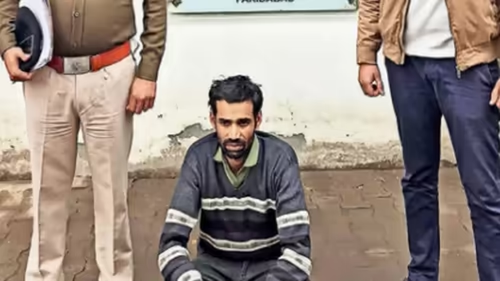
It’s almost unthinkable: a four-year-old girl, barely old enough to hold a pencil properly, beaten to death because she made an error in her math assignment. Yet that is the chilling reality in the case of Vanshika Jaiswal, a young child from Faridabad whose life was cut short by the very person meant to protect her—her father.
According to police reports and neighbor testimonies, Vanshika’s father, an employee at a private firm, flew into a rage over a perceived mistake in her homework. The beating that followed was so severe it resulted in her death. Even more heartbreaking? Neighbors revealed that Vanshika had learned to suppress her tears around him—she “stopped crying to survive” .
The Horrifying Pattern of Abuse
This wasn’t an isolated incident of lost temper. Investigators and locals confirm that Vanshika’s father regularly abused her, especially when under the influence of alcohol. The home, which should have been her safest space, was instead a site of terror.
Key details from the investigation include:
- The father would return home drunk and lash out at Vanshika over minor issues, including schoolwork.
- Neighbors heard frequent shouting and crying but assumed it was “discipline”—a dangerous normalization of violence.
- Vanshika had reportedly stopped crying in front of her father, a survival mechanism developed from repeated trauma.
- On the day of her death, the trigger was a simple math exercise—a task far beyond what any four-year-old should be held accountable for.
This pattern reflects a broader crisis: the blurring of discipline and brutality in many households, often excused as “strict parenting.”
Understanding Child Abuse in India
Vanshika’s case is not an anomaly—it’s a symptom of a deep-rooted problem. According to a 2023 report by the National Crime Records Bureau (NCRB), over 175,000 cases of crimes against children were reported in India, with physical abuse constituting a significant portion .
Yet these numbers likely represent only a fraction of actual incidents. Many cases go unreported due to fear, stigma, or lack of awareness. Cultural norms often discourage “interfering” in family matters, even when a child’s life is at risk.
The World Health Organization defines child abuse as “all forms of physical and emotional ill-treatment, sexual abuse, neglect, and exploitation” that results in actual or potential harm to a child’s health, dignity, or development . By this definition, Vanshika’s daily reality was one of sustained abuse.
[INTERNAL_LINK:signs-of-child-abuse-in-india] explores how teachers, neighbors, and relatives can spot red flags before it’s too late.
Why Did No One Intervene?
Perhaps the most haunting question is: why didn’t anyone step in?
Neighbors admitted they heard disturbances but dismissed them as “normal scolding.” This reflects a dangerous societal mindset—that parental authority is absolute, and questioning it is taboo. In many communities, raising concerns about another family’s parenting is seen as disrespectful or intrusive.
But silence enables violence. As child rights advocate Anjali Gopalan notes, “When we normalize yelling, hitting, or ‘tough love,’ we create environments where extreme abuse can flourish unnoticed” .
India does have legal safeguards—the Protection of Children from Sexual Offences (POCSO) Act and the Juvenile Justice Act—but enforcement remains inconsistent, especially in cases of non-sexual physical abuse within families.
Recognizing the Signs of Child Abuse
Vanshika’s story underscores the urgent need for public education on identifying abuse. Warning signs may include:
- Behavioral changes: Sudden withdrawal, fear of going home, or regressive behaviors like bedwetting.
- Unexplained injuries: Bruises, burns, or fractures with inconsistent explanations.
- Emotional suppression: A child who stops crying, flinches at sudden movements, or appears overly compliant.
- School performance decline: Difficulty concentrating, absenteeism, or anxiety about homework.
If you suspect abuse, you are legally and morally obligated to report it. In India, you can call the national child helpline at **1098**—a free, 24/7 service run by CHILDLINE India Foundation .
What Can Be Done? Systemic Solutions
Beyond individual vigilance, systemic change is critical:
- Mandatory reporting laws: Require teachers, doctors, and community leaders to report suspected abuse.
- Parenting education programs: Promote non-violent discipline methods through schools and anganwadis.
- Community watch networks: Empower neighborhoods to safely monitor and support at-risk families.
- Stronger police training: Ensure law enforcement treats domestic child abuse as a serious crime, not a “family issue.”
Countries like Sweden, which banned all forms of corporal punishment in 1979, have seen dramatic declines in child abuse rates—proof that cultural change is possible .
Conclusion: Honor Vanshika by Acting
Vanshika Jaiswal’s name should not fade into another tragic headline. Her story must ignite action—not just grief. Every adult has a role to play in protecting children. If you hear a child being hurt, speak up. If you see signs of distress, reach out. And if you’re struggling as a parent, seek help—never take it out on a child.
Let Vanshika’s silenced cry become a national wake-up call against child abuse.
Sources
- Times of India: Four-year-old girl beaten to death over maths lesson was thrashed regularly by father
- National Crime Records Bureau (NCRB): Crime in India 2023 Report
- World Health Organization (WHO): Child Maltreatment Fact Sheet
- CHILDLINE India Foundation: National Child Helpline – 1098