Table of Contents
- An Epic of Love and Endurance
- The 600km Rickshaw Journey: A Timeline
- Why He Refused Help—and What It Reveals
- The State of Rural Healthcare in India
- Public Response and Social Impact
- Conclusion: More Than a Love Story
- Sources
An Epic of Love and Endurance
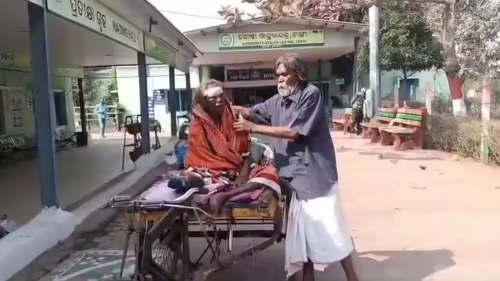
In a world often dominated by headlines of conflict and despair, a quiet yet powerful story has emerged from Odisha that restores faith in human devotion. A 70-year-old man, whose name has become synonymous with unwavering love, recently completed a staggering 600-kilometer round-trip—pedaling his wife in a rickshaw van to a hospital and back home.
This wasn’t a symbolic gesture or a short commute. It was a grueling, days-long physical ordeal driven by one simple motive: to get his ailing wife the medical care she desperately needed. With no money for transport, no access to ambulances, and limited public infrastructure, he did what many would consider impossible—he turned his humble cycle rickshaw into a lifeline.
The 600km Rickshaw Journey: A Timeline
The journey began when his wife fell seriously ill in their remote village in Odisha. Local clinics couldn’t provide adequate treatment, so they needed to reach a larger hospital—approximately 300 kilometers away. Unable to afford a bus ticket or private vehicle, the elderly man made a decision that would soon capture national attention.
Here’s how the journey unfolded:
- Day 1–5 (Outbound Trip): He loaded his wife onto the rickshaw van—a modified cycle rickshaw with a covered cabin—and began pedaling toward the nearest major hospital. Traveling only during daylight hours and resting at night, he covered roughly 60–70 km per day.
- Hospital Stay: After arriving, his wife received critical treatment. Throughout her stay, he slept on the hospital floor, surviving on minimal food and water.
- Return Journey: Once she was stable enough to travel, he began the 300-km return trip—again, entirely under his own pedal power.
What makes this feat even more remarkable is that he reportedly refused offers of help from locals, NGOs, and even government officials who learned of his plight mid-journey. “I can do it myself,” he is said to have told well-wishers .
Why He Refused Help—and What It Reveals
At first glance, his refusal of assistance might seem puzzling. But experts in rural sociology suggest it reflects a deep-seated sense of dignity, self-reliance, and perhaps even shame associated with asking for charity—a common trait among India’s rural poor.
As Dr. Anjali Sharma, a public health researcher at the Tata Institute of Social Sciences, explains: “Many elderly individuals in villages view dependence on others as a loss of autonomy. For this man, taking care of his wife wasn’t just a duty—it was his identity” .
This mindset, while admirable, also underscores a systemic failure: why should a 70-year-old man have to choose between pride and practicality when seeking life-saving care for his spouse?
The State of Rural Healthcare in India
This rickshaw journey is not just a personal triumph—it’s a stark indictment of India’s rural healthcare infrastructure. Despite progress in recent decades, millions in remote areas still lack access to basic medical services.
Consider these facts from the National Health Profile 2023 :
- Only 38% of sub-centers in rural India meet the Indian Public Health Standards for staffing and equipment.
- Ambulance services under the National Health Mission cover less than half of all villages in states like Odisha and Jharkhand.
- The doctor-to-patient ratio in rural areas is 1:11,000—far below the WHO-recommended 1:1,000.
In such a landscape, stories like this man’s are not anomalies—they are symptoms of a broken system. Families are forced to become their own first responders, often risking their health, safety, and livelihoods just to reach a clinic.
[INTERNAL_LINK:rural-healthcare-challenges-in-india] explores how policy gaps continue to affect millions despite government initiatives like Ayushman Bharat.
Public Response and Social Impact
Since news of his journey went viral, social media has erupted with admiration. Hashtags like #RickshawOfLove and #OdishaHero trended across platforms, with celebrities and politicians praising his devotion.
However, many activists have used the moment to call for structural change rather than just emotional applause. “We shouldn’t celebrate suffering as heroism,” tweeted Dr. Rekha Nair, a public health advocate. “We should fix the system that made this journey necessary.”
Local authorities in Odisha have since announced plans to review ambulance accessibility in the region, though critics argue such measures often come too late and lack follow-through.
Conclusion: More Than a Love Story
Yes, this is a beautiful story of marital devotion. But it’s also a wake-up call. The 600km rickshaw journey of a 70-year-old man should not be remembered only for its romance—but for what it reveals about inequality, neglect, and the urgent need for equitable healthcare access in rural India.
His pedals didn’t just move a rickshaw—they moved a nation to reflect. Now, the real test is whether that reflection leads to action.
Sources
- Times of India: Elderly man pedals 600km in rickshaw van for ailing wife’s treatment
- Tata Institute of Social Sciences (TISS): Public Health Research Division
- National Health Profile 2023 – Ministry of Health & Family Welfare, Government of India: National Health Profile 2023