Table of Contents
- The Illusion in the Sky
- Why the Moon Changes Shape: The Orbital Truth
- The Eight Main Moon Phases
- A Simple Experiment You Can Try at Home
- Common Misconceptions About the Moon
- Why Understanding Moon Phases Matters
- Conclusion
- Sources
Have you ever looked up at the night sky and wondered, why the moon changes shape? One night it’s a bright, full circle. A week later, it’s just a sliver. It’s a mystery that has captivated humans for millennia. But the answer isn’t magic—it’s pure, beautiful science.
The truth is, the moon itself never changes shape. It’s always a sphere, just like Earth. What changes is how much of its sunlit side we can see from our planet. This simple concept is the key to unlocking the entire lunar cycle.
The Illusion in the Sky
The moon is a master of illusion. As it orbits our planet, the angle between the Earth, the moon, and the sun constantly shifts. Because the sun is our only source of light for the moon, this changing angle determines which part of the moon’s surface is illuminated and visible to us .
Think of it like this: imagine you’re sitting in a dark room with a friend holding a basketball. If you shine a flashlight (the sun) on the ball from one side, your friend will see a fully lit ball. But if they walk around you in a circle, the amount of the lit side they can see will change—from a full circle to a half-circle, to a thin crescent, and back again. That’s exactly what’s happening in space .
Why the Moon Changes Shape: The Orbital Truth
The core reason behind the moon’s changing appearance is its 27.3-day orbit around the Earth. During this journey, the moon is always half-lit by the sun—the side facing the sun is in “daytime,” while the other side is in “nighttime” . We on Earth, however, get a front-row seat to different slices of that sunlit half.
This cycle, from one New Moon to the next, actually takes about 29.5 days. This period is called a synodic month, and it’s the basis for many of our calendar months. The slight difference between the orbital period and the cycle of phases is due to the Earth’s own movement around the sun during the moon’s orbit .
The Eight Main Moon Phases
The lunar cycle is typically broken down into eight distinct phases. Here’s a quick guide:
- New Moon: The moon is between the Earth and the sun. The side facing us is dark, so we can’t see it.
- Waxing Crescent: A small, sliver of the right side becomes visible as the moon moves in its orbit.
- First Quarter: Half of the moon’s face is illuminated (the right half in the Northern Hemisphere).
- Waxing Gibbous: More than half is lit, growing toward a full moon.
- Full Moon: The Earth is between the sun and the moon. The entire face is illuminated and visible.
- Waning Gibbous: The illuminated portion begins to shrink, starting from the right edge.
- Last Quarter: The left half of the moon is illuminated (in the Northern Hemisphere).
- Waning Crescent: A final thin crescent appears before the cycle returns to New Moon.
A Simple Experiment You Can Try at Home
You don’t need a telescope to understand this! All you need is a lamp (to represent the sun), a small ball (the moon), and your head (the Earth). Stand in a dark room, hold the ball out in front of you, and have a friend turn on the lamp across the room. As you slowly turn your body in a circle, keep the ball in front of you. You’ll see the ball go through all the phases of the moon right before your eyes . This hands-on activity is a fantastic way to solidify the concept, especially for kids.
Common Misconceptions About the Moon
There are a few persistent myths about the moon’s phases that are worth clearing up:
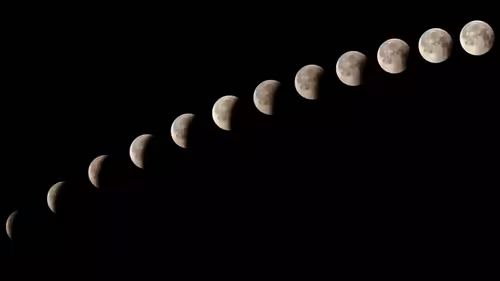
- Myth: The Earth’s shadow causes the phases. This is false. The Earth’s shadow falling on the moon is what causes a lunar eclipse, which is a rare event, not the monthly phases .
- Myth: The moon produces its own light. The moon is not a light source. It simply reflects sunlight, which is why its brightness varies with its phase.
- Myth: The same side of the moon is always dark. This is known as the “dark side of the moon,” but it’s a misnomer. The far side of the moon gets just as much sunlight as the near side; we just never see it from Earth because the moon is tidally locked to our planet.
Why Understanding Moon Phases Matters
Beyond satisfying curiosity, understanding the lunar cycle has practical applications. For centuries, farmers have used moon phases to plan planting and harvesting. Fishermen track tides, which are heavily influenced by the moon’s gravitational pull—especially during the Full and New Moons when tides are at their highest (spring tides). Even today, many cultural and religious calendars, such as the Islamic and Chinese calendars, are based on the lunar cycle .
Conclusion
So, the next time you gaze up at a crescent or a full moon, you’ll know the secret. The moon isn’t changing shape at all. It’s a cosmic dance of light and shadow, a predictable and elegant ballet between the Earth, the moon, and the sun. The question of why the moon changes shape is a perfect example of how a little scientific knowledge can transform a simple observation into a profound appreciation for our place in the universe.
Sources
[INTERNAL_LINK:astronomy-for-beginners]
[EXTERNAL_LINK:https://www.nasa.gov/]
National Geographic, “The phases of the moon”
BBC Bitesize, “Phases of the Moon”
Times of India, “Why the moon changes shape: Surprising science of moon phases”