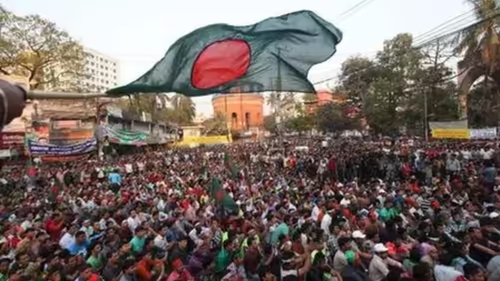
Bangladesh is on the cusp of a quiet but profound political transformation. As the nation gears up for its next general election, a striking development has emerged from the candidate lists: a record-breaking 80 individuals from religious and ethnic minority backgrounds are running for office. This isn’t just a number—it’s a powerful statement about the evolving face of Bangladeshi democracy.
What makes this wave even more remarkable is its composition. While the ruling Awami League—the party that has dominated Bangladesh’s political landscape for over a decade—has not fielded any minority candidates in this cycle, the opposition has stepped into the void with surprising vigor. A coalition of 22 parties, including the Bangladesh Nationalist Party (BNP) and the controversial Jamaat-e-Islami, has collectively nominated 68 minority candidates. Add to that 12 independent contenders, and you have a diverse field that could reshape parliamentary discourse .
Table of Contents
- The Numbers Behind the Movement
- Awami League’s Absence: A Strategic Omission?
- Jamaat-e-Islami’s Historic First
- Who Are Bangladesh’s Minority Communities?
- Why This Election Could Be a Turning Point
- Conclusion: A New Chapter for Inclusive Democracy?
- Sources
The Numbers Behind the Movement
The figure of 80 Bangladesh election minority candidates is more than symbolic. It represents a significant increase from previous electoral cycles and reflects growing political mobilization within minority groups. These candidates hail from communities such as Hindus, Buddhists, Christians, and various indigenous ethnic groups like the Chakma, Marma, and Garo, who together make up roughly 10% of the country’s population .
Of the 80, 68 are backed by registered political parties, while 12 are running as independents—a sign of both organized support and grassroots ambition. This dual-track approach suggests that minority political engagement is no longer confined to party lines but is also emerging as a citizen-led movement.
Awami League’s Absence: A Strategic Omission?
Perhaps the most puzzling aspect of this development is the complete absence of minority candidates from the ruling Awami League’s roster. Given the party’s long-standing public commitment to secularism and minority rights, this omission is conspicuous. Analysts speculate it could be a result of internal party dynamics, strategic seat allocation, or even a miscalculation of minority voter influence in key constituencies.
This vacuum has been eagerly filled by the opposition, particularly the BNP, which has a history of courting minority votes. The BNP’s active nomination of minority candidates may be an attempt to rebuild its base and position itself as a more inclusive alternative to the current government.
Jamaat-e-Islami’s Historic First
One of the most headline-grabbing elements of this election is Jamaat-e-Islami’s decision to nominate its first-ever minority candidate. This is a seismic shift for a party historically associated with Islamist ideology and accused of war crimes during Bangladesh’s 1971 liberation war. The move is widely seen as a strategic rebranding effort aimed at softening its image and broadening its appeal beyond its traditional voter base .
Whether this gesture is genuine or purely tactical remains to be seen. But its symbolic weight is undeniable. It signals that even the most ideologically rigid parties recognize the growing political capital in representing Bangladesh’s diverse population.
Who Are Bangladesh’s Minority Communities?
To understand the significance of this moment, it’s essential to know who these communities are:
- Hindus: The largest religious minority, comprising about 8% of the population, concentrated in districts like Khulna and Barisal.
- Buddhists: Primarily from the Chittagong Hill Tracts, including ethnic groups like the Chakma and Marma.
- Christians: A small but influential community, with a presence in urban centers and among certain tribal groups.
- Indigenous Peoples: Over 50 distinct ethnic groups, many of whom have long advocated for land rights and cultural autonomy.
These communities have often faced challenges ranging from land grabbing to social discrimination. Their increased political participation is a direct response to decades of marginalization.
Why This Election Could Be a Turning Point
If even a fraction of these 80 candidates win seats, it could lead to several transformative outcomes:
- Amplified Voices: Minority MPs can directly advocate for community-specific legislation on issues like hate crimes, property rights, and cultural preservation.
- Policy Shifts: A more diverse parliament could push for reforms in education, law enforcement, and local governance to be more inclusive.
- Social Cohesion: Visible minority representation can foster a stronger sense of national belonging and reduce communal tensions.
This election is not just about who wins power—it’s about who gets a seat at the table.
Conclusion: A New Chapter for Inclusive Democracy?
The surge of Bangladesh election minority candidates is a hopeful sign for the future of South Asian democracy. It demonstrates that marginalized communities are no longer waiting to be represented—they are stepping forward to represent themselves. While the road to true political parity is long, this election marks a critical milestone. The world will be watching to see if Bangladesh’s parliament finally begins to reflect the rich tapestry of its people.
Sources
[INTERNAL_LINK:south-asia-politics]
[INTERNAL_LINK:minority-rights-bangladesh]
U.S. Department of State – Bangladesh
The Times of India [[1], [3]]
Minority Rights Group International