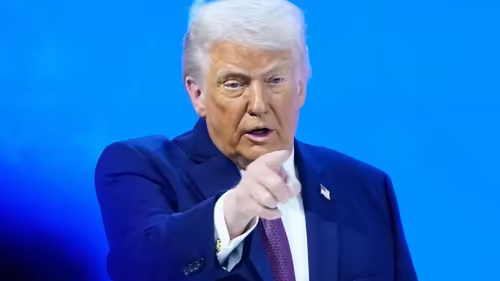
It’s a classic Trumpian maneuver: a controversial statement that ignites an international firestorm, followed by a seemingly conciliatory remark that only deepens the confusion. This week, the former U.S. President found himself at the center of a transatlantic diplomatic row over his views on NATO and the sacrifices of allied troops in Afghanistan.
The saga began with Trump’s now-familiar skepticism about the NATO alliance, where he reportedly claimed that European troops, including the British, were not on the front lines—a statement that was met with immediate and fierce condemnation from London. In response, newly minted UK Prime Minister Keir Starmer didn’t mince words, labeling the comments “insulting and appalling” and paying solemn tribute to the 457 British service members who made the ultimate sacrifice in Afghanistan .
Just 24 hours later, Trump appeared to backtrack, or at least pivot, praising the very same British forces he’d implicitly disparaged. He called them “among the greatest of all warriors,” a stark contrast to his previous narrative . This sudden reversal has left analysts and allies alike questioning the consistency and sincerity of his foreign policy stance.
Table of Contents
- The Original Offense: Trump’s NATO Comments
- Starmer Strikes Back: A Prime Minister’s Rebuke
- Damage Control or Duplicitous? Trump’s Praise for UK Soldiers
- The Human Cost Behind the Politics
- What This Means for the Future of NATO
- Conclusion: A Test of Alliance and Respect
- Sources
The Original Offense: Trump NATO Comments
Donald Trump’s long-standing ambivalence toward the North Atlantic Treaty Organization (NATO) is well-documented. His presidency was marked by repeated demands for member nations to increase their defense spending, often framing the alliance as a bad deal for the United States. However, his latest remarks crossed a new line by directly questioning the combat role and bravery of allied soldiers.
By suggesting that European forces were not on the front lines in Afghanistan, Trump not only distorted historical fact but also dishonored the memory of thousands of non-American troops who fought and died alongside their U.S. counterparts. This specific claim ignored the intense and deadly campaigns waged by British, Canadian, Dutch, and other allied forces in some of Afghanistan’s most dangerous provinces, like Helmand.
Starmer Strikes Back: A Prime Minister’s Rebuke
UK Prime Minister Keir Starmer, known for his measured and legalistic approach, delivered a rare and powerful public rebuke. He called Trump’s comments “deeply hurtful” and a direct insult to the families of the fallen . His statement was more than just political posturing; it was a defense of national honor and a recognition of a shared, painful history.
Starmer’s tribute to the 457 British personnel who lost their lives in the 20-year conflict served as a potent reminder of the tangible cost of the war. He framed their sacrifice not as a point of contention, but as a solemn fact that should command respect from all, especially from a former leader of their closest ally .
Damage Control or Duplicitous? Trump’s Praise for UK Soldiers
Facing a significant backlash, Trump’s subsequent praise for British soldiers as “among the greatest of all warriors” felt less like a genuine change of heart and more like a strategic retreat . The timing was too convenient, the language too generic to erase the sting of his initial remarks.
Critics argue this is a familiar pattern: make a provocative statement to rally a base, then offer a vague platitude to soften the blow when the criticism becomes too loud. This leaves allies in a difficult position—do they accept the olive branch, knowing it may be withdrawn at any moment, or do they hold firm on the principle of mutual respect?
The Human Cost Behind the Politics
Beyond the political sparring, it’s crucial to remember the human dimension of this story. The number 457 isn’t just a statistic; it represents fathers, mothers, sons, and daughters whose lives were cut short in a complex and distant war. Their families have already borne an unimaginable burden. To have their loved ones’ courage and contribution questioned for political gain is a second, deeply personal wound.
This episode underscores a dangerous trend where the sacrifices of military personnel become pawns in a larger geopolitical game. It’s a reminder that words from leaders have real-world consequences and can inflict deep pain on those who have already given so much.
What This Means for the Future of NATO
This incident is a stark preview of the challenges NATO could face if Trump were to return to the White House. His transactional view of alliances, where loyalty is measured in financial contributions rather than shared values and blood spilled together, fundamentally undermines the spirit of Article 5—the collective defense clause that is the bedrock of the alliance.
European leaders are watching these developments closely. The trust that is essential for effective military and intelligence cooperation is fragile. Repeated episodes of public doubt and criticism from a potential future U.S. President could accelerate Europe’s push for greater strategic autonomy, a move that would reshape the global security landscape.
Conclusion: A Test of Alliance and Respect
The clash between Trump’s Trump NATO comments and Starmer’s dignified defense of his nation’s fallen heroes is about more than just a diplomatic spat. It’s a fundamental test of what an alliance truly means. Is it a partnership of mutual respect, forged in shared sacrifice, or is it merely a ledger of debits and credits? For the families of the 457, and for the future of Western security, the answer must be the former. The world will be watching to see if that principle can withstand the next political storm.
Sources
[INTERNAL_LINK:us-foreign-policy]
[INTERNAL_LINK:nato-alliance-explained]
UK Government – World News
The Times of India [[1], [2], [3]]