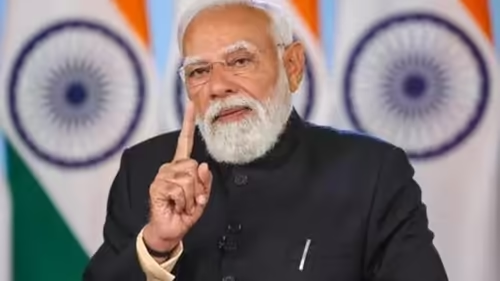
Imagine walking into a government office, lost in a maze of paperwork, facing indifferent stares, and leaving hours later with nothing but a headache. For millions of Indians, this has been a frustrating reality. Now, Prime Minister Narendra Modi has handed a powerful weapon to a new army of over 61,000 recruits to dismantle that very system from within.
At the 18th Rozgar Mela, PM Modi didn’t just hand out appointment letters; he issued a philosophical and operational directive that could redefine the relationship between the Indian citizen and the state. His message was clear: remember your own struggles, and ensure no one else has to endure them. This isn’t just about policy; it’s about empathy as a core administrative principle .
Table of Contents
- The Mandate From Memory: Turning Frustration into Fuel
- Nagrik Devo Bhava: The Philosophy Behind the Reform
- From Ease of Doing Business to Ease of Living
- The 61,000-Strong Army of Change
- What This Means for You, the Citizen
- Conclusion: A New Chapter for Indian Governance
- Sources
The Mandate From Memory: Turning Frustration into Fuel
PM Modi’s instruction to the new recruits was deeply personal. He asked them to tap into their own recent experiences as ordinary citizens navigating the complexities of government offices. That memory of long queues, confusing procedures, and unhelpful staff is now their most valuable asset. Their job is to use that memory as a checklist of what not to do.
This approach is a masterstroke in human-centered design for public services. Instead of imposing top-down rules, the Prime Minister is leveraging the lived experience of a new generation of officials who are only a few steps removed from the very people they now serve. It’s a call to build a government that is not just efficient, but also kind and understanding.
Nagrik Devo Bhava: The Philosophy Behind the Reform
At the heart of this directive is the ancient Sanskrit phrase, “Nagrik Devo Bhava“—”Citizen is akin to God.” This isn’t just a slogan; it’s a radical reorientation of power dynamics within the bureaucracy. For too long, the citizen has been at the mercy of the official. PM Modi is flipping that script, placing the citizen on a pedestal and demanding that every interaction be treated with reverence and respect .
This philosophy is already visible in other government initiatives. From the sweeping GST 2.0 reforms, which were described as a “festival of savings” for the common man, to the Jan Vishwas initiative aimed at decriminalizing minor business compliance issues, the “Nagrik Devo Bhava” ethos is becoming the guiding light for policy-making [[23], [24]].
From Ease of Doing Business to Ease of Living
India’s journey on the global Ease of Doing Business rankings was a significant milestone. But PM Modi’s vision has evolved beyond that. The new frontier is “ease of living,” a holistic concept that touches every aspect of a citizen’s daily life—from securing a house under PMAY to accessing healthcare, from seamless digital payments to clean streets under Swachh Bharat [[22], [25]].
The 61,000 new recruits are the frontline soldiers in this mission. Their success won’t be measured just by files processed, but by the quality of life they help improve for the people they serve. This shift from transactional efficiency to transformational impact is what sets this reform apart.
The 61,000-Strong Army of Change
The scale of this recruitment drive is staggering. At the 18th Rozgar Mela, PM Modi virtually distributed appointment letters to these new employees, marking a significant push in the government’s employment generation strategy [[1], [5]]. Notably, a majority of these new recruits are women, signaling a move towards a more diverse and representative civil service .
These individuals are joining a system that is itself undergoing massive transformation. They are not just filling vacancies; they are being onboarded into a dynamic, reform-oriented ecosystem that includes modernized infrastructure, digital public goods, and a streamlined regulatory framework .
What This Means for You, the Citizen
For the average Indian, this mandate should translate into tangible, on-the-ground improvements:
- Faster Service Delivery: Expect shorter wait times and quicker resolution of your requests.
- Empathetic Interactions: Officials trained to see you as a person, not a file number.
- Simplified Processes: A continued push to eliminate redundant paperwork and complex procedures.
- Greater Accountability: A system where the citizen’s satisfaction is a key performance indicator.
This is the promise of a government that is not just of the people and for the people, but one that actively remembers what it was like to be a person standing in its own line.
Conclusion: A New Chapter for Indian Governance
PM Modi’s message to the 61,000 new recruits is more than a welcome speech; it’s a foundational document for the next generation of Indian governance. By anchoring his PM Modi government reforms in the powerful combination of personal memory and the sacred principle of “Nagrik Devo Bhava,” he has set a high bar for public service. The success of this mission will be the ultimate test of whether a vast bureaucracy can truly become an instrument of empathy and empowerment. The eyes of a billion citizens are watching.
Sources
[INTERNAL_LINK:india-politics]
[INTERNAL_LINK:ease-of-living-initiatives]
Prime Minister’s Office, India
The Times of India