Table of Contents
- An Epic Journey of Love and Resilience
- Who Is Babu Lohar? The Man Behind the Pedals
- 70-Year-Old Cycles 600km with Wife: The Full Story
- Why He Refused Help—and What It Reveals
- The Healthcare Crisis in Rural India
- Public Response and Government Silence
- What This Story Tells Us About Dignity and Devotion
- Conclusion: A Call for Systemic Change
- Sources
An Epic Journey of Love and Resilience
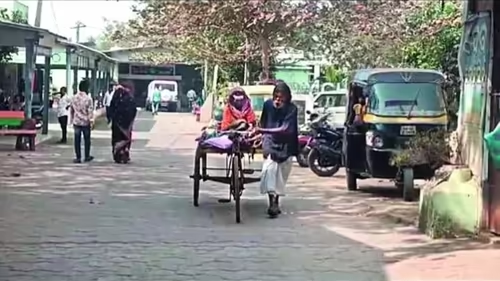
Imagine pedaling a heavy, three-wheeled rickshaw van—not for a few kilometers, but for 300 kilometers—through scorching heat, monsoon mud, and bone-chilling winter winds. Now imagine doing it at the age of 70, with your ailing wife lying in the back, too weak to walk. That’s not fiction. That’s the real-life odyssey of Babu Lohar from Odisha.
His journey didn’t end in Cuttack. After two months of her treatment, he’s now making the grueling 300km return trip—alone, exhausted, but unwavering. This isn’t just a story of endurance; it’s a searing indictment of a system that forces the poorest to choose between dignity and survival.
Who Is Babu Lohar? The Man Behind the Pedals
Babu Lohar, a resident of a remote village in Odisha’s Kendujhar district, has spent his life as a daily wage laborer and part-time rickshaw puller. With no savings, no vehicle, and no family support, he and his wife have lived on the margins of society for decades.
When his wife fell seriously ill with chronic respiratory issues, local clinics offered little help. Doctors advised immediate consultation at a specialized hospital in Cuttack—over 300km away. With no money for train tickets or ambulance services, and too proud to beg, Babu made a decision that would leave the nation stunned: he would pedal her there himself.
70-Year-Old Cycles 600km with Wife: The Full Story
In early November 2025, Babu loaded his wife onto his modified rickshaw van—a small, covered cart usually used for transporting goods—and began the long haul toward Cuttack. He carried only a few blankets, dry rations, and a plastic bottle of water.
The journey took over 10 days. He cycled during daylight, rested under bridges at night, and survived on kindness from strangers who offered food or water. Upon reaching SCB Medical College in Cuttack, his wife was admitted for treatment. For two months, Babu stayed by her side, sleeping on the hospital floor and surviving on temple meals.
Now, as she recovers enough to travel, he’s begun the return journey—again, on his rickshaw, again, refusing offers of transport. “I brought her here on my own strength,” he told reporters. “I will take her back the same way.”
Why He Refused Help—and What It Reveals
Multiple NGOs and local officials offered Babu bus tickets or ambulance rides—for both the onward and return journeys. He declined every time. Why?
“He said he didn’t want to be a burden,” shared a local journalist who tracked his journey. “He believes this is his duty as a husband.”
But beneath this noble sentiment lies a deeper truth: generations of neglect have taught India’s rural poor that institutional help is often temporary, conditional, or humiliating. Babu’s refusal isn’t just pride—it’s a quiet protest against a system that failed him long before his wife got sick.
The Healthcare Crisis in Rural India
Babu’s story is extreme—but not unique. According to the National Health Profile 2023, over 70% of India’s rural population lives more than 5km from a functional public health facility with specialist doctors . In states like Odisha, Jharkhand, and Bihar, the doctor-to-patient ratio is as low as 1:15,000.
Key systemic failures include:
- Lack of emergency transport: Many districts still lack 108 or 102 ambulance coverage in remote blocks.
- Underfunded PHCs: Primary Health Centers often lack basic diagnostics, forcing patients to travel to cities.
- Financial barriers: Even with Ayushman Bharat, out-of-pocket expenses for transport and informal care remain crippling for the poor.
Babu’s rickshaw wasn’t just a vehicle—it was the only option left.
Public Response and Government Silence
Since the story went viral, social media has erupted with admiration—and outrage. Donations have poured in, and a crowdfunding campaign has raised over ₹5 lakh for the couple’s medical and living expenses .
Yet, notably absent is any official statement from the Odisha Health Department or the Ministry of Health. No policy review. No promise of better rural transport. Just silence.
This gap between public empathy and institutional action is perhaps the most tragic part of Babu’s saga.
What This Story Tells Us About Dignity and Devotion
At its core, this is a love story. In a world obsessed with grand gestures, Babu Lohar’s quiet, relentless devotion—measured in pedal strokes and sleepless nights—redefines what commitment looks like.
But it’s also a mirror. It forces us to ask: Why must love be so hard? Why must care require superhuman effort? And how many more Babus are cycling in silence across India’s forgotten roads?
Conclusion: A Call for Systemic Change
The image of a 70-year-old man cycling 600km with his sick wife is haunting—and heroic. But heroism shouldn’t be necessary for basic healthcare. Babu Lohar’s journey must not be remembered just as a viral tale of grit. It must become a catalyst for reform: better rural ambulances, stronger primary care, and a social safety net that doesn’t force the elderly to choose between their dignity and their spouse’s life. Until then, every pedal stroke is a silent scream for justice.
Sources
- [1] Times of India. (2026, January 24). Ailing wife in rickshaw van, 70-yr-old in Odisha cycles 600km to hospital & back. Retrieved from [INTERNAL_LINK:odisha_rickshaw_story]
- [2] National Health Profile 2023. Ministry of Health and Family Welfare, Government of India. Retrieved from https://main.mohfw.gov.in/
- [3] Ketto Crowdfunding Campaign. (2026). Support Babu Lohar and His Wife. Retrieved from https://www.ketto.org/