Assam Form 7 Controversy: A Deep Dive into the Political Firestorm
In the lead-up to the crucial assembly elections, Assam is embroiled in a heated political controversy that strikes at the very heart of its democracy. At the center of this storm is Assam Form 7, a seemingly routine administrative tool that has now become a symbol of alleged voter suppression and ethnic targeting. The opposition has raised a loud alarm, claiming the process is being weaponized to disenfranchise a specific community—Bengali-speaking or ‘Miya’ Muslims.
Table of Contents
- What is Assam Form 7 and How is it Supposed to Work?
- The Allegations of Misuse: A Coordinated Attack?
- CM Himanta Biswa Sarma’s Defense: “Keeping Them Under Pressure”
- The Election Commission’s Stance and Public Outcry
- Conclusion: A Critical Test for Assam’s Democracy
- Sources
What is Assam Form 7 and How is it Supposed to Work?
Form 7 is a standard document used across India during the electoral roll revision process. Its official purpose is to allow any citizen to file an objection against the inclusion of a name in the voter list, or to request the deletion of a name due to reasons like death or a change of residence . It’s a legal mechanism designed to keep the electoral rolls clean and accurate.
The process is meant to be fair and transparent. When a Form 7 is filed against a voter, the Electoral Registration Officer (ERO) is required to send a notice to the individual in question, giving them a chance to present their case and submit proof of their citizenship and residence before any final decision is made . This hearing is a critical safeguard for genuine voters.
The Allegations of Misuse: A Coordinated Attack?
The current Special Revision (SR) of the electoral rolls in Assam has triggered widespread panic and accusations of foul play. Opposition parties, including the Congress and AIUDF, have written to the Election Commission of India, urging immediate action to prevent what they describe as the systematic and malicious misuse of Form 7 .
Their core allegation is stark: thousands of Form 7 applications are being submitted in bulk, not based on genuine grounds, but with the sole intent of removing the names of eligible voters from the rolls. These objections, they claim, are disproportionately targeting Bengali-speaking Muslim communities, often referred to as ‘Miya’ Muslims in the state’s political discourse .
Reports from districts like Morigaon and Sivasagar have surfaced of genuine voters finding their names marked for deletion with reasons like ‘shifted’ or ‘dead’, despite them living in the same place for decades . In one alarming instance, a training session for booth-level officers in Sribhumi district was allegedly used to facilitate the creation of ‘forged’ forms aimed at deleting thousands of voters . These incidents have fueled fears of a coordinated effort to manipulate the electorate.
CM Himanta Biswa Sarma’s Defense: “Keeping Them Under Pressure”
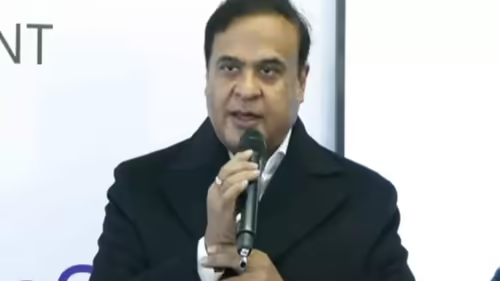
Chief Minister Himanta Biswa Sarma has offered a robust defense of the process, directly challenging the opposition’s narrative. He has stated that the notices sent out are not aimed at genuine Indian citizens but are specifically targeted at individuals who are suspected of being “illegal immigrants” .
In a series of statements that have further inflamed the controversy, CM Sarma has openly declared that the government will continue to send these notices to ‘Miya’ Muslims to “keep them under pressure” . He has dismissed the entire episode as a non-issue for the Assamese Hindu and indigenous Muslim populations, framing it as a necessary step to protect the state’s demographic integrity . His comments have been seen by critics as a clear admission of a targeted political strategy using the electoral machinery.
The Election Commission’s Stance and Public Response
Amid the growing chaos, the Election Commission of India has stepped in to reassure the public. It has clarified a crucial point: no voter’s name can be deleted from the rolls based solely on a Form 7 application. Every individual who receives a notice has the legal right to a hearing where they can contest the objection .
However, activists and legal experts warn that the process itself can be a form of harassment. The burden of proof falls on the accused voter, who must navigate bureaucratic hurdles and potentially incur costs to defend their fundamental right to vote. For many, especially those from marginalized communities, this can be a daunting and intimidating experience, regardless of the final outcome.
The opposition has also flagged the tight deadline for resolving these claims and objections—set for February 2—as insufficient for a fair and thorough process, urging the EC to extend it to ensure no genuine voter is left out .
Conclusion: A Critical Test for Assam’s Democracy
The Assam Form 7 controversy is far more than a bureaucratic dispute; it is a litmus test for the health of the state’s democracy. On one side, the government claims it is a legitimate exercise to purge the electoral rolls of ineligible voters. On the other, a significant section of the population and the political opposition see it as a thinly veiled attempt at voter suppression along communal lines.
As the February 2 deadline looms, the Election Commission’s role as an impartial arbiter will be under intense scrutiny. The coming weeks will determine whether the democratic right to vote is protected for all eligible citizens of Assam, or if the process becomes a tool for political engineering. For a state with a complex history of identity and migration politics, the stakes could not be higher.
Sources
- Times of India: Assam SR under fire, oppn alleges misuse of Form-7; CM says genuine voters safe
- India Today: Form 7 row in Assam: Voters flag ‘arbitrary’ deletions
- PTI via various sources: Opposition urges EC to ensure no misuse of Form 7 in Assam
- Election Commission of India: Official Website