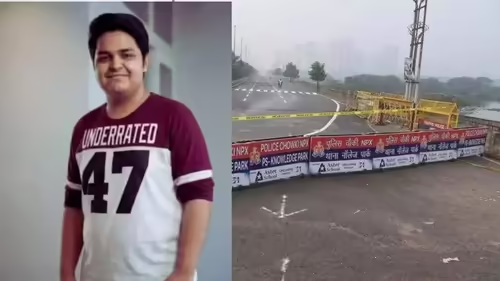
It was a foggy night in Noida on January 16, 2026. Software engineer Yuvraj Mehta was driving home when his car plunged into a massive, unmarked, 70-foot-deep water-filled excavation pit. What followed was a harrowing 12-hour ordeal that ended not with a rescue, but with a recovery—and a nation asking a single, devastating question: How could 80 trained rescuers fail to save one man? [[1], [5]]
This isn’t just another news story; it’s a stark, real-time audit of India’s emergency response infrastructure. The Noida drowning tragedy has ripped open a festering wound in our public safety systems, revealing a landscape of uncoordinated agencies, inadequate equipment, and a catastrophic lack of specialized urban rescue protocols.
Table of Contents
- The Night Everything Went Wrong
- The Rescue Operation: A Tale of Chaos and Confusion
- Why the System Failed: Institutional Gaps Exposed
- Beyond Noida: India’s Broader Emergency Response Crisis
- What Needs to Change: A Roadmap for Reform
- Conclusion: A Life Lost, A System Broken
- Sources
The Night Everything Went Wrong
Yuvraj Mehta, a 27-year-old resident of Sector 150, was returning home around 12:30 AM through dense fog and poorly lit roads—a common hazard in many of India’s rapidly expanding urban centers . His vehicle, a Grand Vitara, veered off the path and into a deep, water-filled construction pit that had no safety barriers or warning signs .
Initial reports suggest he was alive for a significant period after the fall. The autopsy later confirmed death due to asphyxia from ante-mortem drowning, followed by cardiac arrest, with his nose clogged with mud and water found in his chest cavity [[2], [4]]. This grim detail underscores the terrifying reality that he likely struggled for his life while help was on its way—but was tragically ineffective.
The Rescue Operation: A Tale of Chaos and Confusion
Over the next 12 hours, a massive operation was launched involving the local police, fire department, National Disaster Response Force (NDRF), and State Disaster Response Force (SDRF)—totaling more than 80 personnel . Yet, despite this overwhelming show of force, the rescue was fatally flawed from the start.
The core issue? A complete lack of coordination and the right tools for the job. Rescuers arrived without the specialized diving equipment needed to navigate the murky, 70-foot depths. They were forced to rely on basic ropes and manpower, a strategy wholly inadequate for such a complex underwater rescue scenario. The operation quickly devolved into a scene of well-intentioned chaos, with multiple agencies working at cross-purposes instead of as a unified team.
Why the System Failed: Institutional Gaps Exposed
The Noida drowning tragedy is a textbook case of systemic failure. Several critical gaps were laid bare:
Lack of Specialized Urban Rescue Training
While the NDRF is a highly capable force, its primary focus has historically been on large-scale natural disasters like floods and earthquakes . Urban-specific scenarios—like a car sinking in a deep, confined water body—require a different, more technical skill set, including advanced diving and confined space rescue. The Standard Operating Procedures (SOPs) for such events appear to be either non-existent or not effectively implemented at the local level .
Poor Inter-Agency Coordination
The disaster management framework in India involves a complex web of agencies: local police, fire services, NDRF, SDRF, and municipal bodies. In theory, they are supposed to work in concert. In practice, as seen in Noida, there was no clear on-ground commander to unify the effort. This lack of a single command structure led to duplicated efforts, wasted time, and critical delays .
Inadequate Equipment and Infrastructure Oversight
Beyond the rescue, the root cause was the very existence of the deadly pit. Unregulated construction and a failure of municipal oversight allowed a lethal hazard to exist in a residential area. Furthermore, the rescue teams simply did not have the necessary gear—sonar equipment to locate the vehicle, professional dive teams, or heavy-lift machinery ready to deploy immediately.
Beyond Noida: India’s Broader Emergency Response Crisis
This incident is not an isolated one. It’s a symptom of a much larger problem. India’s emergency response system is fragmented. The national emergency number 112 is meant to be a unified solution, but its implementation across states is inconsistent and often inefficient, failing to integrate various emergency services into a single, seamless system .
A comprehensive analysis of India’s emergency care system reveals a crucial gap in the optimal delivery of services at the district and local levels . While funds like the State Disaster Response Fund (SDRF) are allocated for mitigation, their use for proactive, specialized urban rescue training and equipment is often overlooked .
What Needs to Change: A Roadmap for Reform
To prevent another Yuvraj Mehta, a multi-pronged reform is essential:
- Mandate Specialized Urban Rescue Drills: NDRF and SDRF battalions must conduct regular, mandatory drills for urban-specific scenarios like this, in coordination with local fire and police departments .
- Establish a Unified Command Protocol: Every major rescue operation must have a single, pre-designated incident commander with the authority to direct all agencies on the ground.
- Invest in Critical Equipment: Major cities must maintain a dedicated inventory of advanced rescue equipment, including sonar, professional dive kits, and confined space rescue tools, readily available for immediate deployment.
- Enforce Construction Site Safety: Municipal authorities must be held accountable for ensuring all construction sites, especially deep excavations, are properly barricaded and marked, with severe penalties for non-compliance.
Conclusion: A Life Lost, A System Broken
The death of Yuvraj Mehta is a profound personal tragedy for his family. But it must also serve as a national wake-up call. The presence of 80 rescuers was not a sign of a robust system, but of its desperate, last-minute scramble. True safety doesn’t come from the number of people you send to a disaster, but from the quality of your preparation, the clarity of your protocols, and the strength of your coordination. Until these fundamental issues are addressed, the Noida drowning tragedy will remain a haunting precedent, not an isolated event. For more on urban safety failures, see our coverage on [INTERNAL_LINK:infrastructure_safety_in_indian_cities].
Sources
- Times of India: 80 rescuers, no saviour: Who let Noida techie Yuvraj Mehta drown?
- National Disaster Management Authority (NDMA): Official Guidelines and SOPs
- World Health Organization (WHO) – Emergency Care Systems: Strengthening Emergency Care Systems