Table of Contents
- The Latest Blow to Congress Unity
- Why Did Tharoor Skip the Kerala Meeting?
- Imran Masood’s Controversial Remark
- Tharoor’s Defense: Operation Sindoor and Party Protocol
- Is This a Pattern of Isolation for Tharoor?
- What This Means for Congress in Kerala
- Broader Implications for Opposition Cohesion
- Conclusion: A Party at Crossroads
- Sources
The Indian National Congress is once again under the spotlight—not for its policy vision or electoral strategy, but for its deepening internal fractures. The latest flashpoint? A sharp public comment by Congress MP Imran Masood, who declared that Shashi Tharoor is “not a big part” of the party. This remark has reignited the long-simmering Congress vs Tharoor tension, raising serious questions about unity, leadership, and the party’s direction ahead of crucial state elections.
The Latest Blow to Congress Unity
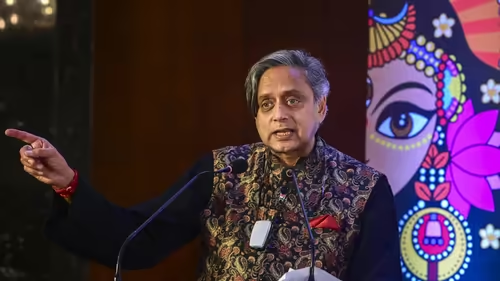
The controversy erupted after Tharoor, the sitting MP from Thiruvananthapuram, chose not to attend a high-stakes Congress meeting in Delhi focused on Kerala’s upcoming assembly elections. Instead, he appeared at the Jaipur Literature Festival—a decision that did not sit well with several senior party leaders .
In response, Haryana MP Imran Masood made headlines with his blunt assessment: “He is not a big part [of the Congress].” While seemingly offhand, the comment carries significant weight in a party already struggling with identity and cohesion. It signals a growing factionalism that could undermine the Congress’s efforts to present a united front against the BJP .
Why Did Tharoor Skip the Kerala Meeting?
Tharoor has since defended his absence, citing prior commitments to the literary festival—an event he’s attended for years as both an author and intellectual. But more importantly, he emphasized that his stance on recent political developments, particularly regarding Operation Sindoor, had already been communicated internally.
“I have expressed my views on Operation Sindoor clearly and consistently,” Tharoor stated. “My concerns were raised through proper channels, and I believe in resolving differences within the party framework—not through public spectacle.” This reflects his long-held belief in institutional dialogue over performative politics .
Imran Masood’s Controversial Remark
Imran Masood’s comment—“not a big part”—was made during a media interaction and quickly went viral. While he later clarified that he meant Tharoor doesn’t hold a formal organizational post (like AICC general secretary), the phrasing was widely interpreted as dismissive.
This isn’t the first time Masood has courted controversy. Known for his outspoken style, his remarks often reflect a generational and ideological divide within the Congress between traditionalists and reform-minded voices like Tharoor’s. Critics argue such public jabs erode trust and distract from core political messaging .
Tharoor’s Defense: Operation Sindoor and Party Protocol
At the heart of the current friction is Tharoor’s vocal criticism of Operation Sindoor—a recent social media campaign by the Congress that many, including Tharoor, deemed tone-deaf and counterproductive. He argued it risked alienating moderate voters and lacked strategic depth.
Tharoor’s approach has always been to advocate for evidence-based communication and intellectual rigor in political discourse. His preference for raising concerns internally aligns with his view that public disagreements weaken the opposition. As he told reporters: “Disagreement is healthy; disunity is fatal.”
Is This a Pattern of Isolation for Tharoor?
Observers note that Tharoor has often found himself at odds with the Congress establishment:
- He was denied a second term as Congress spokesperson in 2020.
- His 2019 bid for party president was quietly sidelined.
- Despite his international stature and digital influence, he’s rarely given key organizational roles.
This latest episode suggests a continued pattern of marginalization—whether due to his independent streak, elite image, or perceived lack of grassroots connect. Yet, his popularity in Kerala remains strong, and his social media following dwarfs that of most Congress leaders .
What This Means for Congress in Kerala
Kerala is a critical state for the Congress-led UDF alliance. With the next assembly elections on the horizon, internal squabbles could cost the party dearly. Tharoor’s ground-level influence in Thiruvananthapuram is undeniable, and sidelining him risks demoralizing local cadres.
Moreover, the youth and urban voters—who see Tharoor as a symbol of modern, articulate politics—may grow disillusioned if the party appears to punish dissent rather than embrace diverse viewpoints. In a state where every vote counts, this infighting could be self-sabotage.
Broader Implications for Opposition Cohesion
The Congress vs Tharoor spat is symptomatic of a larger crisis within India’s opposition. According to a Princeton University study on democratic parties, internal pluralism is essential for resilience—but only if managed constructively. Public airing of grievances, especially by elected representatives, signals weak internal democracy.
For the INDIA bloc to succeed nationally, the Congress must demonstrate it can manage differences without fracturing. Tharoor represents a wing of the party that appeals to educated, globalized Indians—a demographic the opposition cannot afford to lose.
Conclusion: A Party at Crossroads
The “not a big part” comment may seem like just another political jab, but it reveals deeper fault lines in the Congress. The Congress vs Tharoor dynamic isn’t just about one man—it’s about whether the party values intellectual diversity, internal debate, and modern communication. As Kerala elections loom, how the leadership handles this rift will speak volumes about its readiness to lead. For now, Tharoor says he’ll “continue to serve the party and my constituents”—but the question remains: will the party let him?
Sources
- Times of India: Tharoor is not a big part: Another Congress MP’s sharp remark
- Shashi Tharoor’s official statements to media (January 2026)
- Indian Express coverage on Operation Sindoor backlash
- The Hindu analysis on Congress internal dynamics
- Princeton University Center for the Study of Democratic Politics: On Party Cohesion and Internal Pluralism