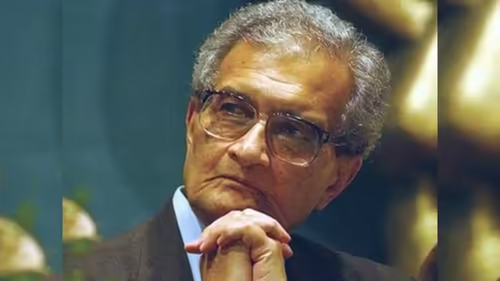
Amartya Sen’s Stark Warning on the SIR in Bengal
In a powerful intervention that has reignited a national debate, Nobel laureate and renowned economist Amartya Sen has raised a sharp red flag over the Special Intensive Revision (SIR) of electoral rolls in West Bengal. Sen, a native of the state, has not held back his criticism, calling the entire exercise “unjust to voters” and “unfair to democracy” . His central concern? The process is being executed in an undue and dangerous hurry, potentially leaving millions of eligible citizens off the voting list.
This isn’t just a theoretical worry for Sen. He has pointed to his own personal challenges with documentation as a stark example of how even the most educated and privileged can face bureaucratic hurdles—imagine, he argues, the plight of the poor, the marginalized, and minority communities who lack the resources or knowledge to navigate this complex system .
Table of Contents
- What Exactly is the SIR in Bengal?
- Deconstructing Amartya Sen’s Criticism
- Who is Most at Risk of Being Excluded?
- The Broader Implications for Indian Democracy
- Conclusion: A Call for a More Inclusive Process
- Sources
What Exactly is the SIR in Bengal?
The Special Intensive Revision (SIR) is a comprehensive and door-to-door verification drive mandated by the Election Commission of India (ECI). Unlike routine updates, the SIR aims for a complete and fresh enumeration of all eligible voters in a state . The official goal is noble: to ensure the electoral rolls are accurate, up-to-date, and free from duplicate or ineligible entries, thereby strengthening the integrity of the democratic process .
In West Bengal, this massive exercise has been rolled out ahead of the crucial 2026 assembly elections. The ECI has stated that the process involves physical confirmation of residents and a meticulous cross-checking of documents . While the intent may be administrative efficiency, the execution on the ground has become a source of significant controversy and anxiety for many citizens.
Deconstructing Amartya Sen’s Criticism
Sen’s critique goes beyond mere procedural complaints. He frames the rushed nature of the SIR in Bengal as a fundamental assault on the principle of universal adult suffrage. His argument hinges on two key points:
- The Tyranny of the Deadline: The breakneck speed of the revision leaves little room for error correction or for citizens to gather the necessary paperwork. For someone who has lived in the same home for decades, being asked to suddenly produce a decade-old utility bill or a specific type of residence proof can be an impossible task .
- A Personal Anecdote with a Universal Message: Sen has openly shared his own struggle with voter registration, highlighting that even a globally recognized intellectual can be tripped up by bureaucratic red tape. This personal story serves as a powerful metaphor for the systemic barriers that the SIR could erect for ordinary citizens .
His conclusion is damning: a process that excludes eligible voters, however inadvertently, is not just an administrative failure—it is a direct threat to the very foundation of a healthy democracy .
Who is Most at Risk of Being Excluded?
While Sen’s personal experience is illustrative, his deepest concern lies with the most vulnerable sections of society. Evidence from the ground suggests his fears are well-founded.
Reports indicate that Muslim-majority districts in West Bengal have seen a disproportionately high number of voters being called for SIR hearings, creating a climate of fear and suspicion within the community . Similarly, other marginalized groups like the Matua community and Dalits are also reporting significant challenges and a sense of being targeted for exclusion [[28], [33]].
These communities often face systemic disadvantages:
- Lack of stable housing or formal rental agreements.
- Difficulty in obtaining legacy documents that prove long-term residence.
- Lower levels of literacy, making it harder to understand complex bureaucratic notices.
- A general distrust of state machinery, which can deter them from proactively engaging with the process.
The rushed SIR in Bengal amplifies these existing vulnerabilities, turning a routine administrative exercise into a potential tool for mass disenfranchisement.
The Broader Implications for Indian Democracy
Amartya Sen’s intervention is a crucial reminder that the health of a democracy is measured not just by the act of voting, but by the inclusivity of the process that precedes it. A voter list that is inaccurate or exclusionary fundamentally distorts the will of the people.
This situation in West Bengal is not happening in a vacuum. It echoes broader national anxieties about citizenship and belonging. The fear is that exercises like the SIR, if not conducted with the utmost care, transparency, and ample time for public recourse, can be weaponized to alter the demographic composition of the electorate .
For a robust democracy, every eligible citizen must have a clear, accessible, and fair path to being on the voter list. Any process that creates unnecessary hurdles, especially for the poor and the marginalized, undermines the principle of equality that is central to democratic governance. As a leading voice on social justice and development, Sen’s warning carries immense weight and should be a call to action for the Election Commission to ensure the process is both efficient and equitable.
Conclusion: A Call for a More Inclusive Process
Amartya Sen’s condemnation of the rushed SIR in Bengal is a timely and vital contribution to the national discourse. His message is clear: the pursuit of a “clean” voter list must never come at the cost of excluding legitimate citizens. The Election Commission of India must heed this advice and ensure that the process includes sufficient safeguards, extended timelines for appeals, and proactive outreach to vulnerable communities. After all, a democracy is only as strong as its commitment to including every single voice. To learn more about the technical aspects of electoral management, you can visit the official website of the Election Commission of India. For more on West Bengal’s political landscape, see our coverage on [INTERNAL_LINK:west-bengal-politics].
Sources
- Times of India: ‘Unjust to voters, unfair to democracy’: Amartya Sen says ‘SIR in Bengal done in hurry’‘
- Election Commission of India: ‘Office of the Chief Electoral Officer, West Bengal‘
- The Hindu: ‘Amartya Sen flags concerns over voter roll revision in Bengal‘
- India Today: ‘Muslims might face bias: Amartya Sen says ‘rushed’ Bengal SIR exercise‘