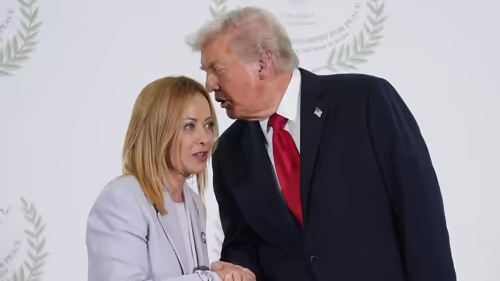
It’s not every day that a sitting European leader ties a former U.S. president’s legacy to a Nobel Peace Prize—and adds a geopolitical condition to boot. But that’s exactly what Italian Prime Minister Giorgia Meloni did in a recent interview, sparking headlines and heated discussion across diplomatic circles.
Meloni, known for her conservative stance and close (though nuanced) ties to both Washington and Brussels, stated plainly: Donald Trump deserves the Nobel Peace Prize—but only if he can deliver what no one else has: a lasting peace deal to end the war in Ukraine.
This isn’t just flattery or political theater. It’s a high-stakes diplomatic signal wrapped in a provocative soundbite. And it raises urgent questions: Is Meloni endorsing Trump’s rumored “30-day peace plan”? Is Europe growing weary of the war? And can a former president—even one as influential as Trump—actually broker peace from the sidelines?
Table of Contents
- What Did Meloni Actually Say?
- The Trump Nobel Peace Prize Debate: A History
- Why Ukraine Is the Key Condition
- Can Trump Really End the War in Ukraine?
- European Reactions and Geopolitical Implications
- What the Nobel Committee Thinks
- Conclusion: A Bet on Diplomacy—or Politics?
- Sources
What Did Meloni Actually Say?
During a televised interview, Meloni was asked about Donald Trump’s potential return to the White House and his repeated claims that he could “end the Ukraine war in 24 hours.” Her response was direct:
“If Donald Trump succeeds in bringing peace to Ukraine, he will deserve the Nobel Peace Prize.”
She emphasized that such an outcome would require genuine negotiation—not just rhetoric—and must respect Ukraine’s sovereignty. Notably, she didn’t endorse Trump’s methods, but framed the prize as a reward for results, not intentions.
This conditional praise reflects a broader sentiment among some European conservatives: frustration with the war’s duration, coupled with hope that a deal-maker like Trump might break the deadlock—even if his approach is unorthodox.
The Trump Nobel Peace Prize Debate: A History
This isn’t the first time Trump’s name has been floated for the Nobel Peace Prize. In fact, he was nominated in 2021 by a Norwegian lawmaker for brokering the Abraham Accords between Israel and several Arab nations—a rare diplomatic breakthrough in the Middle East.
However, his presidency was also marked by chaotic foreign policy swings, withdrawal from international agreements (like the Paris Climate Accord and the Iran nuclear deal), and inflammatory rhetoric that often alienated allies.
The Nobel Committee has historically favored leaders who achieve verifiable, lasting peace—not just short-term deals. Past winners include Barack Obama (2009), Jimmy Carter (2002), and Nelson Mandela (1993). For Trump to join that list, he’d need more than promises; he’d need a signed, sustainable peace treaty.
Why Ukraine Is the Key Condition
Meloni’s focus on Ukraine isn’t random. The war has now entered its fourth year, with devastating humanitarian, economic, and strategic consequences for Europe. Italy, like many EU nations, faces energy instability, refugee pressures, and defense spending hikes.
Her condition—tying the Trump Nobel Peace Prize to a Ukraine resolution—serves multiple purposes:
- Signals openness to negotiation: Even as NATO backs Kyiv, some European leaders quietly seek off-ramps to avoid escalation.
- Pressures all sides: By setting a high bar (“Nobel-worthy peace”), she indirectly challenges Russia, Ukraine, and the U.S. to get serious.
- Aligns with Italian public opinion: Polls show growing war fatigue among Italians, especially on the right.
Importantly, Meloni reaffirmed Italy’s support for Ukraine’s territorial integrity—making clear that any peace must not reward Russian aggression.
Can Trump Really End the War in Ukraine?
Trump has repeatedly claimed he could “stop the war in 24 hours” by calling both Putin and Zelenskyy. But experts are deeply skeptical. Here’s why:
- No leverage over Putin: Despite past rapport, Putin has shown little interest in concessions without battlefield gains.
- Ukraine’s red lines: Kyiv refuses to cede territory. Any deal ignoring this would be rejected domestically.
- U.S. legal constraints: As a private citizen, Trump can’t negotiate treaties or commit U.S. resources.
- Trust deficit: Many Ukrainians view Trump as pro-Putin due to his past comments and reluctance to send aid.
That said, if Trump wins the 2026 election, his influence would grow dramatically. His threat to cut off aid unless Europe pays more could force new negotiations—but at the risk of weakening Ukraine’s position.
European Reactions and Geopolitical Implications
Meloni’s comments have drawn mixed reactions. Eastern European leaders, like those in Poland and the Baltics, worry such statements embolden Moscow. Meanwhile, some Western European conservatives see it as pragmatic realism.
The Biden administration has not officially responded, but U.S. officials have consistently warned against “peace at any price.” The official NATO line remains: Ukraine must decide its own terms.
Still, Meloni’s move highlights a growing rift within the West: between those prioritizing immediate ceasefire and those insisting on justice and deterrence. Her endorsement of a Trump Nobel Peace Prize—however conditional—is a subtle nudge toward the former camp.
What the Nobel Committee Thinks
The Norwegian Nobel Committee, which awards the Peace Prize, keeps nominations secret for 50 years. But its chair, Berit Reiss-Andersen, has previously stated that the prize rewards “concrete achievements,” not intentions or promises .
Given that, Trump would need to produce a verified, implemented peace framework—not just a photo op—to be seriously considered. Until then, talk of a Nobel remains speculative.
Conclusion: A Bet on Diplomacy—or Politics?
Giorgia Meloni’s statement about the Trump Nobel Peace Prize is equal parts diplomacy, domestic messaging, and geopolitical signaling. By making peace in Ukraine the sole criterion, she’s not just praising Trump—she’s setting a benchmark for what the world should demand from any would-be peacemaker.
Whether Trump can—or should—play that role remains hotly contested. But one thing is clear: as the war drags on, the pressure for a solution is mounting. And in that high-stakes game, even a Nobel Prize might be used as a bargaining chip.
For deeper analysis on transatlantic relations, see our feature on [INTERNAL_LINK:eu-us-foreign-policy-2026].
Sources
- Times of India: Meloni says Trump deserves Nobel Peace Prize, but sets Ukraine condition
- Nobel Prize Official Website: https://www.nobelprize.org/prizes/peace/
- Council on Foreign Relations – Ukraine War Timeline: https://www.cfr.org/timeline/ukraine-crisis