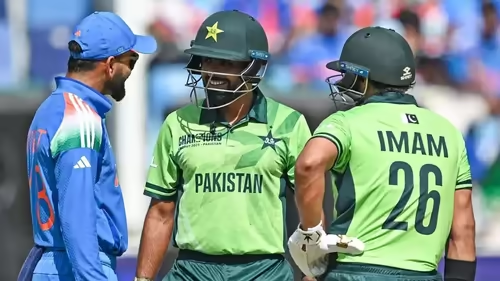
Is an India vs Pakistan Bilateral Series Possible? The BCCI’s Final Word
For millions of cricket fans across the globe, a full-fledged India vs Pakistan bilateral series is the ultimate sporting spectacle—a clash that transcends sport and taps into decades of history, rivalry, and emotion. Yet, despite the immense commercial and cultural appeal, this dream remains firmly out of reach.
BCCI Vice-President Rajeev Shukla has delivered a sobering reality check: bilateral cricket between the two nuclear-armed neighbors is “not possible in the current situation.” The board’s stance is unequivocal—it will strictly follow the guidance of the Indian government, making political clearance the non-negotiable prerequisite for any future tour .
Table of Contents
- The BCCI’s Official Stance
- Why the Last Bilateral Series Was in 2012-13
- Operation Sindoor and Its Impact on Cricket Ties
- The ‘Third Soil’ Policy: A New Normal
- Fan Sentiment vs. Political Reality
- Conclusion: What Does the Future Hold?
- Sources
The BCCI’s Official Stance
In a recent statement, Rajeev Shukla emphasized that the BCCI does not operate in a political vacuum. “We are a sports body, but we are also a national institution,” he said. “Our primary responsibility is the safety of our players and staff. Therefore, we will only proceed with any engagement with Pakistan if the Government of India gives the green signal” .
This position aligns with long-standing protocol. Since the 2008 Mumbai attacks, India-Pakistan bilateral ties—both diplomatic and sporting—have been deeply intertwined. Cricket, once a bridge for dialogue, has increasingly become a barometer of broader geopolitical tensions.
Why the Last Bilateral Series Was in 2012-13
The last time India toured Pakistan for a bilateral series was during the 2012–13 season, which included three ODIs and two T20Is. Since then, all encounters between the two sides have occurred exclusively at neutral venues during ICC tournaments like the World Cup or the Asia Cup.
Key reasons for this freeze include:
- The 2008 Mumbai terror attacks, which led to a suspension of all bilateral ties.
- The 2009 attack on the Sri Lankan cricket team in Lahore, which raised serious security concerns for international teams touring Pakistan.
- Ongoing cross-border tensions and periodic escalations along the Line of Control.
Operation Sindoor and Its Impact on Cricket Ties
A significant new factor has emerged in recent years: **Operation Sindoor** in 2025. While official details remain classified, credible defense analysts describe it as a major counter-terrorism operation by Indian forces that dramatically altered the regional security calculus .
The aftermath of this operation has led to a hardening of India’s stance on all forms of engagement with Pakistan, including cultural and sporting exchanges. The BCCI’s reluctance is not just about past incidents—it’s a reflection of the current, highly sensitive security environment. As one senior BCCI official anonymously noted, “After 2025, the risk assessment changed completely.”
The ‘Third Soil’ Policy: A New Normal
In the absence of bilateral tours, the ICC has become the sole platform for India-Pakistan clashes. This “third soil” policy—where matches are played in countries like the UAE, England, or Australia—has become the de facto standard.
While these games draw massive global viewership (the 2023 ODI World Cup match attracted over 500 million viewers), they lack the unique atmosphere of a home-and-away series. For fans in Lahore or Chennai, watching their heroes on a neutral ground simply isn’t the same. Nevertheless, it remains the only viable option under current circumstances.
Fan Sentiment vs. Political Reality
There’s no denying the commercial potential. A single India-Pakistan bilateral series could generate hundreds of millions in broadcast and sponsorship revenue. Fan petitions, social media campaigns, and even player appeals (like those from former cricketers Wasim Akram and Sachin Tendulkar) have kept hope alive.
Yet, as Shukla’s comments underscore, cricket boards cannot override national security protocols. The BCCI’s position is not unique; many national sports federations consult their governments before engaging with certain countries. For a deeper look at how politics shapes sports, see our [INTERNAL_LINK:How Geopolitics Influences International Cricket Schedules].
Conclusion: What Does the Future Hold?
For now, the prospect of an India vs Pakistan bilateral series remains a distant dream. The BCCI has drawn a clear line: no government approval, no cricket. Until there’s a significant thaw in diplomatic relations—and a formal assurance on security—fans will have to be content with high-stakes, emotionally charged encounters on neutral grounds during ICC events. While the rivalry lives on, its most authentic form remains suspended in time, waiting for a political breakthrough that may or may not come.
Sources
- Times of India: Original Article
- Ministry of External Affairs, Government of India: Official Statements Archive
- International Cricket Council (ICC): Tournament Regulations & Security Guidelines