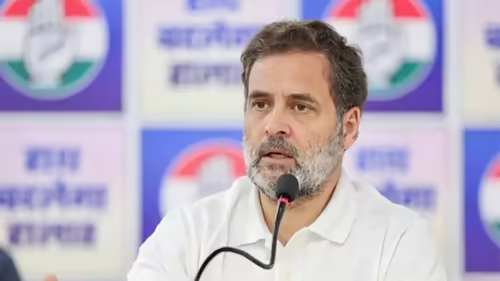
Rahul Gandhi’s Explosive Allegations: Is the Vote Chori Conspiracy Real?
In a dramatic escalation of political tensions, senior Congress leader Rahul Gandhi has launched a blistering attack on the ruling BJP and the Election Commission of India (ECI). He alleges a deep-rooted and systematic ‘vote chori conspiracy‘ is underway in Gujarat, orchestrated under the guise of the Special Intensive Revision (SIR) of electoral rolls .
Gandhi’s core accusation is that the SIR, a process meant to clean up voter lists, has been weaponized to disenfranchise millions of voters from specific communities, effectively stealing their right to vote before an election even begins. He went so far as to label the ECI not as a neutral guardian of democracy, but as the ‘chief accomplice’ in this alleged conspiracy .
Table of Contents
- What is the Special Intensive Revision (SIR)?
- Rahul Gandhi’s Specific Allegations
- The Congress Party’s Broader Claims
- ECI and BJP Response
- Historical Context and National Implications
- Conclusion: A Democratic Crisis or Political Rhetoric?
- Sources
What is the Special Intensive Revision (SIR)?
The Special Intensive Revision (SIR) is a process conducted by the Election Commission of India to update and verify the electoral rolls in a specific area. It typically involves field visits by Booth Level Officers (BLOs) to confirm the residence and identity of voters, with the aim of removing duplicate, deceased, or non-resident entries to ensure the integrity of the voter list.
While the stated objective is to maintain a clean and accurate electoral roll, the process has become a flashpoint for controversy. Critics argue that its implementation can be highly subjective and prone to manipulation if not monitored with extreme diligence.
Rahul Gandhi’s Specific Allegations
Rahul Gandhi’s central claim is that the SIR in Gujarat has been perverted from its original purpose. He asserts that it is being used as a ‘new weapon’ for ‘vote chori’—a strategic effort to delete the names of legitimate voters en masse .
He highlighted disturbing cases where individuals who had voted in the recent Lok Sabha elections were subsequently declared ‘dead’ in the SIR records, rendering them ineligible to vote in future polls . This, he argues, is not an administrative error but a deliberate act of disenfranchisement. His most damning statement was that the ECI has ceased to be the ‘protector of democracy’ and has instead become a ‘key participant’ in this alleged conspiracy .
The Congress Party’s Broader Claims
Supporting Gandhi’s narrative, the Gujarat Congress unit has presented its own data, claiming that millions of objections were filed during the SIR process, disproportionately targeting voters from particular communities . They argue this pattern points to a coordinated effort to alter the demographic composition of the electorate in favor of the ruling party.
The party has called for an immediate halt to the SIR process in its current form and has demanded a transparent, independent audit of all deletions. They see this as a fundamental threat to the democratic principle of universal adult suffrage.
ECI and BJP Response
As of now, the Election Commission of India has maintained its standard position of procedural neutrality, stating that the SIR is a routine exercise conducted across the country to ensure the purity of the electoral rolls. They have not issued a direct rebuttal to Gandhi’s specific ‘accomplice’ charge.
The BJP, predictably, has dismissed the allegations as baseless and politically motivated. Party leaders have accused the Congress of crying foul play to cover up its own organizational weaknesses and lack of public support in Gujarat. They maintain that the SIR process is transparent and any genuine grievances can be addressed through the existing appellate mechanisms provided by the ECI.
Historical Context and National Implications
This is not the first time the SIR process has come under fire. Similar allegations of targeted voter deletion have surfaced in other states like Bihar, where Rahul Gandhi has also led the opposition’s charge against what they term ‘vote chori’ .
The controversy raises critical questions about the independence and operational autonomy of the ECI, an institution long considered a cornerstone of Indian democracy. If the allegations hold any water, the implications are national in scope, potentially affecting the fairness of future elections across the country. For a deeper look at the ECI’s role, see our [INTERNAL_LINK:Election Commission of India: Powers and Functions].
Conclusion: A Democratic Crisis or Political Rhetoric?
The gravity of Rahul Gandhi’s ‘vote chori conspiracy’ allegations cannot be understated. Accusing a constitutional body like the ECI of being a ‘chief accomplice’ in a scheme to steal votes is an extraordinary claim that demands an extraordinary response. While it may be easy to dismiss this as pre-election political posturing, the specific examples cited—like active voters being declared dead—warrant a serious, independent investigation. The health of India’s democracy depends on the absolute integrity of its electoral process, and any shadow of doubt over that integrity must be addressed with the utmost urgency and transparency.
Sources
- Times of India: Original Article
- Election Commission of India: Official Website
- Web Search Results: , , , ,