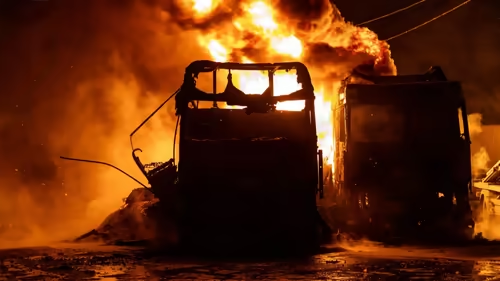
In a move that can only be described as a masterclass in diplomatic cynicism, Russia unleashed a devastating wave of over 370 drones and 21 missiles on Ukrainian cities just as its own delegation was shaking hands with American and Ukrainian counterparts in the sun-drenched halls of Abu Dhabi. The timing wasn’t a coincidence—it was a message. And that message has thrown the fragile Abu Dhabi peace talks into immediate chaos.
Table of Contents
- The Attack That Shook the Negotiation Table
- Inside the Abu Dhabi Peace Talks: A Delicate Balancing Act
- Putin’s Strategy of Chaos and Intimidation
- The US Role: Walking a Diplomatic Tightrope
- What Comes Next for the Peace Process?
The Attack That Shook the Negotiation Table
The sheer scale of the overnight assault was staggering. Ukrainian President Volodymyr Zelenskyy confirmed that the barrage targeted critical infrastructure and residential areas across Kyiv, Kharkiv, and other major cities . The attack resulted in at least one civilian death and left more than 20 others injured, a grim reminder of the war’s brutal reality just miles away from the air-conditioned conference rooms where diplomats debated ceasefires [[1], [10]].
This wasn’t just another military operation; it was a calculated act of psychological warfare. By striking during the first official trilateral talks between Russia, Ukraine, and the US, Moscow demonstrated its willingness to use violence as a primary negotiating tool, effectively holding the peace process hostage to its own military whims .
Inside the Abu Dhabi Peace Talks: A Delicate Balancing Act
Hosted by the United Arab Emirates, these Abu Dhabi peace talks were billed as a potential breakthrough—a rare opportunity for direct dialogue between the warring parties, facilitated by a powerful neutral third party . The central issue on the table was the most contentious one of all: territory. Ukraine’s stance has been clear and unwavering: any peace must be based on the restoration of its internationally recognized borders, including the return of Crimea and the Donbas region .
For Ukraine, participating in these talks was a significant step, demonstrating a willingness to explore a diplomatic path forward. However, the massive Russian attack has severely undermined the trust and goodwill necessary for any meaningful negotiation to take place. As Zelenskyy noted, his team was providing him with hourly updates from the talks, highlighting the high stakes and intense pressure of the moment .
Putin’s Strategy of Chaos and Intimidation
Vladimir Putin’s regime has long employed a dual-track strategy: talk peace while preparing for war. This latest escalation is a textbook example. While Russian diplomats spoke of de-escalation in Abu Dhabi, their military command was executing one of the most complex and large-scale drone and missile operations of the conflict. The goal is clear: to weaken Ukraine’s resolve, destroy its energy grid ahead of winter, and signal to the West that Russia remains an unpredictable and dangerous adversary that cannot be easily contained through diplomacy alone .
This tactic of coupling negotiation with intensified violence is designed to create a state of permanent crisis, making it nearly impossible for Ukraine or its allies to build a stable foundation for peace. It’s a cynical ploy that prioritizes battlefield gains over genuine compromise.
The US Role: Walking a Diplomatic Tightrope
The United States, as the key facilitator of this US-backed peace initiative, now finds itself in an incredibly difficult position . On one hand, it must condemn Russia’s blatant aggression and reaffirm its support for Ukraine. On the other, it must prevent the entire diplomatic effort from collapsing. The Biden administration is walking a tightrope, trying to keep the channels of communication open without appearing to reward Moscow’s bad faith actions.
The success of these talks was always uncertain, but Russia’s attack has made the path forward exponentially more treacherous. The US will need to demonstrate strong leadership to either salvage the process or pivot to a new strategy that accounts for Russia’s apparent disinterest in a negotiated settlement.
What Comes Next for the Peace Process?
The immediate future of the Abu Dhabi peace talks hangs in the balance. Ukraine is justifiably furious and may be reluctant to return to the table under such conditions. The attack has exposed a fundamental truth: a ceasefire or a lasting peace cannot be negotiated with a party that uses the negotiation period itself as a window for its most destructive attacks.
For the international community, this event is a stark wake-up call. It underscores that any viable peace plan must include robust, verifiable mechanisms to ensure that talks are not used as a smokescreen for further aggression. Until then, the dream of a diplomatic end to Europe’s deadliest conflict in decades remains just that—a dream, shattered by the sound of 370 drones in the night sky.
Summary
Russia’s massive drone and missile assault on Ukraine, launched in direct coordination with the start of the Abu Dhabi peace talks, has dealt a severe blow to the nascent diplomatic process. This act of bad faith has not only caused civilian casualties but has also revealed the deep chasm of distrust that any future negotiations will have to overcome. The path to peace now appears longer and more uncertain than ever.
Sources
- Original Article: Times of India
- Context on Attacks & Casualties: [[1], [10], [13]]
- Details on Abu Dhabi Talks: [[2], [14], [15]]
- Analysis of Russian Strategy:
- High-Authority External Source: Reuters