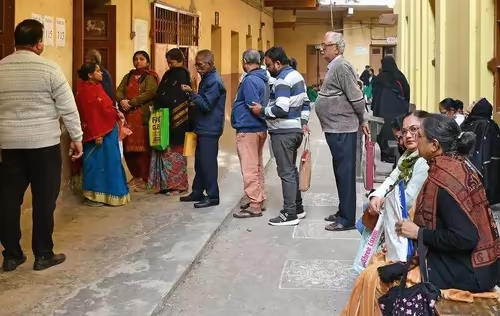
In the heart of West Bengal, a quiet bureaucratic storm is brewing—one that threatens to erase a core piece of the state’s cultural heritage. The issue? A simple name. Or rather, the complex, centuries-old legacy behind names like Mukherjee, Banerjee, and Chatterjee. What was once a mark of identity is now being treated as a “logical discrepancy” by the Election Commission of India (ECI), leaving millions of Bengalis scrambling to prove they are who they say they are.
Table of Contents
- The SIR Crisis: When Your Name Becomes a Crime
- Bengali Surnames: A Colonial Twist of History
- Why the EC’s Software is Getting It Wrong
- Mamata Banerjee’s Fight Against Cultural Insensitivity
- What Voters Need to Know & How to Respond
- Conclusion: More Than Just a Name
- Sources
The SIR Crisis: When Your Name Becomes a Crime
The Special Intensive Revision (SIR) of electoral rolls was meant to clean up voter lists. Instead, it has created a Kafkaesque nightmare for countless Bengalis. The ECI’s automated system is flagging historical variations in Bengali surnames as errors. If your official documents say “Mukherjee” but an ancestor on the 2002 electoral roll was listed as “Mukhopadhyay,” you’re now in a “logical discrepancy” category—a bureaucratic purgatory that requires you to appear at a hearing to justify your own existence as a voter .
This isn’t a minor glitch. The ECI has identified a staggering 91.46 lakh such cases in West Bengal alone . For many families, this isn’t just an administrative hassle; it’s a direct assault on their lineage and identity.
Bengali Surnames: A Colonial Twist of History
To understand the current crisis, we must travel back to the British Raj. The original Sanskrit forms of these surnames—Mukhopadhyay, Bandyopadhyay, and Chattopadhyay—are derived from the word “Upadhyaya,” meaning “teacher” or “priest,” a title for learned Brahmins . These names were long and complex for British clerks to pronounce and spell.
So, a simplification occurred. Mukhopadhyay became Mukherjee, Bandyopadhyay became Banerjee, and Chattopadhyay became Chatterjee . This wasn’t a random change but a systematic anglicization that became so widespread that the shortened versions are now the primary identity for millions of Bengalis across the globe .
Over generations, families have legally adopted these simplified forms. Birth certificates, passports, and property deeds all bear the “Mukherjee” spelling. To now demand a reversion to the archaic form for the sake of an electoral roll is not just impractical—it’s historically ignorant.
Common Anglicized vs. Original Bengali Surnames
| Anglicized Surname | Original Sanskrit Form |
|---|---|
| Banerjee | Bandyopadhyay |
| Mukherjee | Mukhopadhyay |
| Chatterjee | Chattopadhyay |
| Ganguly | Gangopadhyay |
Why the EC’s Software is Getting It Wrong
The core of the problem lies in the ECI’s rigid, algorithm-driven approach. The software is designed to match a voter’s current name against the 2002 electoral roll with zero tolerance for historical or linguistic evolution . It treats “Mukherjee” and “Mukhopadhyay” as two entirely different entities, not as two valid forms of the same ancestral name.
This lack of cultural and historical context is what Chief Minister Mamata Banerjee has fiercely criticized as “cultural insensitivity” . The system fails to account for the fact that a family’s surname can evolve over time due to migration, personal choice, or, as in this case, colonial influence. The result is a process that feels less like a democratic safeguard and more like a targeted disenfranchisement.
Mamata Banerjee’s Fight Against Cultural Insensitivity
CM Mamata Banerjee has been at the forefront of the opposition to this process. She has accused the ECI of using an AI tool allegedly developed by the BJP to unilaterally delete voters’ names, particularly targeting women whose surnames may have changed after marriage or due to the historical anglicization [[1], [24]].
Her government has taken the matter to the Supreme Court, which has since directed the ECI to publicly display the names of all voters flagged under “logical discrepancies” and to be mindful of the “stress” this process is causing ordinary citizens [[5], [22]]. Banerjee’s stance has framed the issue not just as a political one, but as a defense of Bengal’s cultural sovereignty against a centralized, tone-deaf bureaucracy.
What Voters Need to Know & How to Respond
If you or a family member in West Bengal has received a notice about a “logical discrepancy,” here’s what you should do:
- Check the Draft List: Visit the official ECI portal or your local booth level officer to verify your status on the SIR draft list .
- Gather Documentation: Collect all relevant documents—birth certificates, old voter IDs, school records—that show the consistent use of your family’s surname.
- Attend the Hearing: Do not ignore the summons. Your presence at the hearing centre is crucial to present your case and retain your voting rights.
- Seek Help: Local civic groups and political parties are organizing help desks to assist voters through this process. Don’t hesitate to use these resources.
For a deeper dive into the legal framework, see our guide on [INTERNAL_LINK:voter-rights-in-india].
Conclusion: More Than Just a Name
At its core, this controversy is about far more than bureaucratic accuracy. It’s about the right of a people to define their own identity. The Bengali surnames of Mukherjee, Banerjee, and Chatterjee are not mere labels; they are living artifacts of a rich, complex history that includes both indigenous tradition and colonial encounter. To dismiss their modern forms as “discrepancies” is to erase that history. As the legal and political battle unfolds, one thing is clear: for the people of Bengal, their name is their story, and they will not be forced to fall in line quietly.
Sources
- Times of India: Bengali? Yes, SIR. Brahmin? Yes, SIR. Go, fall in line [[2], [10], [23]]
- Hindustan Times: Bandyopadhyay or Banerjee? British-era surname confusion lands Bengal voters in SIR net [[3], [6], [16], [17]]
- The Hindu: SC directs ECI to display names of voters under logical discrepancies [[5], [22]]
- India Today: Mamata Banerjee Charges EC with Political Bias in Voter Rolls [[1], [24]]
- Wikipedia: Mukherjee (surname)