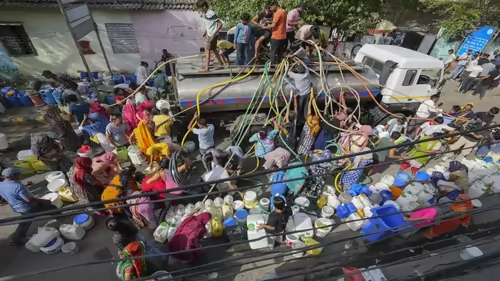
For residents of North and West Delhi, the simple act of turning on a tap has become a gamble. For days, many have been met with nothing but an unsettling silence—a stark reality of the deepening Delhi water crisis. The culprit? A toxic cocktail of industrial waste and sewage has sent ammonia levels in the Yamuna River soaring to a dangerous 3 parts per million (ppm), far beyond what the city’s aging water treatment infrastructure can handle .
This isn’t just an inconvenience; it’s a public health emergency in the making. With the Delhi Jal Board (DJB) forced to slash supply from key plants like Haiderpur, families are scrambling for alternatives, often resorting to expensive and unreliable private water tankers. Officials have grimly warned that this disruption could last until February 4th, casting a long shadow over daily life for millions .
Table of Contents
- What is Causing the Delhi Water Crisis?
- How Ammonia Cripples Delhi’s Water Treatment Plants
- Health Risks of Ammonia in Drinking Water
- Areas Most Affected by the Water Shortage
- Why Doesn’t Delhi Have Ammonia Removal Facilities?
- What Residents Can Do and What the Future Holds
What is Causing the Delhi Water Crisis?
The current Delhi water crisis is a classic case of a ‘double whammy’ . On one front, the annual winter dip in the Yamuna’s flow reduces its natural ability to dilute pollutants. On the other, a steady stream of untreated industrial effluent—particularly from upstream Haryana—continues to pour into the river, rich in ammonia compounds.
This recurring problem is exacerbated by the fact that several canals that feed into Delhi’s water system are currently closed for maintenance, further straining the already limited supply from the Yamuna . The result is a perfect storm that has pushed the river’s ammonia concentration to a critical level of 3 ppm .
How Ammonia Cripples Delhi’s Water Treatment Plants
Delhi’s water treatment plants were not designed for this level of chemical assault. Their standard process involves neutralizing low levels of ammonia (up to 0.9 ppm) by adding chlorine gas, which forms a compound called chloramine . However, when ammonia levels surge beyond this threshold, as they have now, this method becomes ineffective and can even produce harmful by-products.
At least seven major water treatment plants, including the crucial Haiderpur plant, have been forced to operate at a fraction of their capacity to avoid pushing unsafe water into the city’s pipelines . This drastic reduction in output is the direct cause of the widespread water cuts across North and West Delhi.
Health Risks of Ammonia in Drinking Water
While the World Health Organization (WHO) hasn’t set a specific health-based limit for ammonia in drinking water because levels are usually too low to be a direct threat, the current situation in Delhi is far from usual . Long-term ingestion of water with high ammonia concentrations (above 1 mg/l or ppm) can potentially lead to health issues, including damage to organ systems .
More immediately, the presence of high ammonia forces water treatment authorities to use more chlorine, which can affect the taste and odor of the water and create other disinfection by-products that pose their own health risks . The primary concern for the DJB is to prevent any water that hasn’t been properly treated from reaching consumers, hence the severe supply restrictions.
Areas Most Affected by the Water Shortage
The brunt of the crisis is being felt most acutely in areas dependent on the Haiderpur and other Yamuna-fed treatment plants. While a full official list is dynamic, reports confirm significant disruptions in large parts of:
- North Delhi (including Civil Lines, Model Town, and Pitampura)
- West Delhi (including Rajouri Garden, Punjabi Bagh, and Paschim Vihar)
- Parts of Central and South-West Delhi
The DJB has issued a press note stating that the curtailed supply will be in effect from January 20 to February 4, 2026, for these regions .
Why Doesn’t Delhi Have Ammonia Removal Facilities?
This is the million-dollar question that has plagued Delhi for years. Despite repeated warnings and recurring annual crises, the city lacks dedicated, large-scale ammonia removal technology at its main water treatment plants. The existing infrastructure simply isn’t equipped for it.
There have been promises. The Delhi government has announced plans to build its own ammonia treatment plant, and the DJB has approved schemes for new water treatment plants with advanced ammonia removal capabilities [[24], [27]]. However, these projects have been slow to materialize, leaving the city vulnerable year after year . The current crisis is a painful reminder of this critical infrastructure gap.
What Residents Can Do and What the Future Holds
For now, residents are left to cope. Many are forced to buy expensive water cans or rely on erratic private tanker services. The DJB has assured that it is working to restore normalcy by February 4th, but this depends entirely on the Yamuna’s ammonia levels dropping back to a manageable range .
The long-term solution requires a two-pronged approach: a massive investment in upgrading Delhi’s water treatment infrastructure with modern ammonia removal technology, and a serious, coordinated effort with neighboring states to stop the illegal discharge of industrial waste into the Yamuna at its source. Until then, the specter of the Delhi water crisis will continue to haunt the city every winter.
Conclusion
The ongoing water shortage in Delhi is more than a temporary glitch; it’s a symptom of a deeper systemic failure in water management and environmental protection. The ammonia spike in the Yamuna is a man-made disaster that exposes the city’s fragile water security. As residents count down the days until February 4th, hoping for their taps to run again, the larger question remains: how many more crises will it take before permanent, effective solutions are put in place?