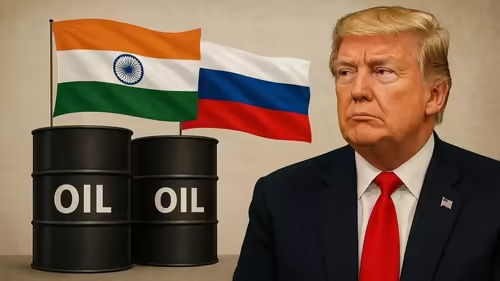
In a move that’s sent shockwaves through global trade corridors, a senior aide to former President Donald Trump has dropped a major hint: the punishing US tariffs on India might be on the chopping block. The reason? India’s apparent retreat from its once-booming Russian oil trade.
For months, Indian businesses—from steel mills to auto parts exporters—have been grappling with a 25% tariff wall erected by the US, a direct consequence of New Delhi’s energy dealings with Moscow. But now, with data showing a sharp decline in those very oil purchases, the political calculus in Washington may be shifting. Is this the beginning of the end for these controversial tariffs?
Table of Contents
- The Origin of the 25% Tariff: A Geopolitical Weapon
- India’s Russian Oil Purchases: A Strategic Collapse?
- The Trump Aide’s Hint: What It Really Means
- The Real-World Impact on Indian Industry
- What’s Next for US Tariffs on India?
- Conclusion
- Sources
The Origin of the 25% Tariff: A Geopolitical Weapon
The 25% tariff on a wide range of Indian goods wasn’t born from a standard trade dispute over market access or subsidies. Instead, it was a blunt instrument of foreign policy. In mid-2025, the Trump administration explicitly linked the tariff to India’s role as a top buyer of Russian crude oil, accusing New Delhi of “financing Russia’s war” in Ukraine .
This action fell under the umbrella of Section 232 of the Trade Expansion Act, which allows the US to impose tariffs on national security grounds. While initially targeting steel and aluminum, the scope was expanded to include other goods as a form of economic pressure . The message was clear: continued energy trade with Moscow would come at a steep cost in the American market.
India’s Russian Oil Purchases: A Strategic Collapse?
The strategy appears to have worked, at least on the surface. Recent data paints a stark picture of a dramatic reversal in India’s energy imports. According to shipping analytics firm Kpler, India’s imports of Russian crude have seen a significant plunge .
In fact, by the end of 2025, India had even fallen to the third position among global buyers of Russian fossil fuels, a sharp drop from its previous top spot, as major refiners like Reliance Industries and state-owned entities drastically cut their orders . This trend is confirmed by a nearly 18% year-on-year decline in Russian crude imports during the first ten months of 2025 .
This “collapse,” as described by the Trump aide, seems to be the key trigger for the potential policy shift in Washington.
The Trump Aide’s Hint: What It Really Means
The clearest signal yet came directly from a top Trump advisor, who stated, “We put 25% tariffs on India for buying Russian oil and the Indian purchases by their refineries of Russian oil have collapsed. So that is a… path to take them off” .
This statement is more than just an observation; it’s a conditional offer. The US is essentially saying that India has met the primary demand that led to the tariff’s imposition. However, experts caution that a formal rollback is not guaranteed. The US may use this as leverage to secure further concessions from India on other trade issues, such as intellectual property rights or market access for American dairy and agricultural products.
The Real-World Impact on Indian Industry
While the tariff was politically motivated, its impact has been deeply felt in the real economy. Indian exporters of steel, aluminum, and their derivative products have faced a significant competitive disadvantage in the crucial US market.
The consequences include:
- Reduced Profit Margins: Many exporters were forced to absorb the 25% cost, slashing their profits.
- Lost Market Share: Competitors from nations not facing these tariffs, like South Korea or Japan, gained ground in the US.
- Supply Chain Disruptions: Companies relying on a seamless flow of goods between the two nations had to re-evaluate their entire logistics and pricing strategies.
For many small and medium-sized enterprises (SMEs) in India, this tariff represented an existential threat, making their products unviable in one of the world’s largest consumer markets.
What’s Next for US Tariffs on India?
The current situation is fluid. While the Trump aide’s comments are a positive sign, the official stance remains that the 25% tariff is in place . The ball is now in India’s court to formally engage with US trade representatives and present its case for a full rollback, backed by the data on its reduced Russian oil dependence.
For businesses on both sides of the Pacific, the next few months will be critical. A removal of the tariff would be a massive relief for Indian exporters and could signal a thaw in broader US-India trade relations. Conversely, if the tariff remains, it could push India to seek deeper trade partnerships with other regions, potentially accelerating a long-term shift away from the US as its primary export destination.
Conclusion
The saga of the US tariffs on India is a prime example of how modern trade policy is inextricably linked to global geopolitics. What began as a punitive measure over energy choices has evolved into a complex negotiation with significant economic stakes. With India seemingly having complied with the US’s primary demand by collapsing its Russian oil purchases, the stage is set for a potential de-escalation. All eyes are now on Washington to see if this hint from a Trump aide will translate into concrete policy action, offering a much-needed reprieve to a strained but vital trade relationship.
Sources
- Times of India: ‘Russian oil purchase collapsed’: Will US roll back 25% tariffs on India? Trump aide drops hint
- Kpler Data: India’s import of Russian crude drops 29% month-on-month
- Bloomberg: India falls to third position in Russian fossil fuel imports
- Reuters: India’s Russian oil imports fall 18% in 2025
- White House Fact Sheet: President Donald J. Trump Takes Action on Trade
- Baker Botts L.L.P.: Trump Tariff Tracker – January 19