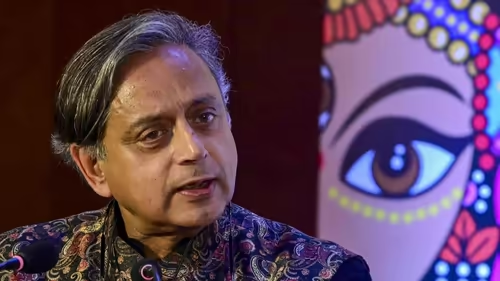
Shashi Tharoor’s ‘Operation Sindoor’ Stand: A Party Line Breach or Patriotic Duty?
In the high-stakes world of Indian politics, few figures command attention like Shashi Tharoor. The erudite Congress MP has once again found himself at the center of a national debate, not for his eloquent prose, but for his unapologetic stance on a matter of grave national security: Operation Sindoor. Following his conspicuous absence from a key party meeting and swirling rumors of a deepening rift with the Congress leadership, Tharoor has issued a clear and firm defense of his position.
His message is simple yet powerful: supporting a decisive military action against terrorism is not a betrayal of party loyalty, but a fundamental duty to the nation. But is this a principled stand or a political misstep that could fracture his party from within?
Table of Contents
- The Controversy Unfolds: Absence, Snubs, and Public Statements
- What is Operation Sindoor? Understanding India’s Counterterrorism Shift
- Tharoor’s Defense: “I Didn’t Violate the Party Position”
- The Congress Dilemma: Navigating Nationalism and Opposition Politics
- What’s Next for Tharoor and the Congress?
- Conclusion
- Sources
The Controversy Unfolds: Absence, Snubs, and Public Statements
The current storm began brewing after Tharoor skipped a crucial Congress strategy meeting in Kerala on January 23, 2026. This absence was widely interpreted as a sign of protest, coming on the heels of what he perceived as an “ill-treatment by the state leadership and Rahul [Gandhi]” during a recent event in Kochi . Reports suggest he was publicly snubbed, leading to sharp internal criticism and even being labeled “irrelevant” by some party colleagues .
This incident has brought to the fore a deepening internal friction within the Kerala unit of the Congress, especially as the state braces for its 2026 Assembly elections [[8], [9]]. Tharoor, a four-time MP from Thiruvananthapuram, is seen as a key asset, but his independent streak has often put him at odds with the party’s central command.
What is Operation Sindoor? Understanding India’s Counterterrorism Shift
To understand the gravity of Tharoor’s comments, one must first grasp the significance of Operation Sindoor. Launched on May 7, 2025, this military operation marked a radical transformation in India’s counter-terrorism doctrine . It was a direct and forceful response to a major terrorist attack, signaling a new era where India would not just react defensively but would proactively eliminate terrorist threats at their source .
The operation involved precision strikes against terrorist infrastructure in Pakistan and was met with strong international backing, showcasing India’s growing strategic competence on the global stage [[18], [19]]. For many Indians, it became a symbol of national resolve and strength. The Modi government framed it as a necessary step to rewrite the rulebook on counter-terrorism .
Tharoor’s Defense: “I Didn’t Violate the Party Position”
It is in this highly charged atmosphere that Tharoor chose to speak out. On January 24, 2026, he categorically stated, “I have never violated the party’s stated positions in Parliament,” before making a crucial clarification [[1], [4]]. He asserted that his only public disagreement or point of emphasis was on Operation Sindoor and India’s broader counterterrorism position.
Tharoor’s argument hinges on a critical distinction. He contends that while the Congress party may be in opposition, its official stance in Parliament has always been to support actions taken in the national interest, especially concerning security. By praising the operation’s objective—the elimination of terrorists—he believes he was aligning with this unwritten, yet fundamental, principle of national unity over partisan politics. He recalled past events and the views of former leaders to underscore that national security has historically been a bipartisan issue .
The Congress Dilemma: Navigating Nationalism and Opposition Politics
Tharoor’s position puts the Congress party in a difficult bind. On one hand, outright criticism of a popular and successful military operation against terrorism is politically perilous, as it can be easily painted as being “anti-national.” On the other hand, as the primary opposition, the party is expected to hold the government accountable and offer a distinct policy alternative.
The internal conflict reflects a broader struggle within the Congress on how to effectively oppose a government that has successfully monopolized the narrative of national security and patriotism. Tharoor’s independent voice, while principled, complicates this delicate balancing act. His exclusion from a recent all-party delegation on the matter, despite his selection to lead the briefing, further highlights the tension between his personal stance and the party’s collective strategy .
What’s Next for Tharoor and the Congress?
The fallout from this episode is far from over. For Shashi Tharoor, this is a test of his influence and his ability to carve out a space for a nuanced, yet patriotic, opposition voice. His next moves will be closely watched by both his supporters and his detractors within the party.
For the Congress, the challenge is to manage this internal discord without alienating a prominent leader who commands significant public respect. The party must decide whether to embrace Tharoor’s line of supporting national security actions while critiquing their execution, or to enforce a stricter party discipline that could risk a public split. The stakes are particularly high in Kerala, where the internal rift could directly impact the party’s electoral prospects in the upcoming assembly polls [[12], [14]].
Conclusion
Shashi Tharoor’s defense of his stance on Operation Sindoor is more than just a personal clarification; it’s a window into the complex and often contradictory demands of modern Indian politics. His insistence that he acted in the national interest, not against his party, poses a fundamental question: where should the line be drawn between loyal opposition and patriotic duty? As the Congress grapples with this question, the answer will shape not only Tharoor’s future but also the very identity of the party itself in an era defined by assertive nationalism.
Sources
- Times of India: “Didn’t violate party position”: Tharoor breaks silence amid rift buzz; defends stand on Op Sindoor
- PIB (Press Information Bureau): Operation Sindoor: A New Chapter in India’s Counter-Terrorism Doctrine
- [INTERNAL_LINK:india-national-security-policy]
- [INTERNAL_LINK:congress-party-leadership-crisis]