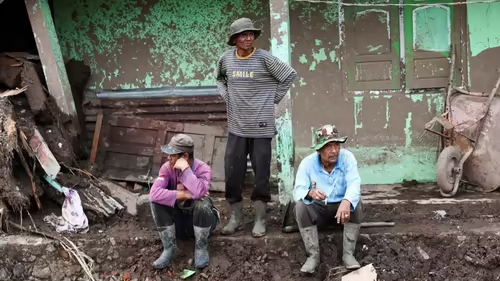
A wall of mud, rock, and debris came crashing down without warning in Indonesia’s West Java province, swallowing homes and lives in its path. Triggered by days of unrelenting heavy rain, the Indonesia landslide has left a community in ruins, with at least 7 confirmed dead and a staggering 82 people still unaccounted for. As rescue teams battle unstable terrain and more rain, the nation watches in anguish, hoping for miracles while bracing for the worst.
Table of Contents
- The Disaster: A Community Buried in Minutes
- Indonesia Landslide Response: The Race Against Time
- Why West Java? Understanding the Region’s Vulnerability
- Is Climate Change Making These Disasters Worse?
- How You Can Help the Victims and Survivors
- Conclusion: A Stark Reminder of Nature’s Power
- Sources
The Disaster: A Community Buried in Minutes
The catastrophe unfolded in the Sumedang Regency of West Java, a region known for its lush hills but also its susceptibility to landslides during the rainy season. According to local officials, the ground gave way suddenly after being saturated by continuous, torrential downpours . Entire houses were swept away or buried under meters of earth and rubble. The scale of the destruction was immediate and overwhelming. Initial reports from the National Search and Rescue Agency (Basarnas) confirmed that dozens of structures were destroyed, with many residents trapped inside their homes with no chance to escape . The confirmed death toll stands at 7, but with 82 people still missing, that number is tragically expected to rise .
Indonesia Landslide Response: The Race Against Time
In the aftermath, a massive emergency response was launched. Hundreds of personnel from Basarnas, the Indonesian National Police, the military (TNI), and local volunteers have been deployed to the site. They are working around the clock, using excavators, shovels, and even their bare hands to sift through the debris in search of survivors . The operation is fraught with danger; the soil remains unstable, and the threat of further landslides or heavy rain looms large, forcing rescuers to pause operations periodically for safety checks. Makeshift medical tents have been set up nearby to treat the injured, while temporary shelters are being organized for those who have lost everything .
Challenges Facing the Rescue Mission
- Unstable Terrain: The risk of secondary landslides makes every step perilous for rescuers.
- Weather Conditions: Ongoing rain hampers visibility and slows down excavation efforts.
- Access Issues: Some affected areas are remote, making it difficult to transport heavy equipment and supplies.
- Emotional Toll: Rescuers are not just fighting the elements; they’re also grappling with the emotional weight of the tragedy.
Why West Java? Understanding the Region’s Vulnerability
West Java is no stranger to landslides. Its geography—a combination of mountainous terrain, volcanic soil, and high population density—creates a perfect storm for such disasters, especially during the monsoon season. Deforestation for agriculture and development has further weakened the soil’s ability to hold together during heavy rainfall. This particular event in Sumedang is a grim reminder of a recurring pattern. In fact, a similar deadly landslide struck the same regency in January 2021, killing over 40 people . This history underscores a critical need for better early warning systems, stricter land-use planning, and long-term investment in community resilience. [INTERNAL_LINK:indonesia-natural-disasters-history] could provide deeper context on this recurring challenge.
Is Climate Change Making These Disasters Worse?
While landslides have always been a part of Indonesia’s natural hazard profile, scientists warn that climate change is tipping the scales. Warmer oceans lead to more intense and unpredictable rainfall events, saturating the ground far beyond its capacity in a shorter period. This increases the frequency and severity of landslides across the archipelago. The Intergovernmental Panel on Climate Change (IPCC) has repeatedly highlighted Southeast Asia as a region highly vulnerable to these impacts [EXTERNAL_LINK: https://www.ipcc.ch/]. The current disaster in West Java may well be another data point in a growing trend of climate-amplified tragedies.
How You Can Help the Victims and Survivors
In times of crisis, global solidarity can make a real difference. Reputable organizations like the Indonesian Red Cross (PMI) and international bodies such as the International Federation of Red Cross and Red Crescent Societies (IFRC) are on the ground providing essential aid. Donations can help fund search and rescue operations, medical care, food, clean water, and shelter for displaced families. Before donating, always verify the legitimacy of a charity through official channels to ensure your contribution reaches those who need it most.
Conclusion: A Stark Reminder of Nature’s Power
The Indonesia landslide in West Java is a heart-wrenching human tragedy that exposes the fragile intersection between human settlement and a dynamic, often unforgiving, natural environment. As the search for the missing continues, the focus must also shift to the future. Investing in preventative measures, heeding scientific warnings about climate change, and building more resilient communities are not just policy choices—they are moral imperatives to prevent such devastating losses in the years to come.
Sources
- Times of India: “7 dead, 80 missing due to landslide in Indonesia’s West Java province”
- Historical data on the 2021 Sumedang landslide.
- Reports from Indonesia’s National Search and Rescue Agency (Basarnas).
- Updates on emergency shelters and medical response from local authorities.
- Details on the multi-agency rescue operation involving police and military.