Table of Contents
- How the Nihilist Penguin Meme Made a Comeback
- Trump’s AI-Generated Penguin: A Geographic Howler
- The Real ‘Nihilist Penguin’: Fact vs. Fiction
- Why Penguins Don’t Live in Greenland (or the Arctic)
- Why the Internet Loves an Existential Penguin
- What Scientists Really Think About Lost Penguins
- Conclusion: When Memes Meet Misinformation
- Sources
How the Nihilist Penguin Meme Made a Comeback
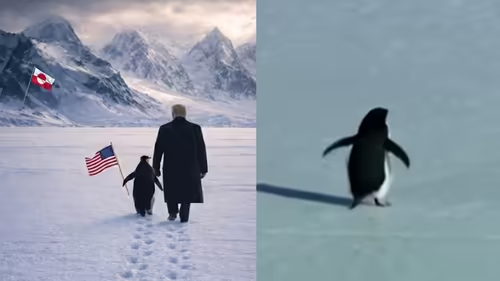
In early 2026, social media timelines were flooded once again with images of a solitary penguin standing on ice, captioned with bleakly humorous lines like “Nothing matters” or “I walked this far for nothing.” This revival of the Nihilist Penguin meme wasn’t random—it was triggered by two unlikely catalysts: a high-profile AI blunder and a haunting nature documentary clip that had gone viral years ago.
The meme, which first gained traction around 2018, personifies a lone penguin as a symbol of existential despair and quiet rebellion. But its latest resurgence has sparked fresh debate: Is this just internet humor, or does it reflect deeper anxieties about climate, isolation, and misinformation in the digital age?
Trump’s AI-Generated Penguin: A Geographic Howler
The spark came when former U.S. President Donald Trump shared an AI-generated image on Truth Social depicting a penguin standing on an iceberg near Greenland—with the caption implying strategic interest in the region. The image quickly went viral, not for its geopolitical message, but for its glaring scientific error: penguins do not live in the Arctic.
Greenland is in the Northern Hemisphere; penguins are native exclusively to the Southern Hemisphere—from Antarctica to South Africa, Australia, and even the Galápagos Islands. The mix-up is a classic example of how AI, despite its sophistication, can perpetuate basic factual errors when trained on flawed or unvetted data .
Climate scientists and educators seized the moment to clarify: “This isn’t just a cute mistake—it reinforces a widespread misconception about global wildlife distribution,” said Dr. Lena Petersen of the Arctic Research Consortium.
The Real ‘Nihilist Penguin’: Fact vs. Fiction
Running parallel to the AI controversy was the resurfacing of a real video clip from a 2014 BBC documentary. It showed a lone emperor penguin walking away from its colony toward the interior of Antarctica—hundreds of miles from the ocean, where it would eventually die.
Online, viewers dubbed it the “Nihilist Penguin,” interpreting its journey as a poetic act of defiance or despair. Reddit threads and TikTok edits portrayed it as “rejecting society” or “choosing freedom over survival.”
But the reality, as explained by the filmmakers, is far less romantic—and far more tragic.
Why Penguins Don’t Live in Greenland (or the Arctic)
To understand the absurdity of a “Greenland penguin,” consider these biological facts:
- Hemispheric divide: Penguins evolved in the Southern Hemisphere and never naturally migrated north due to ocean currents and predator barriers.
- Arctic predators: Polar bears, Arctic foxes, and orcas would make survival nearly impossible for flightless birds like penguins.
- No fossil evidence: Despite extensive paleontological research, no penguin fossils have ever been found north of the equator.
In fact, if you see a “penguin” in the Arctic, it’s almost certainly a puffin—a completely unrelated bird often mistaken for a penguin due to its black-and-white plumage. [INTERNAL_LINK:arctic-vs-antarctic-wildlife] explores this common confusion in depth.
Why the Internet Loves an Existential Penguin
So why does the Nihilist Penguin meme resonate so deeply?
Psychologists suggest it taps into modern feelings of alienation and futility. “In an age of climate anxiety, political polarization, and algorithm-driven loneliness, the image of a small creature walking into oblivion feels strangely relatable,” explains Dr. Arjun Mehta, a digital culture researcher at NYU.
The meme’s power lies in its ambiguity: Is the penguin brave? Delusional? Depressed? That open-endedness invites projection—making it a perfect vessel for Gen Z and millennial angst.
What Scientists Really Think About Lost Penguins
Back to that real wandering penguin from the BBC film: experts believe its behavior was not philosophical—but pathological.
“Emperor penguins rely on precise navigational cues tied to sea ice and ocean proximity,” says Dr. Susan Lee, a marine biologist with the British Antarctic Survey. “When one walks inland, it’s usually due to:
- Disorientation caused by shifting ice patterns due to climate change.
- Neurological issues from injury or disease.
- Youthful inexperience—young birds sometimes get lost during their first migration.
Far from a rebel, the penguin was likely suffering. Conservationists warn that romanticizing such behavior can distract from urgent ecological issues like habitat loss and warming oceans.
Conclusion: When Memes Meet Misinformation
The Nihilist Penguin meme is a fascinating collision of internet culture, AI-generated misinformation, and real-world biology. While it offers a darkly comic lens on modern life, it also underscores a critical need for scientific literacy—especially when AI tools can so easily blur fact and fiction. The next time you see a penguin in Greenland, remember: it’s not a philosopher. It’s a glitch.
Sources
- Times of India: Penguins in Greenland? The story behind the viral ‘Nihilist Penguin’ meme
- BBC Earth – “Frozen Planet” Documentary Series (2011–2014)
- British Antarctic Survey – Penguin Behavior Research
- Arctic Research Consortium of the U.S. (ARCUS) – Wildlife Distribution Facts