Table of Contents
- The Assembly Showdown: What Sparked the Clash?
- ‘Not Inferior to Anyone’: Stalin’s Patriotic Rebuttal
- Why Did Governor Ravi Refuse to Read the Address?
- Stalin’s Defense of the Dravidian Model
- State vs Centre: A Growing Constitutional Tension?
- Public and Political Reactions Across Parties
- Conclusion: Federal Friction in the Spotlight
- Sources
The Assembly Showdown: What Sparked the Clash?
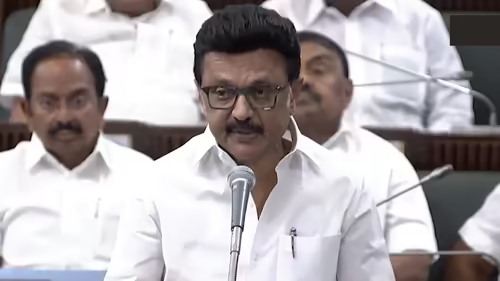
The Tamil Nadu Legislative Assembly became the stage for a high-voltage political confrontation when Chief Minister M.K. Stalin launched a sharp attack on Governor R.N. Ravi—marking one of the most direct rebukes by a sitting CM to a constitutional appointee in recent memory. At the heart of the conflict? The governor’s refusal to deliver the customary Governor’s Address at the start of the budget session—a move Stalin called “unprecedented” and “disrespectful to democratic conventions.”
This act wasn’t just procedural; it was symbolic. By declining to read the prepared speech drafted by the elected state government, Ravi signaled deep ideological disagreement with the DMK-led administration—a tension that has simmered since his appointment in 2021 .
‘Not Inferior to Anyone’: Stalin’s Patriotic Rebuttal
Responding to perceived insinuations about his loyalty to the nation—widely interpreted as coming from the governor’s camp—Stalin delivered a passionate defense of his and his party’s patriotism. “We are not inferior to anyone in patriotism,” he declared in the Assembly, his voice echoing through the chamber. “No one needs to teach us about love for the country.”
The statement was more than rhetoric. It was a direct pushback against a recurring narrative often used by critics to delegitimize regional parties, especially those with Dravidian or federalist roots. Stalin reminded the House that his father, former CM M. Karunanidhi, had spent decades championing both social justice and national unity—and that the DMK’s legacy includes strong support for India’s sovereignty during critical moments like the 1962 Sino-Indian War.
Why Did Governor Ravi Refuse to Read the Address?
Governor R.N. Ravi, a former IPS officer and ex-Governor of Nagaland, has a history of clashing with state governments over ideological lines. In Tamil Nadu, his objections reportedly centered on passages in the draft address that emphasized:
- The success of the Dravidian model of governance (welfare schemes, education, healthcare).
- Criticism of “centralized policies” undermining state autonomy.
- References to Tamil identity and linguistic pride.
Rather than negotiate edits—as is customary—Ravi chose not to deliver the speech at all, instead issuing a brief written message. Constitutional experts argue this breaches established practice. According to Article 176 of the Indian Constitution, the Governor must address the Assembly at the start of the session. While the content is prepared by the Council of Ministers, the Governor’s role is ceremonial—not editorial .
Stalin’s Defense of the Dravidian Model
Seizing the moment, Stalin used his speech to highlight tangible achievements under his administration:
- Universal access to subsidized meals through Amma Unavagam and school noon-meal schemes.
- Free laptops and smartphones for students and women-headed households.
- Expansion of public healthcare, including new medical colleges and free insulin distribution.
- Law and order stability, countering claims of rising crime.
“They question our governance while ignoring our results,” Stalin said, accusing opponents of using “false narratives” to distract from the state’s progress. He framed the Dravidian model not as anti-national, but as an alternative vision of inclusive development rooted in social equity—a point [INTERNAL_LINK:dravidian-model-explained] explores in depth.
State vs Centre: A Growing Constitutional Tension?
This episode is part of a broader pattern. Since 2014, several non-BJP ruled states—including Kerala, West Bengal, and Punjab—have reported friction with BJP-appointed governors accused of acting as “agents of the Centre” rather than impartial constitutional figures.
The Sarkaria Commission (1988) and later the Punchhi Commission (2010) both emphasized that governors must act on the aid and advice of the Council of Ministers, barring exceptional circumstances. Legal scholars warn that politicizing the governor’s office erodes India’s federal fabric—a concern echoed by opposition leaders nationwide .
Public and Political Reactions Across Parties
The fallout was swift:
- DMK allies (Congress, CPI, CPI-M) rallied behind Stalin, calling Ravi’s actions “undemocratic.”
- BJP state unit defended the governor, claiming the original address contained “anti-national sentiments.”
- Civil society groups and legal forums expressed alarm over the erosion of gubernatorial neutrality.
On social media, #TNAssembly and #StalinVsGovernor trended nationally, with citizens debating where legitimate dissent ends and constitutional overreach begins.
Conclusion: Federal Friction in the Spotlight
The phrase “Stalin hits out at TN governor” captures more than a headline—it reflects a deeper struggle over India’s federal future. As regional governments assert their mandates and governors appointed by the Centre grow more interventionist, the balance of power is being tested in real time. Stalin’s impassioned speech wasn’t just about one address; it was a defense of democratic dignity, state autonomy, and the right of Tamil Nadu to define its own path—without having its patriotism questioned. Whether this sparks national introspection or further polarization remains to be seen.
Sources
- Times of India: ‘Not inferior to anyone in patriotism’: Stalin hits out at TN governor
- Constitution of India, Article 176
- Sarkaria Commission Report on Centre-State Relations
- The Hindu – Analysis: “The Politicisation of the Governor’s Office” (January 2025)