Table of Contents
- The Tragic Incident That Shook Noida
- Legal Action Against Nirmal Singh: The Non-Bailable Warrant
- Charges Under BNS and Environmental Laws
- A History of Lotus Greens Violations?
- What Happens Next in the Case?
- Conclusion: A Call for Accountability
- Sources
The Tragic Incident That Shook Noida
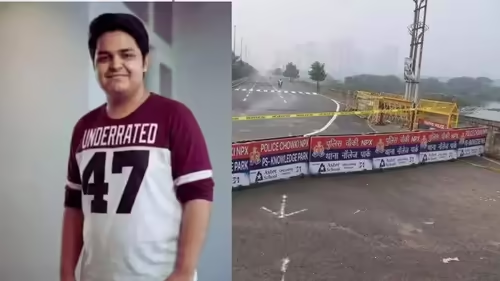
The city of Noida is reeling from a heartbreaking incident that has sparked outrage and demands for justice. On a fateful day, 27-year-old software engineer Yuvraj Mehta lost his life in a horrific accident. His car plunged into an unguarded, water-filled pit, leading to his drowning . The autopsy report confirmed that Mehta’s death was due to asphyxia caused by ante-mortem drowning, followed by cardiac arrest . This wasn’t just an accident; it was a tragedy born from alleged criminal negligence.
The incident has become a focal point for public anger, not just over the loss of a young life but over the apparent lack of safety measures and accountability from powerful real estate developers. The Noida techie death case has now become a symbol of the dangers posed by unchecked construction and environmental degradation in rapidly expanding urban areas like Noida.
Legal Action Against Nirmal Singh: The Non-Bailable Warrant
In a significant turn of events, the judicial system has taken a firm stance. A court has issued a non-bailable warrant (NBW) against Nirmal Singh, the founder of Lotus Greens, in direct connection with the Noida techie death case . Singh is currently absconding, evading law enforcement authorities who are actively searching for him .
Police have issued a stern warning: if Singh fails to surrender, they will proceed with the attachment of his properties. This move underscores the seriousness of the charges against him and the authorities’ determination to bring him to justice. The issuance of an NBW is a powerful legal tool, indicating that the court believes Singh may not appear for trial voluntarily and that his potential release on bail could obstruct the course of justice.
Charges Under BNS and Environmental Laws
Nirmal Singh isn’t just facing a single charge. The legal net cast around him is wide, encompassing both environmental statutes and the newly enacted Bharatiya Nyaya Sanhita (BNS). He is being charged under various sections of the BNS for acts of negligence and creating a public nuisance .
Specifically, Section 270 of the BNS defines public nuisance as an act or illegal omission that causes common injury, danger, or annoyance to the public . The unguarded, water-filled pit that claimed Yuvraj Mehta’s life is a textbook example of such a hazard. Furthermore, Section 292 of the BNS provides punishment for public nuisance in cases not otherwise covered, which could also be applicable here .
Beyond the BNS, the case has strong environmental angles. Multiple FIRs have been filed against Lotus Greens and its associates for alleged violations of the Environment Protection Act [[8], [11]]. These fresh FIRs highlight the company’s role in creating the dangerous conditions that led to the tragedy, pointing to serious environmental lapses .
A History of Lotus Greens Violations?
This incident raises critical questions about the past conduct of Lotus Greens. Was this a one-off failure, or part of a larger pattern of flouting regulations? Investigations have revealed that the land in question was purchased by Lotus Greens back in 2014 . The fact that multiple FIRs have been slapped on the company and its partners, including MZ Wiztown Planners Pvt Ltd, for environmental violations suggests a systemic issue [[9], [15]].
The National Green Tribunal (NGT) has already taken suo motu cognizance of the case, pointing directly to “serious environmental lapses” by the builders . This scrutiny from a high-level environmental body adds another layer of complexity and pressure to the case. For residents and investors in Lotus Greens projects, this is a moment of deep concern, prompting them to look into the company’s compliance history and safety records. [INTERNAL_LINK:real-estate-developer-safety-standards] can offer more insights into what to watch for.
What Happens Next in the Case?
With a non-bailable warrant active and police raids underway to locate Nirmal Singh, the immediate next steps are clear:
- Arrest of Nirmal Singh: The primary focus of law enforcement is to apprehend the absconding founder.
- Property Attachment: If he remains at large, the court is likely to authorize the seizure of his assets as a coercive measure.
- Deepening Investigation: Authorities will continue to build their case, examining the chain of command within Lotus Greens to determine who else might be culpable for the unsafe conditions.
- NGT Proceedings: The parallel investigation by the National Green Tribunal will run its course, potentially leading to heavy fines or other penalties for environmental damage.
The outcome of this case will be closely watched, as it could set a precedent for holding real estate developers accountable for public safety and environmental stewardship in India.
Conclusion: A Call for Accountability
The Noida techie death is more than a news story; it’s a stark reminder of the human cost of negligence and regulatory failure. The non-bailable warrant against Lotus Greens founder Nirmal Singh is a crucial step towards justice for Yuvraj Mehta and his grieving family. It sends a powerful message that no one is above the law, regardless of their position or influence in the business world. As the legal process unfolds, the public will be watching to see if this case leads to genuine accountability and, hopefully, prevents such a tragedy from ever happening again. For more on corporate accountability in India, you can refer to resources from the Ministry of Home Affairs.
Sources
- Times of India: Noida techie death: Non-bailable warrant against absconding Lotus Greens founder Nirmal Singh
- Web Search Results: , , , , , , , , , ,