Table of Contents
- The Crisis in Mhow: What Happened?
- How Contaminated Water Leads to Jaundice
- Systemic Failures: Why is This Happening Again?
- What Residents Can Do to Protect Themselves
- Conclusion: A Call for Accountability
- Sources
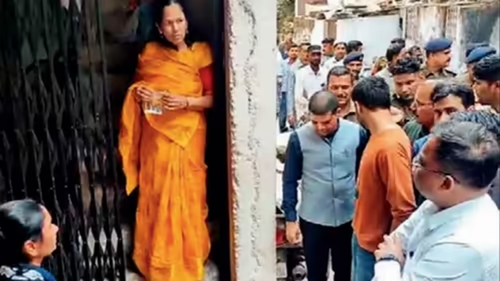
In a chilling echo of a recent tragedy in Indore, the quiet town of Mhow in Madhya Pradesh is now grappling with its own public health nightmare. At least 22 residents, many of them vulnerable children, have fallen violently ill after consuming what is now believed to be contaminated water. Nine of these individuals are currently hospitalized, suffering from severe nausea and vomiting, with doctors diagnosing them with jaundice—a clear red flag for waterborne disease .
This isn’t just an isolated incident; it’s a symptom of a much deeper, systemic rot in the region’s water infrastructure. For the families in Patti Bazaar and Chandar Marg, the fear is palpable, and their trust in the most basic necessity—safe drinking water—has been shattered .
The Crisis in Mhow: What Happened?
The trouble began when residents in specific localities of Mhow started reporting sudden and severe gastrointestinal distress. The symptoms were textbook for a waterborne illness: intense vomiting, debilitating nausea, and a tell-tale yellowing of the skin and eyes—jaundice .
Local health officials swiftly moved to hospitalize the nine most critical cases, all of whom were diagnosed with jaundice. While the immediate medical response was activated, the source of the contamination remains under investigation. However, locals aren’t waiting for official reports. They point to long-standing, visible issues: aging pipelines that run perilously close to open drains, creating a direct pathway for sewage to infiltrate the drinking water supply .
To make matters worse, this incident comes on the heels of a far deadlier contaminated water crisis in Bhagirathpura, Indore, which claimed multiple lives just weeks prior . A family in Bhagirathpura has even alleged that their loved one’s death was directly linked to the toxic water, though the district administration has yet to confirm this connection . The timing has fueled public outrage and a deep-seated fear that these are not accidents, but predictable failures.
How Contaminated Water Leads to Jaundice
Jaundice itself is not a disease, but a symptom of an underlying problem, often a liver infection. In the context of a community-wide outbreak like the one in Mhow, the culprit is almost always a virus spread through the fecal-oral route—meaning it travels from infected feces into the water or food supply, and then into a new host .
The primary viruses responsible are Hepatitis A and Hepatitis E. When a water source is contaminated with sewage, it becomes a breeding ground for these pathogens. Consuming this contaminated water allows the virus to enter the body, attack the liver, and cause inflammation, leading to the characteristic yellowing of the skin and eyes .
Early signs of such an infection include:
- Fever and extreme fatigue
- Nausea and vomiting
- Abdominal pain and discomfort
- Dark urine and pale stools
- The visible yellowing of the skin and eyes (jaundice)
For children and those with compromised immune systems, these infections can be particularly dangerous, which explains why so many young residents in Mhow were among the first to fall ill.
Systemic Failures: Why is This Happening Again?
The recurring nature of these water crises in Madhya Pradesh points to a failure at the institutional level. The Public Health Engineering Department (PHED) of Madhya Pradesh is the primary body responsible for ensuring that the water supplied to citizens is “free from pathogenic organisms, clear, palatable and free from undesirable taste” .
Yet, time and again, we see a gap between policy and practice. The department’s own guidelines for a ‘Water Quality Monitoring System’ seem to exist only on paper . The reality on the ground, as reported by Mhow residents, is one of neglected infrastructure where clean water pipes lie alongside open sewers—a recipe for disaster .
This lack of robust, regular monitoring and maintenance is a critical vulnerability. Without consistent testing and swift action to repair leaks and upgrade old pipelines, communities remain at constant risk. The PHED must move beyond reactive damage control and implement a proactive, transparent system that prioritizes public health over bureaucratic inertia.
What Residents Can Do to Protect Themselves
While the onus of providing safe water lies squarely with the authorities, residents can take some immediate steps to protect their families in the interim:
- Boil All Water: Boiling water for at least one minute is the most effective way to kill viruses and bacteria. Make this a non-negotiable habit for all drinking and cooking water.
- Use Certified Filters: Invest in a water purifier that is certified to remove viruses (look for models with UV or UF technology).
- Stay Informed: Demand regular water quality reports from your local PHED office. Knowledge is power.
- Report Issues Immediately: If you notice a strange smell, color, or taste in your tap water, report it to local authorities right away and stop using it.
For more on protecting your home from environmental health hazards, see our guide on [INTERNAL_LINK:home-water-safety].
Conclusion: A Call for Accountability
The contaminated water crisis in Mhow is a stark and urgent reminder that access to clean water is not a privilege, but a fundamental human right. The suffering of these 22 individuals, especially the children, is a direct consequence of systemic neglect. It’s time for the Madhya Pradesh government and the PHED to be held accountable. They must launch a thorough, transparent investigation, fix the broken infrastructure, and implement a foolproof water quality monitoring system to ensure that no family has to live in fear of their own tap water. The health of an entire state depends on it.
Sources
- Times of India: 22 fall ill in Mhow; toxic water sends 9 residents to hospital
- Web Search Results on Mhow Incident: , ,
- Information on Jaundice and Waterborne Diseases: , ,
- Madhya Pradesh PHED Guidelines: ,
- World Health Organization on Water Safety: WHO Water, Sanitation and Health